There is a question you have been avoiding
your entire life. It will not wait forever.
What is your own SELF worth?
If this were the last day, what would you stop worrying about?
Outward, the answer keeps changing. Inward is the one place you haven’t asked.
In one paragraph: *SELF is a self-enquiry framework — a synthesis of Vedanta, Stoicism, Jungian psychology, and modern neuroscience, built around the practice of noticing the gap between a trigger and your reaction to it. It exists as a free website, a paid write-in workbook, and a free web companion — with a token launching soon to fund and stress-test it in public. These are related but not the same, and you don’t need all of them to use any one.
You want to understand the model before deciding anything. No commitment, no signup.
Read the Framework →Launching soon. You'll be able to find the contract and supply here once it's live.
Go to the Contract →Who this isn’t for, right now
If you’re in acute emotional crisis, this site is not the right first stop — talk to a mental health professional or a crisis line first. This framework is a lens for reflection, not treatment. More on that distinction in the full disclaimer.
Human birth is a rare opportunity for Self-Realization — everything else we seek is, at bottom, sought for the sake of the SELF.
Why Realize the SELF? Because what you’re actually looking for — joy, peace, wholeness — isn’t a destination built from achievement, relationships, or the next milestone. Everything built that way changes. This too shall pass. Lasting freedom begins when your identity stops depending on what changes.
An Olympic athlete doesn’t stop eating to win gold — eating becomes a sub-goal serving the ultimate one. Career, family, ambition: all valid sub-goals, on two conditions.
The super-ordinate goal is knowing your SELF — the only gold that never depreciates.
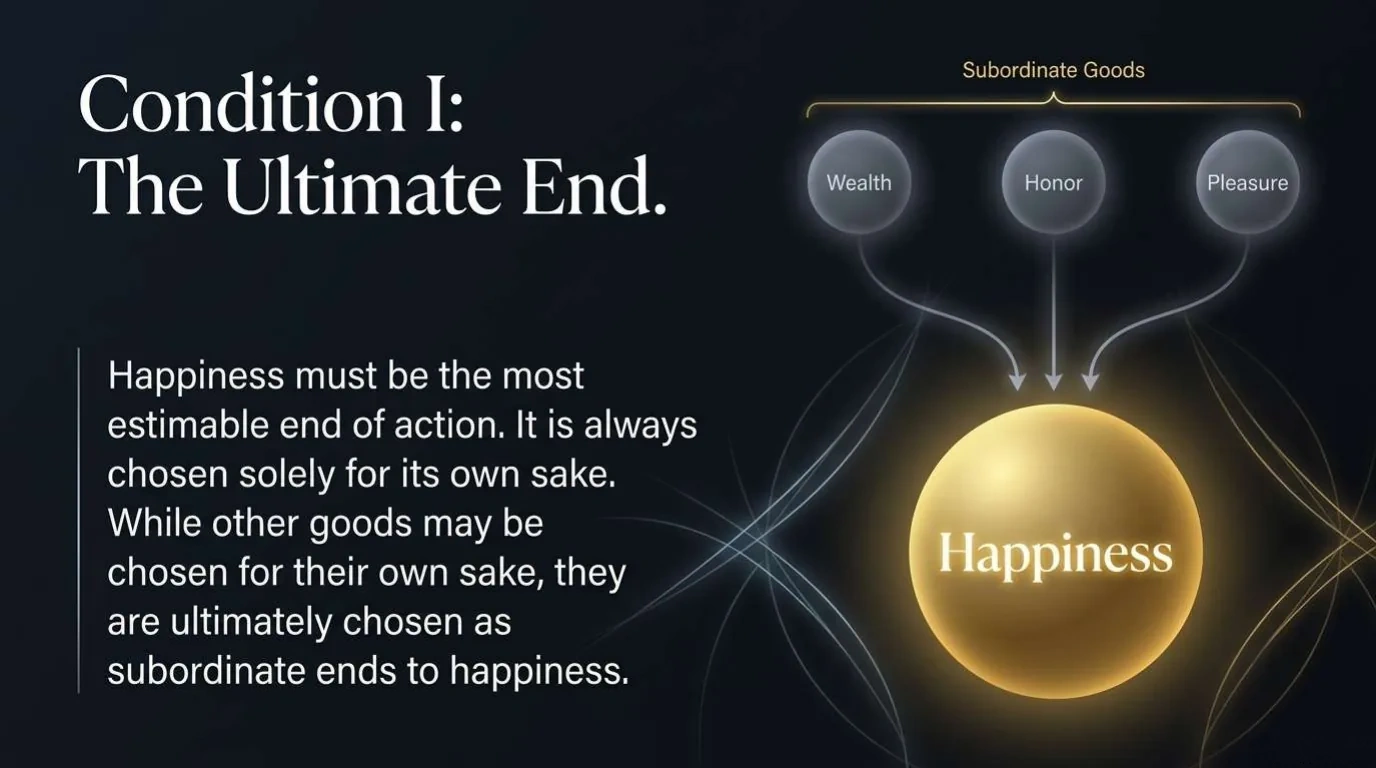
Pick anything you want. Ask: for the sake of what? Money, for security. Security, for peace. Honor, for being at ease among people. Follow any want far enough and it hands you to the next one. Aristotle noticed that the chain has a last link, the one thing never chosen for the sake of anything else, and that every other good is a step toward it.
Run your own chain, from whatever you want most this week. Where does it stop?
After Aristotle, Nicomachean Ethics I.
“The privilege of a lifetime is to become who you truly are.”
— Carl JungThe chart moves. The price moves. The world moves.
None of it was ever yours to govern.
The one territory that answers only to you.
How you meet what happens, not what happens.
What you reach for, and what you flinch from.
Spent trying to govern this, peace leaves with it.
“Seek not that the things which happen should happen as you wish; but wish the things which happen to be as they are, and you will have a tranquil flow of life.”
— EpictetusMost people treat anxiety as a malfunction.
Many Eastern traditions treat it as a message.
It can be a valid signal — pointing at a misalignment, not a flaw. The fix is not to silence it, but to understand what it is pointing at.
“The world will ask you who you are, and if you don’t know, the world will tell you.”
— Carl JungYou knew something was off.
You just couldn’t name it.
You tried to fix it outside.
Wealth. Health. Status.
When outside stops working,
something deeper starts talking.
Every tradition has a name for what comes next.
This section speaks to existential ache, not diagnosable illness. If what you’re carrying includes persistent depression, trauma, or thoughts of harming yourself, please treat that clinically first — see the full note on care.
“It is not a breakdown. It is a breakthrough wearing a disguise.”
The universal initiation no tradition calls optionalTreating a genuine call for deeper meaning as noise to silence with the next distraction.
It is initiation — the forge in which a deeper life becomes possible. It does not end. It graduates.
Two people can meet the same collapse. One is left smaller. One is left larger. What decided it was never the size of the blow.
No one is holding the other end of the rope. Identity shrinks to whatever will survive. What’s left is a wound with nowhere to go.
Someone or something is holding the other end — a person, a practice, a place you keep returning to. The same fall becomes a passage instead of a wound.
The lotus does not grow despite the mud. It grows because of it. There is no clean version of this path — no dimension where the suffering has been edited out. The dark night is not a detour around the work; it is the work’s raw material. You are not waiting for the mud to clear before the flower can open — the flower is what the mud becomes, once something is willing to grow through it.
The dark night doesn’t ask you to survive it alone. It asks what you’re willing to let hold you while you’re in it.
Nelson Mandela
27 years. Not cured. Not escaped. Graduated. What emerged was not the man who entered.
If you have experienced something like this — your journey toward Self-Realization has already started.
Give that ache a name.
The void.
Not a flaw — a signal, pointing in a different direction.
You got what you wanted.
The money. The milestone. The achievement.
Did the void disappear?
The *SELF operating system. Eight layers.
“Until you make the unconscious conscious, it will direct your life and you will call it fate.”
— Carl JungTap to expand — the eight layers of the SELF OS
The chatter beneath every reaction
Stimulus. Response. Repeat. The autopilot running underneath every choice, every decision, every reaction — and most people never notice it running.
In Sanskrit: Vritti+A fluctuation or wave of the mind-stuff (Chitta) — stirred up by the senses, rippling across an otherwise still lake of awareness. — the constant stream of neutral mental chatter, images, and fleeting concepts. Raw, unfiltered data before meaning is attached.
Contact was never the missing piece
A courier hands a package to a man in the park. Correct address, correct signature, exchange complete — he has no idea the man is the district manager of the company that employs him.
That evening, the same man walks through his own front door. His wife looks up and knows him instantly, not as a stranger who happens to live there, but as her husband. Same person. Same body. Nothing about him changed between the park and the door.
What changed was which side of the encounter carried awareness.
Traditional Source
The Kena Upanishad uses this exact image for the Self: everyone is already in contact with it — it's what's doing the thinking, seeing, and acting, all day, every day. The Default OS runs on contact without recognition. That's the courier's half of the exchange, repeated for years at a stretch.
Why the next milestone never satisfies
The false belief that the next milestone will finally bring peace. The brain is wired for the chase, not the catch. Dopamine rewards effort and progress — when the goal is achieved, production drops, leaving an acute emptiness.
In Sanskrit: Bhava+Sanskrit: state of being, feeling. Here, the felt, energetic weight a thought or state carries — not the thought itself, but the charge riding on it. — the somatic and energetic weight attached to thoughts. Nostalgia for the past. Anxiety about the future. Feeling lost after an achievement is not failure.
It is a symptom of an identity built on outcomes rather than essence.
Traditional Source
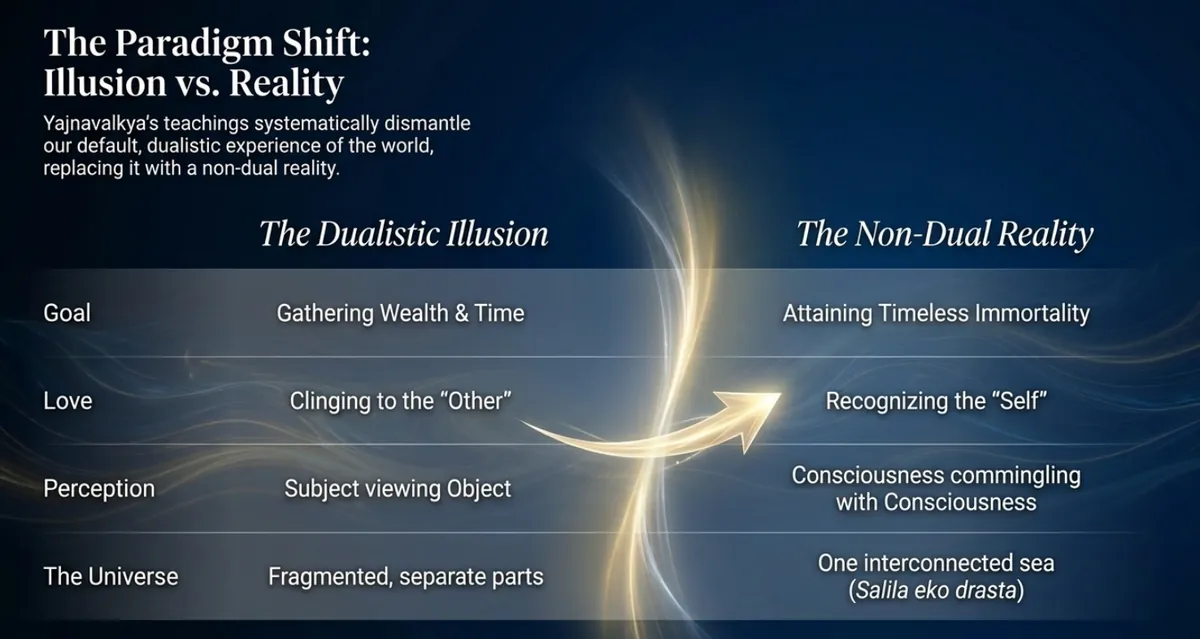
Maitreyi asked Yajnavalkya the same question in older clothing: if she owned the whole earth's wealth, would that make her immortal? His answer was one word — no. Wealth can make you comfortable. It was never going to make you complete — the same gap dopamine's post-goal crash reopens on a shorter, modern timescale. Epictetus ran the same drill daily, in reverse: love the cup, but call it ceramic first, so its breaking doesn't break you. Under both traditions sits one more claim — that the chase itself, every action a person takes, is driven by the same pursuit of happiness. Not a flaw to fix. The mechanism the Four-Phase Loop below runs on.
It isn't a one-off failure — it's a closed loop, not a straight line toward satisfaction
The ego feels incomplete, precarious.
Greed for more stimulus, more possessions.
A brief hit of achievement or consumption.
Hunger returns. Back to Phase 1.
The same loop runs at the scale of a whole economy. Fulfillment rises with spending from survival through comfort — then flattens. Past a threshold, more money spent buys less felt satisfaction, not more. The curve doesn't reward stopping; it rewards noticing where “enough” already was.
Modern Research
Global wealth has multiplied several-fold since 1950, while reported life satisfaction has not moved with it — the Phase-4 restlessness above, measured across an entire economy instead of one person's next purchase.
Traditional Source
The loop feeds on the fruit. The Gita’s answer is one line (2.47): your claim is to the action alone, never to its fruits.
Apply it to whatever you're chasing right now
Three questions, asked of any goal, purchase, or relationship you expect to satisfy you:
| Sat+Being — that which does not come and go. | Chit+Consciousness — that which does not grow stale with repetition. | Ananda+Bliss — that which needs nothing added to feel complete. |
|---|---|---|
| Does it still hold by Monday morning? | Is the tenth time as alive as the first? | Does it ever feel like enough, on its own? |
| Permanent? | Ever-fresh? | Self-sufficient? |
⟳ Tip: turn your phone to landscape for a wider view of this table
Traditional Source
The tradition names Sat-Chit-Ananda as what the Self actually is — not a mood to chase but a standing that doesn't depend on conditions. The old invocation says the third column as arithmetic (Brihadaranyaka 5.1.1, and the traditional opening of the Isha Upanishad): that is full, this is full; take fullness from fullness and fullness remains. Nothing added completes it; nothing lost empties it. This test doesn't tell you the answer. Run it on the last thing you thought would finally be enough, and see what it turns up.
The pleasant, and the good
Every choice offers two paths. One is pleasant now and turns bitter later. The other is bitter now and turns sweet later. The loop above is the first path, repeated; here it's the shape of a single decision.
In Sanskrit: Preya+The pleasant — what is agreeable to the senses in the moment, regardless of where it leads. / Shreya+The good — what serves lasting well-being, whether or not it is agreeable at first. — the same fork modern research calls hedonia and eudaimonia: a dopamine-driven consumer versus a serotonin-driven contributor.
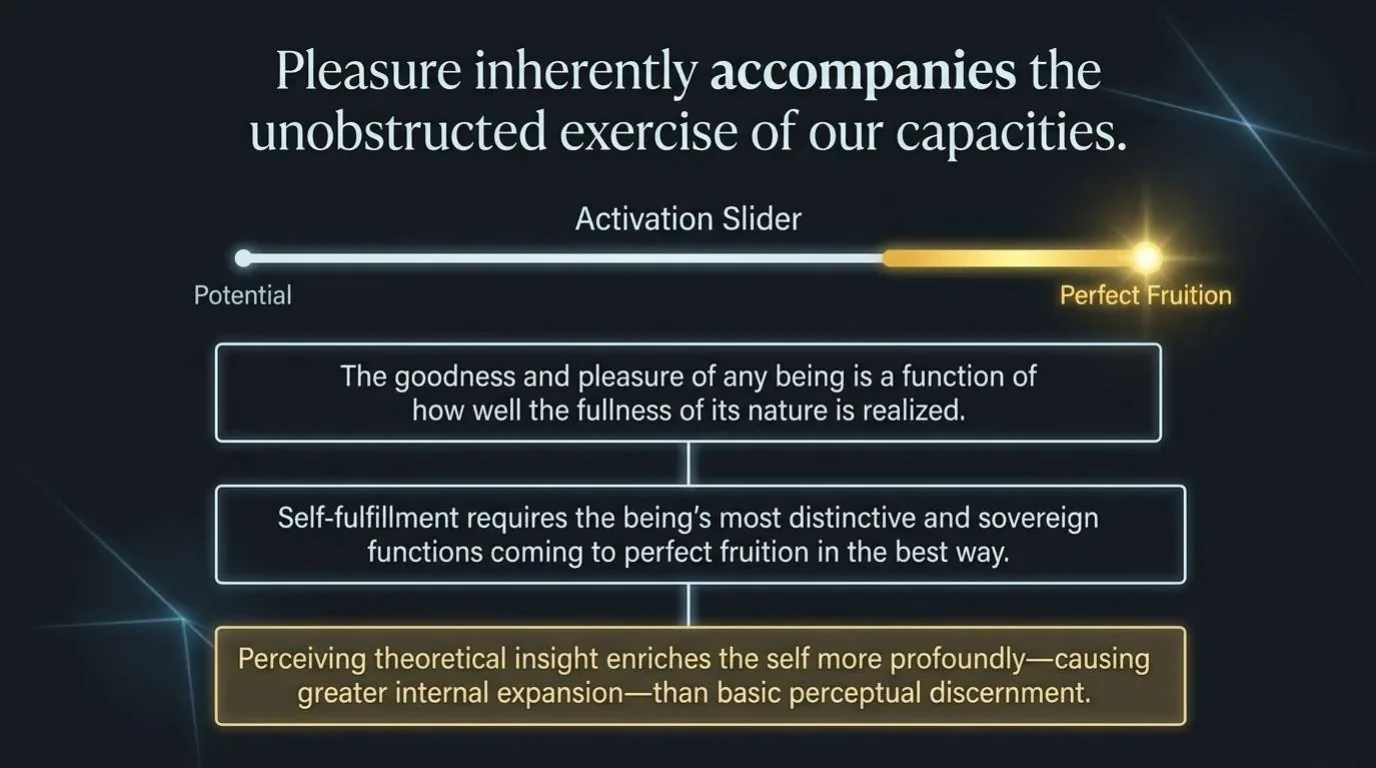
Aristotle drew the same fork from the other side. Pleasure is not the target. It is what arrives when something you are built for is used without obstruction. Aim at the pleasure and you are on the Preya road. Aim at the use, and it comes along unasked.
When did you last forget to ask whether you were enjoying it?
Traditional Source
The Prashna Upanishad draws the same fork as a map. In its first answer, Prajapati+The creator figure of the Vedic texts — in the Prashna Upanishad, the one who performs austerity and splits into the primordial pair of Rayi (matter) and Prana (life). makes the world by splitting into matter and life — the pair named in The Cosmic Exchange. Those who live by rites and the pursuit of offspring — the outward getting — follow the lunar road, and return. Those who seek the Self through discipline, faith and knowledge follow the solar road, and don’t. Read without the afterlife machinery, it is the Arrival Fallacy in older words: a life organized around getting keeps arriving back at the starting line; a life organized around knowing what was never missing doesn’t. Whether “return” is meant literally is a separate question, and this framework doesn’t rest on it.
Traditional Source
The Katha Upanishad names this the choice Nachiketa is offered by Death itself — and Death tells him plainly that most people choose Preya, mistaking it for Shreya, because it looks the same from the outside.
Refusal Under PressureDeath begs him not to ask. He offers endless wealth, long life, chariots, singing women. Nachiketa’s reply: the pleasures of this world don’t last, and they wear away the lustre of all the senses. A man is never satisfied with wealth. Then he asks the same question again.
What would you have to be offered before you stopped asking yours?
How desire becomes “I”
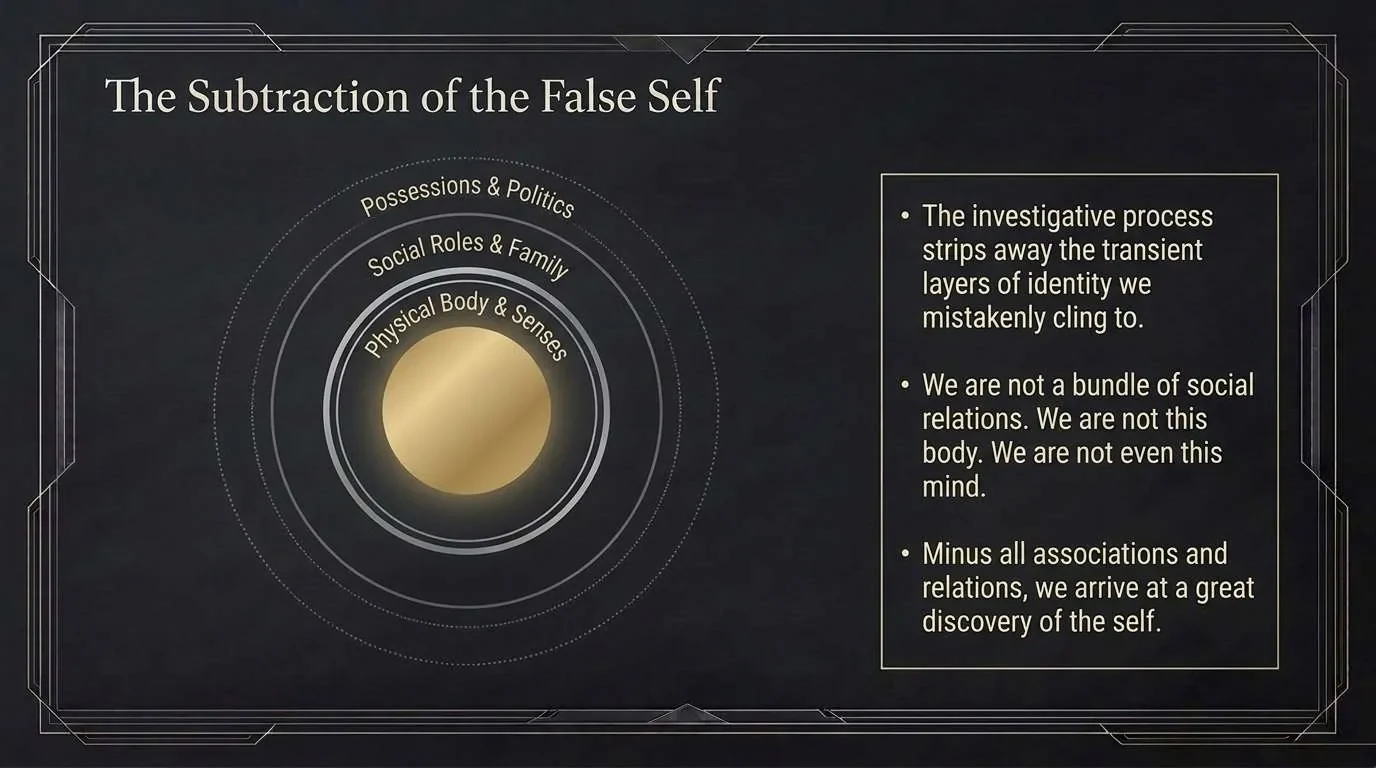
The mask the “I” wears. Your name, status, achievements, wounds, the story you tell about yourself. The false self that keeps seeking outside. To know your true SELF, you first have to see through it.
In Sanskrit: Kama+Desire — wish, longing, or sensory pleasure; one of the four traditional aims of life alongside duty, prosperity, and liberation. Here, the raw craving that hardens into the next column. → Ahamkara+Literally “the I-maker” — the function of mind that stamps “me” onto raw experience, manufacturing a sense of separate identity. — desire collects into a constructed identity that claims ownership: “I want this, I feel that.” The I-Maker claiming all experience as its own.
Traditional Source
Epictetus makes the same point with a horse: if it bragged about its own beauty, you'd find that absurd. Bragging about your wealth or title is the same trick in different clothes — taking credit for something Ahamkara only stamped as “mine.” The Gita names the remedy for the comparing that follows (3.35): better your own dharma, imperfectly done, than another’s done well.
Comparison is attention pointed the wrong way
Comparison feels like a judgment about someone else. Mechanically it is attention, aimed outward at a life you can't edit, while the one you can edit goes unwatched.
Staring at the neighbour’s grass. It always looks better from here: you see the surface and none of the upkeep.
Watering the grass you stand on. The only lawn where an hour of attention turns into something.
The Gita line above is the same redirect in one sentence. The envy is a signal, not a verdict: it shows where your attention just went.
The next time it shows up, what is waiting for you at home, unwatered?
Sat-Chit-Ananda, explained
Your pure, underlying conscious awareness. The silent observer behind every thought. The screen, not the movie — unchanged by whatever plays on it. Many traditions point to the same address.
SAT-CHIT-ANAND.
Existence. Consciousness. Bliss.
Bliss, the third word, is easy to hear as something added on top. An old image says otherwise: sugar is pervaded by the taste of sugarcane, edge to edge. Look at whatever you call “I.” Is the sweetness added, or is it already all through it?
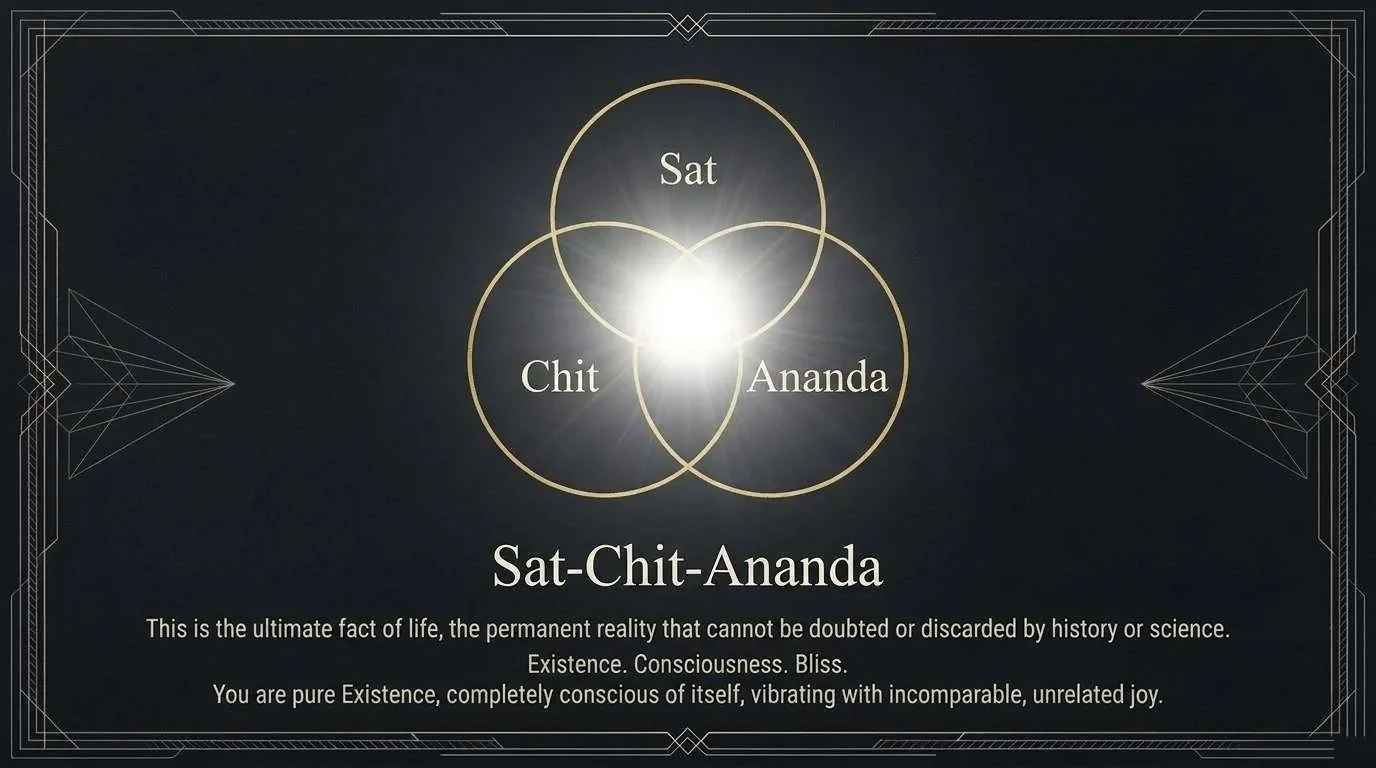
Three circles, one point of light where they overlap: not three things but one fact seen from three sides. The caption under it is the whole card in a sentence — you are existence, conscious of itself, vibrating with joy that depends on nothing.
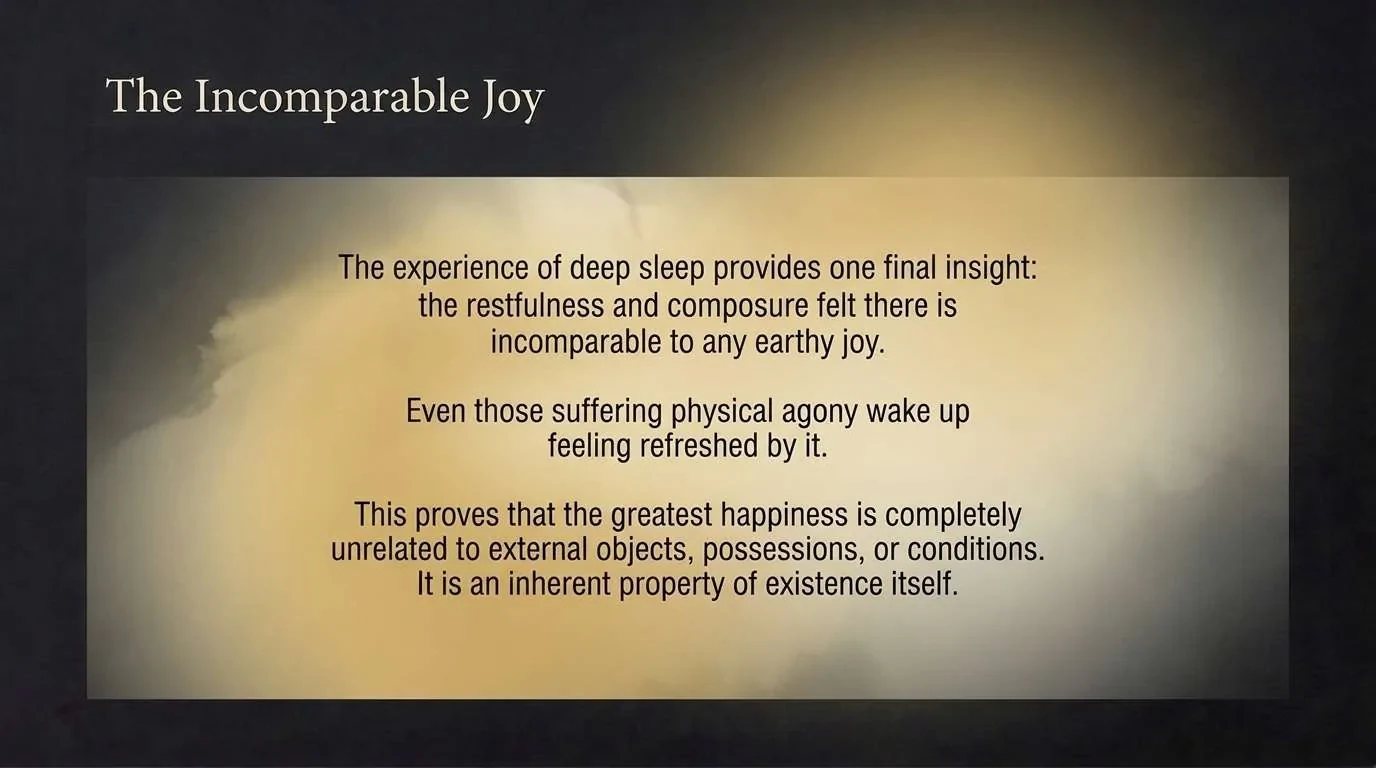
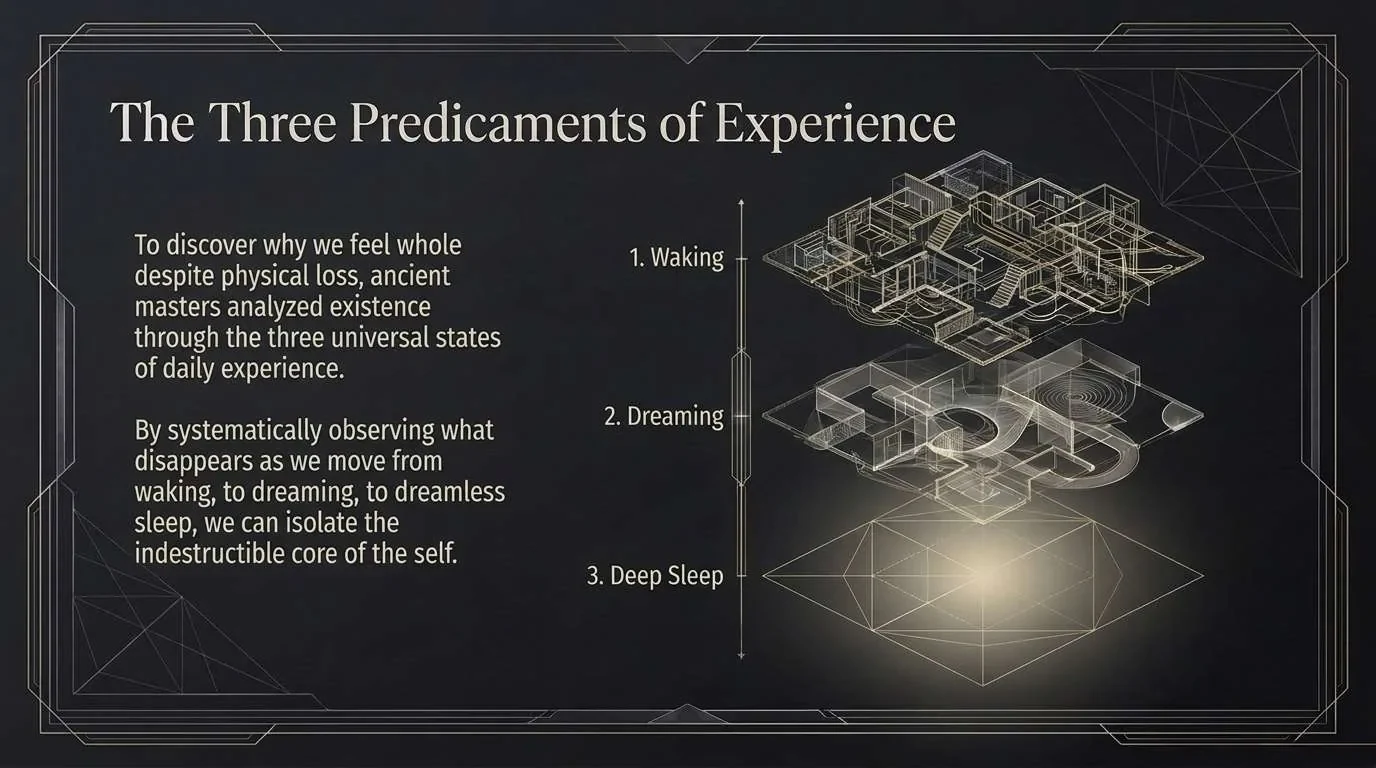
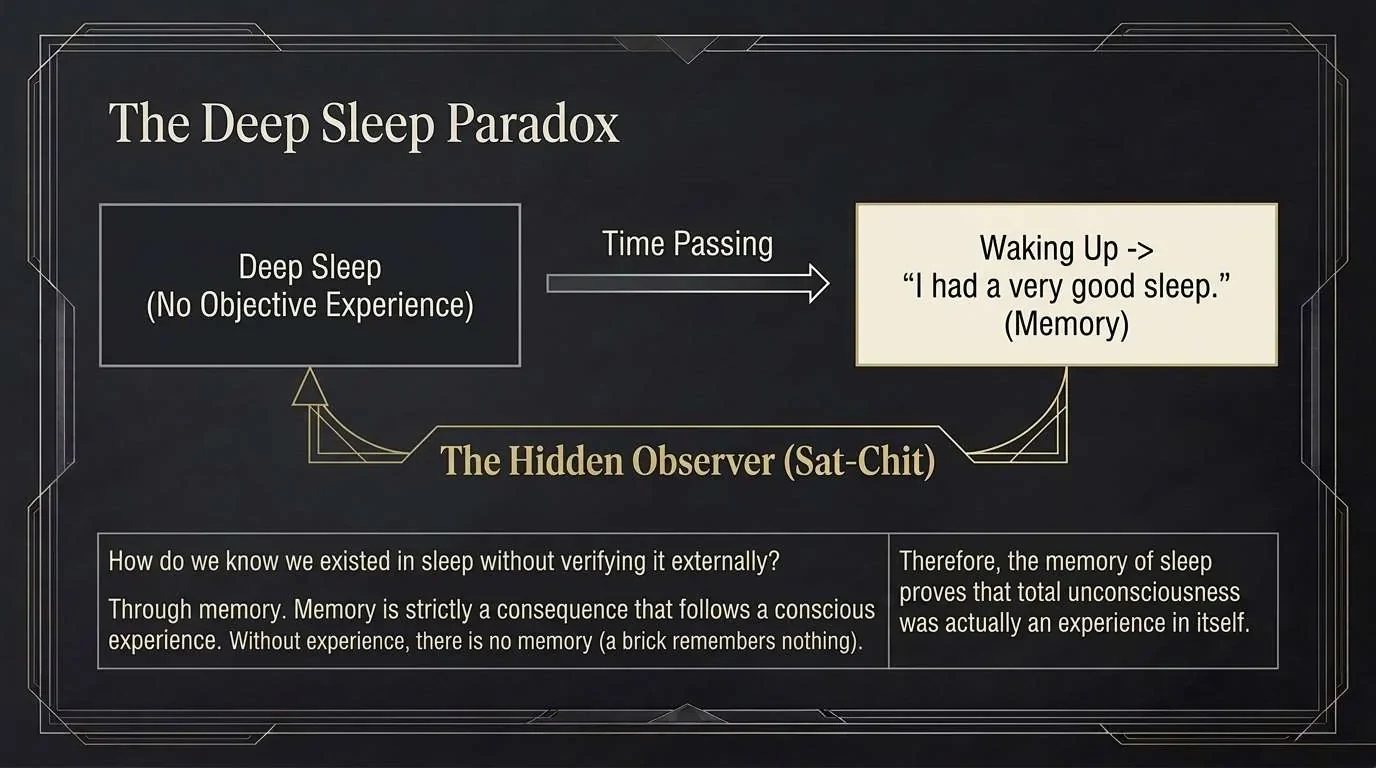
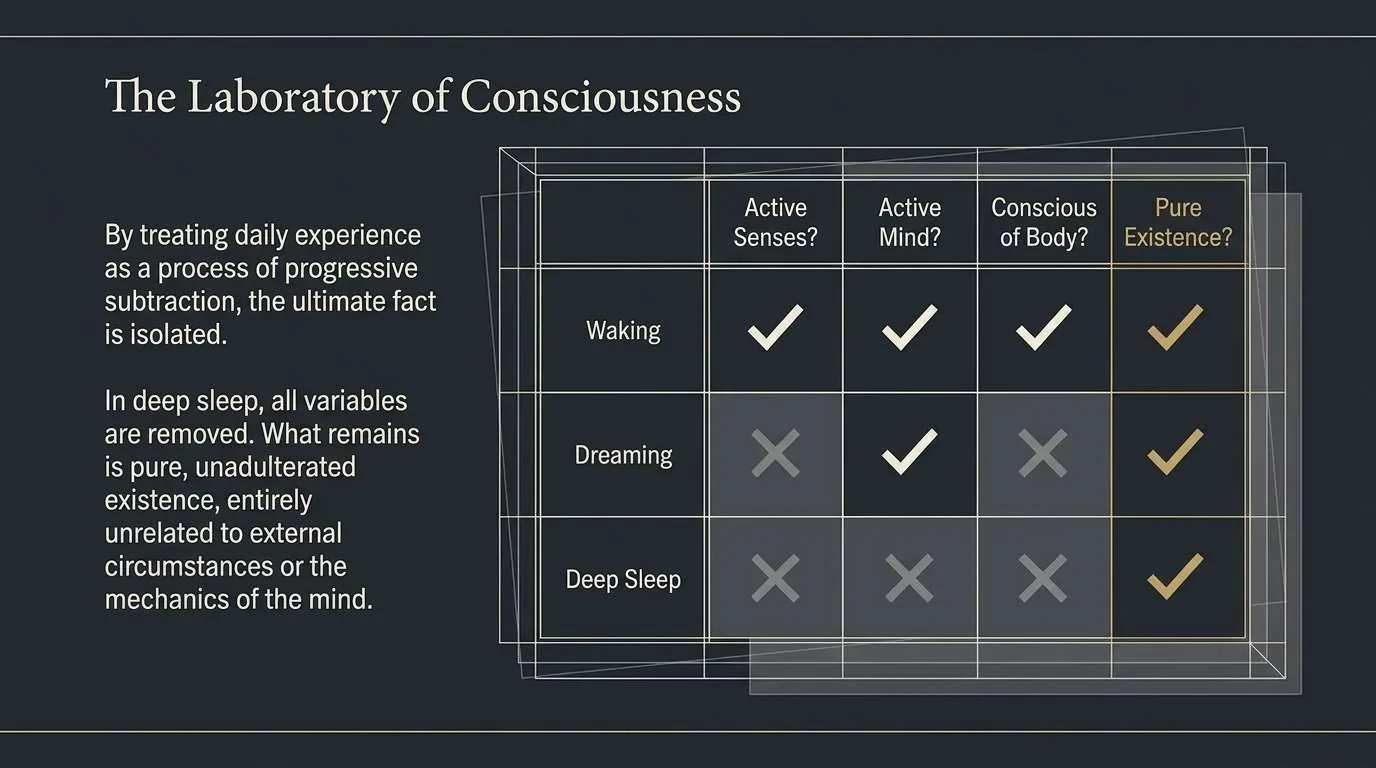
Where the third word comes from, by the deep sleep route. The rest felt there is out of proportion to anything in the day, and it arrives with no object, no possession and no condition met. Even someone in physical pain wakes refreshed by it. So the claim is that happiness is not made by objects but belongs to existence itself.
Honest limit: sleep’s restfulness also has plain physiological causes. The argument is that it is a clue, not that it is proof.
Traditional Source
The Gita gives the screen and the movie their own names in its thirteenth chapter: the body, with everything that happens in it, is the Kshetra+Field — in the Gita’s thirteenth chapter, the body together with mind and senses: everything that can be experienced and known. (field), and the one who knows it is the Kshetrajna+Knower of the field — the one who knows body and mind as objects of awareness; the witness behind experience. (knower of the field) (13.1–2).
The Sanskrit name for “I am Brahman”
Atman+The individual self, in Advaita Vedanta — held as identical to, not separate from, universal consciousness. (Individual SELF) = Brahman+The ground of all reality in Vedanta — not a deity to petition, but the substrate everything, including you, is made of. (Supreme Reality)
Traditional Source
That equation has a Sanskrit name: Aham Brahmasmi+Word by word — Aham (“I,” the individual self), Brahman (the ultimate, unchanging reality), Asmi (“am,” “exist”). One of the four Mahavakyas — “great sayings” — found in the Brihadaranyaka Upanishad of the Yajur Veda. — “I am Brahman,” or “I am the divine absolute.” Not an ego claim — the name, the body, the story from Card 03 is not what's speaking here. It describes the enlightened recognition that your deepest essence was never separate from universal consciousness to begin with, the same non-duality Tat Tvam Asi states from the teacher's side, spoken here from the individual's.
The lens of separation
Maya+Usually translated “illusion,” though “the measuring-out” is closer — the way one undivided reality appears to us as separate things, separate selves, and passing time. / Avidya+Literally “not-knowing” — the root ignorance that mistakes the temporary, changing self for the true, unchanging one. — the lens of separation — is dissolved when you recognize you are not the projection, but the screen. That is who you actually are.
The RRRR practice for the gap
The space between trigger and response. Moving from reactive to intentional.
V1 — Stop the Impulse
Recognize — Name the trigger.
Resist — 60-second pause. Do not act.
Return — Breathe. Walk away.
Release — Reset from clarity.
V2 — Process the Emotion
Recognize — Notice without judgment.
Reflect — What is the deeper trigger?
Reframe — Shift from victim to witness.
Respond — Choose from clarity, not the wound.
Three excuses, and the gap underneath each one
The Excuse
“This is just who I am.”
The Gap
A pattern, not a sentence — it was built, so it can be noticed while it's firing.
The Excuse
“It's my prārabdh karma+The destiny allotted at birth based on past karmas..”
The Gap
The hand dealt isn't in question. What you do with this specific moment of it is.
The Excuse
“Time will sort it out.”
The Gap
Time only passes. The response inside this gap is the only thing actually doing anything.
Each excuse points somewhere outside the gap — character, fate, the calendar — anywhere but the one place a response is actually available: right here, between the trigger and the reaction.
What's yours to hold, and what was never yours
Some things are within your power — your judgments, your desires, your aversions. Everything else — your body, your reputation, what other people do — is not. The gap above is where that distinction actually gets used: pausing before responding is easier once you can name which half of the situation is yours to work with.
In Greek: Prohairesis+The faculty of choice — the one thing Epictetus held to be entirely up to a person, regardless of circumstance. — the seat of judgment and choice. Not the mind's content, but its capacity to assent or withhold assent from what arises in it.
Traditional Source
Epictetus opens the Enchiridion with this split, then spends fifty-three chapters returning to it from every angle — the same witness this site describes as unmoved by the movie, pointed to from a slave's position in Rome, just named through choice rather than consciousness.
Arjuna drops the bow. What happens next is the gap.
Arjuna sets down his bow because he can see the cost of what he is about to do. That is conscience, not weakness. The Gita opens on his grief and does not tell him to stop feeling it. It asks what he will do with it.
Feel it fully. Name it. Then ask once: is this feeling helping me see the situation, or has it become the situation?
Traditional Source
Bhagavad Gita, Chapter 1, named for Arjuna’s despondency. The teaching only begins in Chapter 2, after the grief has been allowed to stand.
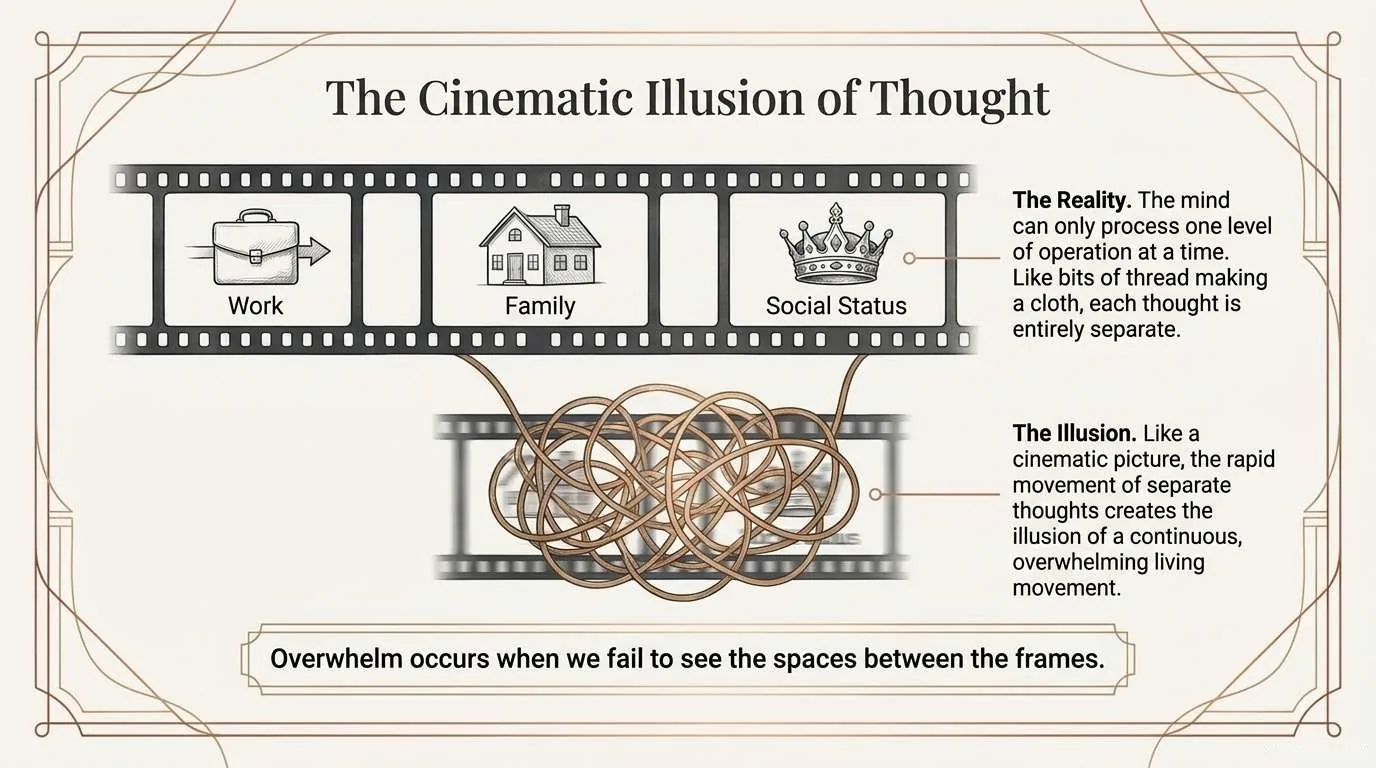
Separate frames, run fast, read as one overwhelming movement. The gap is the space between the frames. Can you find one?
Why delusion needs the dark
Not expected to be achieved in one lifetime. That is not a failure — that is the point. The goal was never arrival. The question is: are you pointed in the right direction?
In Sanskrit: Moha+Delusion — the basic clouding of judgment that mistakes the false for the real. / Vipallasa+Pali (Sanskrit viparyāsa) — a perceptual distortion in Buddhist psychology — seeing the impermanent as permanent, the impure as pure. — delusion is the ultimate end of unchecked conditioning. The loop only functions in the dark. Recognition is liberation. The architecture cannot survive awareness.
Life vs. “my life”
What you casually call “my life” is usually just your life situation — a mental narrative built on circumstances, full of problems and resistance, existing only in psychological time. Life itself is different: it exists only in the eternal Now, problem-free, internal, and indestructible.
Situations are either accepted or acted upon — never turned into “problems.” The moment you say and believe “my life,” you’ve split yourself from life itself. There is no such split. You don’t have a life. You are life.
A memory, recalled Now.
The only place life happens.
An anticipation, arriving as Now.
The division of life into past, present, and future is mind-made. What you remember is an event that took place in the Now — and you are remembering it Now. The future, when it comes, is the Now. Life is never not “this moment.”
What's given vs. what's built
Life hands you the letters — the events, the losses, the circumstances you didn't choose. It never hands you the word. Meaning is not found lying in the tray; it's assembled, tile by tile, out of the same raw alphabet that also spells pain and loss.
This is the dichotomy of control from a different angle: the letters on your rack are not in your hands. But the words you construct — and where you place them — are a matter of skill and practice, not luck.
Two metaphors for effort
| The Manufacturing Metaphor | The Agricultural Metaphor | |
|---|---|---|
| Verbs | Making money, making time, making friends | Growing, nurturing, flowing |
| Life as | A machine you assemble | A seed already carrying what it will become |
The river runs independently of your preferences. Whether you fight the current or swim with it is the only real choice on offer.
Paper and fire, seen as one process
A blueprint shows paper and fire as two separate things — a wall here, a hearth there, fixed and labeled, sitting apart on the page. That's the conceptual world: separate entities, filed and named.
A house actually being lived in doesn't work that way. Light a fire near paper long enough and there's no clean seam left between them — paper is fire, fire is paper, one continuous event. Living was never going to happen on the blueprint. It only happens in the burning.
Most of a life is spent re-checking the blueprint instead of stepping into the house that's already on fire.
Why the mind keeps mistaking form for content
Formless truth passes through the mind like light through a prism — and comes out split into measurements, forms, and calculations. Not because the truth was ever like that. Because the prism is built with four specific defects.
How the prism splits formless truth into form
Reality reduced to physical mass — bodies, money, land. Since none of it can be held forever, it becomes a standing source of unease.
Quality can't be perceived on its own — only by contrast. It quietly becomes just another camouflage for quantity.
The mind tries to physically fuse separate things — two bodies, two lives. An illusion: no two physical things ever organically become one.
Every quantity gets forced into a condition — up or down, moving or still, heavy or light — as if the label were the thing.
Nothing here is being called wrong. This is just the hardware doing what hardware does — running commercial logic on something that was never a commodity to begin with.
Nothing here was invented for this project. It's a distillation, four layers deep.
Easy to mistake any one teaching for a standalone opinion. It isn't. Here's the actual lineage — the same conclusion, distilled down to four progressively more usable forms.
The eternal, vast body of revealed knowledge — too immense for one lifetime to work through directly, even in translation.
The philosophical cream, drawn off the ritual portions — the part asking what's actually real, not how to correctly perform a rite. The Isha even sits inside a ritual text, as the 40th and last chapter of the Shukla Yajurveda; Shankara noted its mantras weren't used in rituals. Source
Ved Vyas's own codification of the Upanishads into one airtight argument — written in a sutra shorthand almost no one outside a trained lineage can read unassisted.
The Gitopanishad+Literally “the Upanishad sung as a song” — a traditional epithet for the Gita, marking it as carrying the same authority as the Upanishads themselves. — the same conclusion, made universally accessible: spoken aloud on a battlefield, in dialogue, and folded into the epic Mahabharat instead of sealed off as ritual scripture.
Why The Fourth Layer Can Be Trusted
The funnel above shows descent — one thing distilled into four. It doesn't show why anyone should trust the distillation. That answer is a separate structure: Shankaracharya+8th-century philosopher-monk whose commentaries systematized Advaita Vedanta; his Brahma-Sutra-Bhasya is the reference point for this section.'s commentary on the Brahma Sutras doesn't just add a fourth opinion — it cross-checks three independent canons against each other and shows they all converge on the same non-dual reality.
The Upanishads — the raw revelation, unmediated.
The Bhagavad Gita — the same content, restated.
The Brahma Sutras — the same content, argued.
Three canons, three different jobs — one heard, one told as a story, one proven by logic. Vedanta, quite literally “the end of the Veda,” is the single point all three were always pointing at. A claim resting on independent confirmation across all three isn't scripture asking to be taken on faith alone. It's scripture that already passed its own cross-examination.
Who Else Read It
Nothing above needs an outside witness. But it is fair to ask whether anyone from outside the tradition sat down with these texts and came away changed. Some did, and said so in print. Two are enough to show the shape.
He met them in a Latin rendering of a Persian translation, and still called them the solace of his life and said they would be the solace of his death.
Introducing a 1944 translation, he called it one of the clearest and most complete summaries of the perennial philosophy ever made — the claim that a common core runs under every tradition.
Stated plainly: a reader’s admiration is a fact about the reader. Schopenhauer built a system of his own and never became a Vedantin, and Huxley wrote as a comparativist. What this shows is narrow — that these texts held up under serious outside reading, not that what they say is true.
Source: Schopenhauer, A. (1851). Parerga and Paralipomena, vol. 2. Huxley, A. (1944). Introduction to Prabhavananda, S. & Isherwood, C., The Song of God: Bhagavad-Gita.
Same author, same realization, four attempts at the right altitude for a listener to actually receive it. That's the whole function of this page too — not a fifth, competing layer, but one more attempt at translation, aimed at whatever altitude you happen to be standing at right now.
Before the cure, the actual disease.
The Veda's diagnosis of the human condition isn't circumstantial — a bad job, a bad year, a bad relationship. It's structural. Samsara+The cycle of birth, death, and rebirth — the ceaseless churn of conditioned existence every layer below the Self remains bound to. isn't only the biological wheel of birth and death. It's a five-step engine, cycling underneath an ordinary Tuesday, that manufactures the felt sense of incompleteness fresh every day — and then hands you the bill for trying to fix it from the wrong end.
Tap to expand — the five-step engine underneath the diagnosis
Ignorance
“I do not know who I truly am.” Not a gap in trivia — a gap in the one piece of self-knowledge everything else gets built on top of.
Wrong Identification
“I am this limited body/mind.” The gap from Step 1 doesn't stay empty — something rushes in to fill it, and what rushes in is always a smaller, borrowed identity.
Desire & Aversion
“I need things to complete me.” A body-mind, mistaken for the whole Self, experiences itself as partial — and partial things reach for completion outside themselves.
Action
Compulsive striving in the world. Desire and aversion don't stay as feelings — they discharge as action, chasing what pulls and fleeing what threatens.
Results
Every action deposits a Vasana+A subtle latent tendency or impression, left behind by past thought and action, that inclines the mind toward repeating the same pattern. — a groove that feeds straight back into Step 1, deepening the same ignorance it was supposed to relieve.
The Veda's word for the baseline human state is bondage — and not primarily the physical fact of birth and death, but the psychological gnawing of incompleteness that runs underneath a life that, from the outside, is going fine.
A finite fix cannot cure an infinite misdiagnosis. If the disease is mistaken identity, the only cure is Moksha+Liberation — release from the cycle of Samsara through the correct recognition of one's true nature, not through any change to circumstance. — not better circumstances inside the cycle, but correct identity, which stops the cycle from having anywhere left to run.
The Shiva Sutras name this same shrinking a different way — The Bondage of “Knowing”.
Laid out layer by layer, this same bondage is the walk through Layers 1–6 of the Master Matrix — and Layer 7, the Self, is Moksha itself: the only way out.
The Same Motion, Twice
Step 3 names two reflexes. Look at them together. Reaching for what promises completion and recoiling from what threatens it are one motion, felt from either end. A pendulum pulled hard to the right is storing exactly what it needs to swing left.
Traditional Source The Gita says it as a rule of living. Yoga is not for the one who eats too much or too little, sleeps too much or too little (6.16). It belongs to the one who is moderate in eating, recreation, action, sleep and waking (6.17). Elsewhere it calls evenness in success and failure yoga itself (2.48).
Stated plainly: the pendulum is an image, not a mechanism from the texts. The texts give the moderation and the evenness. The picture is one way of seeing them.
Not a claim to accept. A place to look. Which end is it swinging toward now, and what is that storing?
Source: Bhagavad Gita 2.48, 6.16–6.17.
Where The Bill Actually Comes From
Phalam, above, explains how the bill is generated. This is a sort of the bill itself — every form of dissatisfaction this tradition recognizes, filed into exactly three sources.
Disease, mental anxiety, grief — generated by the very body and mind claimed as “mine.”
Whatever a rival, a pest, or an enemy inflicts — any misery routed through someone else's choice.
Storms, earthquakes, heat, cold — whatever arrives from forces no individual will was ever going to negotiate with.
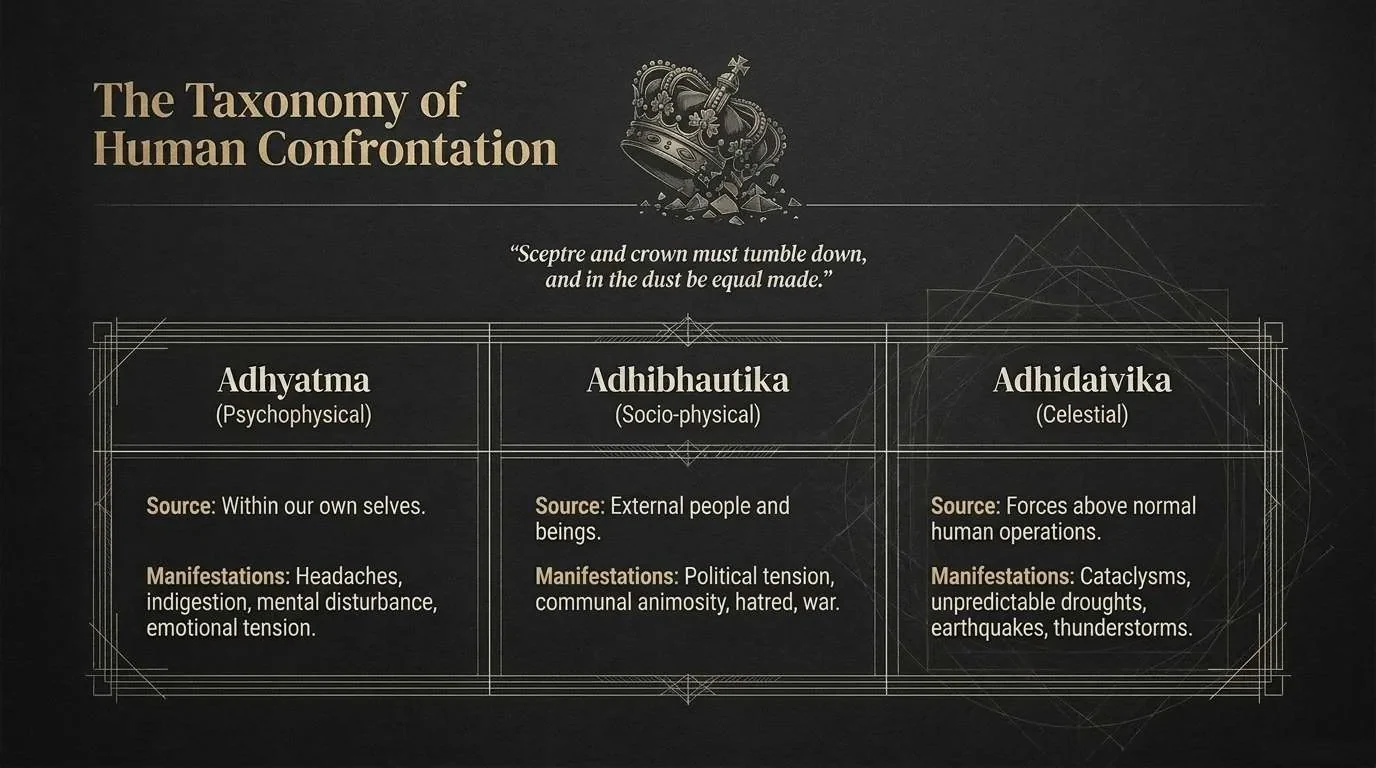
The same three-way sort, drawn as a table. It adds what the cards above leave out: a plainer English name for each source (psychophysical, socio-physical, celestial) and a row of everyday examples — headaches and indigestion, communal animosity and war, droughts and earthquakes. The toppled crown over the table is the quiet point: no rank exempts anyone from any of the three columns.
Every complaint ever filed sorts into one of these three. Which is also the point: rearrange the furniture of a life indefinitely, and it only ever redistributes which of the three does the hurting — it doesn't touch why an identity this fragile went looking for permanent comfort in impermanent material in the first place.
What The Hunger Is Actually After
Desire looks like a thousand different things. Traced down, it is three. Each one is a finite someone trying to become infinite.
Wealth, land, authority. A small self made large by what it holds. Kings are never finished. Neither is anyone who counts. What number would be enough?
Children, lineage. Time cuts the line; biology draws it again. A family continuing is not you continuing. Who exactly is meant to survive?
Name, standing, legacy. The body goes hungry for a reputation it will never hear. Why care what is said after you are gone? Who is that for?
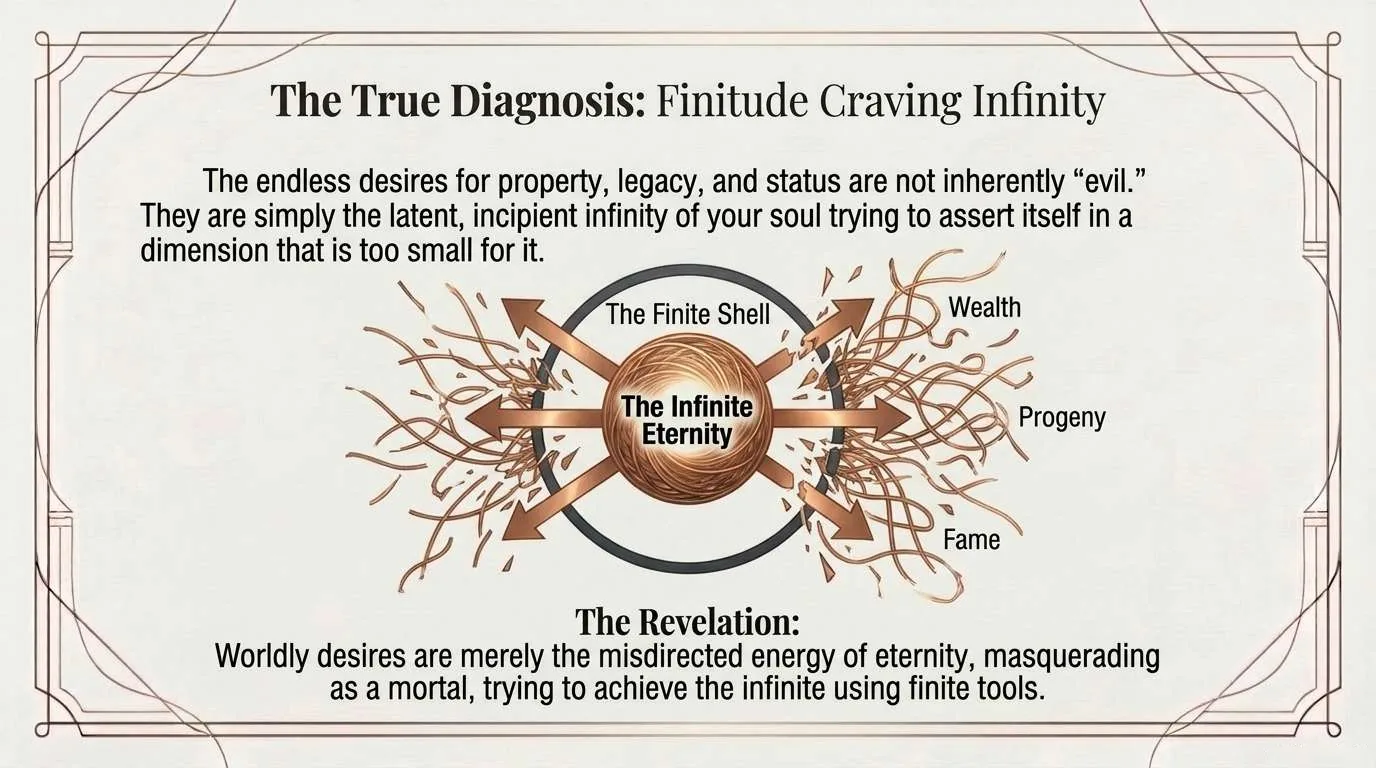
The same three hungers, drawn as pressure on a shell. The arrows push out. The ring is the limit. Which arrow is yours pushing hardest?
Not evil. Misdirected. The same energy, aimed at the wrong dimension, using finite tools for an infinite errand. Look at the thing you want most. What is it trying to make permanent?
Wherever there is a second, there is fear. Wanting is how the second gets pulled in close. The Root Diagnosis shows the engine; this is what it runs on.
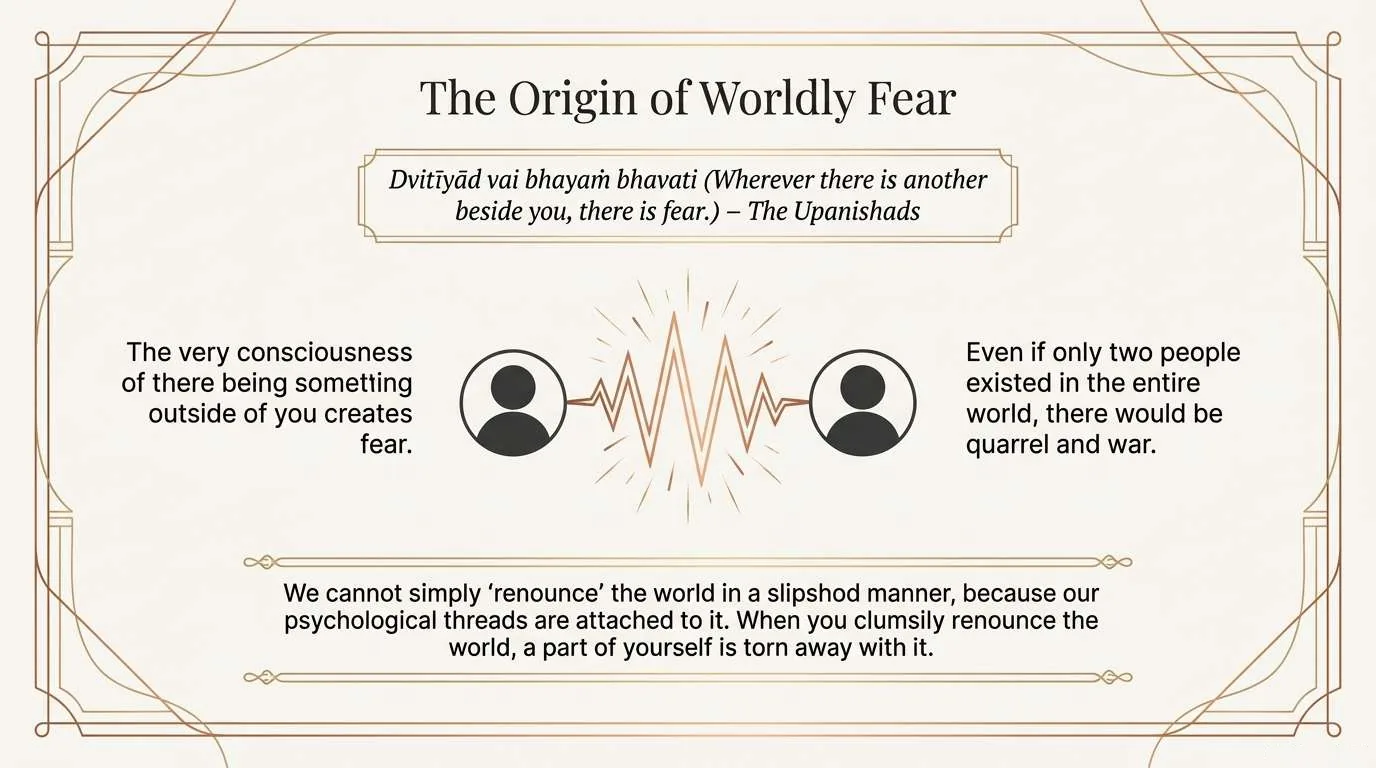
Source: Brihadaranyaka Upanishad 1.4.2, 3.5.1. 42SELF Interpretation
Three Ways To Hold A Thread
Most people think the only choices are cling or cut. There is a third.
Involved, reactive, driven by desire. The mind is glued to the thing. Every pull on it pulls you.
Cut off, avoiding, forced. The thread tears and leaves a scar. Running from a thing is still being tied to it.
Free of the association without fleeing it. The thread runs alongside. Nothing is cut. Nothing is pulling.
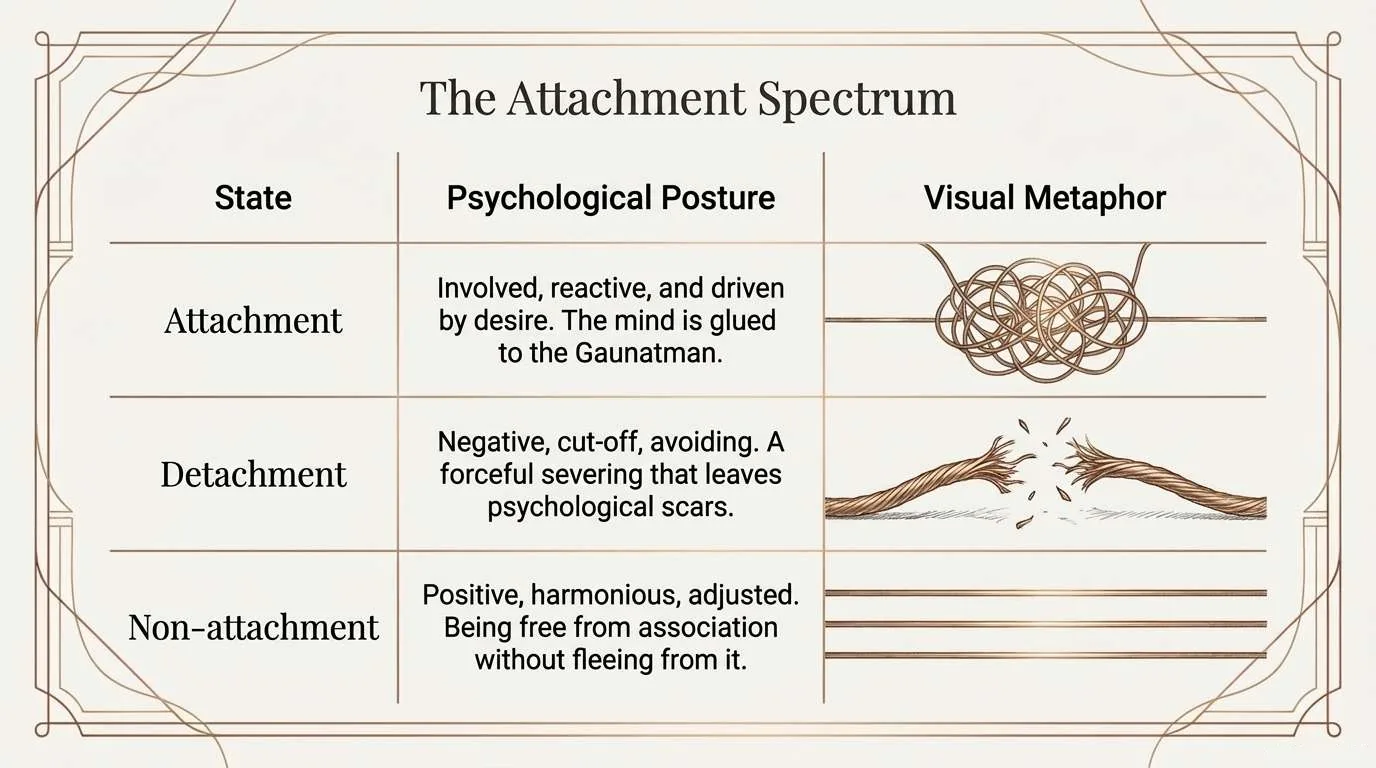
The same three postures, drawn as thread: tangled, snapped, parallel.
Cut a desire and it goes underground. Understand why it arose and it loosens on its own. Which one is your habit with the thing that costs you sleep?
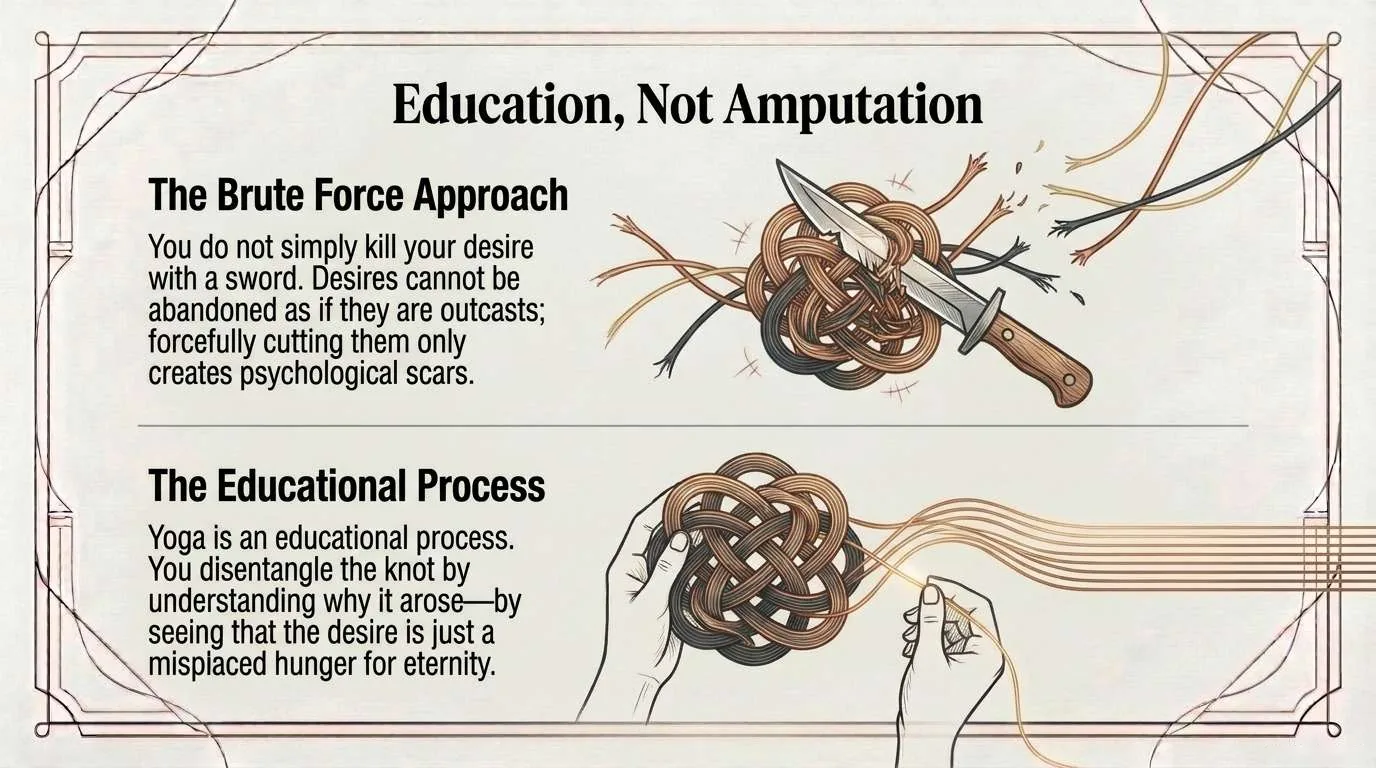
One knot, two ways in. The blade leaves frayed ends. The hands ask how it got tied.
The same shape as Vairagya: the open jar, not the emptied room. Here it sits next to the Eshanas that make the threads.
Source: Yoga Sutras 1.15. 42SELF Interpretation
Everyone Already Serves Something
“Free agent, serving no one” was never actually on the menu. Suffering doesn't start with serving something — it starts with the choice of master.
Refuses higher authority, tries to master the material world directly — and ends up governed by whichever of lust, anger, or greed shouts loudest. The rebellion succeeds. The freedom it was supposed to buy never arrives.
Accepts servitude to something higher — and that acceptance is exactly what hands back command of the senses it was supposedly giving up. Control was never available by demanding it directly.
Which is also the same shape as Purushartha and Sharanagati elsewhere on this page, in blunter language: the one demanding mastery ends up owned by what it was chasing. The one offering service ends up free.
A wet matchstick cannot catch a spark.
Vedic inquiry is not withheld out of secrecy. It's withheld the way a fire is withheld from wet wood — not as punishment, but as physics. An undisciplined mind can be shown the truth directly and still not catch it, the same way a wet matchstick can be struck against the truth itself and still not light. Sadhana Chatushtaya+The “four means of practice” — the traditional set of qualifications said to prepare a mind for Vedantic inquiry, without which the teaching has nothing to take hold of. is the drying process. Four qualifications, each building on the last.
Tap to expand — the four qualifications, base to apex
Discrimination — the base of the pyramid
The capacity to tell the Nitya+The eternal — what does not come and go, was not born and does not end. from the Anitya+The ephemeral — whatever begins, changes, and ends, however long the timescale. — the changeless from the changing. Not a mystical skill: the ordinary discernment that a promotion, a relationship, even a good decade, is not built to outlast time, and that something in you evidently is (it's the one noticing all of the above come and go).
Discrimination isn't all-or-nothing. A traditional ladder of animals shows it maturing in three grades:
The Tortoise — protective. Pulls back from whatever unsettles it and ignores outside ridicule, just to hold steady. Stability first, no sorting yet.
The Duck — practical. Learns what to take in and what to reject, but on a worldly, functional level: useful or harmful, not yet lasting or passing.
The Swan — complete. The legendary bird that separates milk from water. Here the sorting is between the permanent and the transient, which is Viveka proper — and the real beginning of the journey, not its end.
Dispassion — the second tier
Calm, mature renunciation of dependency on the ephemeral — not white-knuckled abstinence, and not a forced move to a cave. It's what naturally follows real Viveka: once something is clearly seen as temporary, leaning on it for permanent peace stops making sense, the way leaning a ladder against smoke stops making sense.
The Six Treasures — the third tier
Mental and emotional discipline, in six parts:
Control of the mind.
Control of the senses.
Withdrawal from distraction.
Endurance of opposites.
Faith in the teaching.
One-pointed focus.
Burning desire for liberation — the apex
Relentless, single-minded focus for Moksha+Liberation — release from the cycle of Samsara through the correct recognition of one's true nature, not through any change to circumstance.. The first three qualifications dry the wood. This is the spark that actually needs somewhere dry to land — without it, a perfectly disciplined mind can still sit indefinitely, never striking the match.
That's all four. One loose thread remains — Shatsampatti's fifth treasure, Shraddha, is faith placed in someone. The next card isn't a fifth qualification of the seeker; it's about the other party in that relationship.
Who Shraddha is actually faith in
The four qualifications above describe the seeker. They say nothing about who the seeker's Shraddha+Faith — provisional trust in the teacher and the teaching, held long enough to actually test it, not blind belief held instead of testing it. is supposed to be placed in — and Vivekachudamani+“Crest-Jewel of Discrimination” — a foundational Advaita Vedanta text attributed to Adi Shankaracharya, on the qualifications and inner work that lead to direct Self-knowledge. is specific that not just anyone qualifies:
Versed in the Vedas; a knower of Brahman, not merely a scholar of texts about Brahman.
Sinless, unsmitten by desire — nothing left to be earned or protected through the teaching.
Withdrawn into Brahman, the way fire settles once it has consumed all its fuel.
A reservoir of mercy that needs no reason — a friend to anyone who comes for shelter.
The distinction matters because Shraddha, above, is provisional trust held long enough to test — which only works if there's something at the other end actually worth testing against.
None of this is a gate keeping the truth away from you. It's a description of what a mind actually needs, structurally, before a non-dual teaching has anything to grip — the same reason the driest kindling, not the most enthusiastic match-striking, decides whether a fire starts.
Why The List Above Is Worth Acting On
The tradition doesn't just list what a seeker needs. It names three things that have to coincide before the list above is even usable — and treats their coincidence as rare enough to be worth stating outright.
And, further, the aptitude and discipline to actually study what's been handed down — not a given, even once the first condition is met.
Wanting it the way one wants air, not the way one wants a book finished.
Someone who has already arrived, willing to point the way — not assumed to be available on demand.
To have all three at once and spend them on anything other than this inquiry isn't neutral, the tradition says — it's closer to injuring yourself over something that was never real to begin with.
Everything else in life responds to effort. This is the one exception.
Before inquiry can even start, it helps to be clear about what kind of thing it's chasing. Liberation gets talked about like an achievement — something earned through enough practice, enough merit, enough time. Vedanta's classical argument says that framing is a category error, and it makes the case on two separate fronts.
Front One — What Each One Depends On
A man can choose to walk, ride, or stand still. Every action bends to whether someone decides to do it, alter it, or skip it entirely.
You cannot choose to see a man where a stump actually stands. Valid knowledge answers to what's there, not to what anyone would prefer to see.
Liberation is the removal of a specific error — mistaking a limited self for the limitless one. Errors get corrected by seeing what's actually there, not by an act of will. Which means, structurally, liberation was never in the will's jurisdiction to grant to begin with.
Front Two — The Four Things An Action Can Do
Every result an action can ever produce falls into exactly four categories. Liberation fits none of them.
Liberation isn't manufactured from nothing — the Self it points to already exists, eternally.
The Self was never dirtied. Action can polish the body or the ego. It can't polish what was already spotless.
Brahman is immutable and without parts — there's no version of it left to change into something else.
You can't obtain what's already all-pervasive. Nothing needs to travel anywhere to reach what was never absent.
Practice still matters enormously — it's what clears the debris blocking the view. But the seeing itself, when it finally happens, isn't the trophy at the end of the effort. It's the recognition of what the effort was clearing the way toward the whole time.
The Same Argument, As A Direct Comparison
The two fronts above are a logical case. The tradition also just states the comparison outright, action against inquiry, with nothing softened.
Its method is doing — countless acts, repeated. Its result is a cleaner mind and some personal enjoyment along the way. Its ceiling is fixed: no amount of it was ever going to end in freedom.
Its method is reasoning, tested against those who've already seen clearly. Its result is recognizing identity with the Atman. Nothing else this direct is on offer anywhere in the first column.
Action can clean the room. It takes discrimination to notice the snake on the floor was a rope the entire time.
Debris doesn't clear itself by being told to.
So what does the clearing actually consist of? Sankaracharya gives it a deliberately unglamorous image: buried treasure, not lightning.
The Self isn't hiding — it's covered, the way a treasure is covered by the earth sitting on top of it. Nobody digs it up by standing over the spot and saying its name. Four things have to happen, in order, none of them optional:
A Guru who has already found the spot points to it exactly — not a general direction, a location.
Sravana+Hearing — attentively taking in the teaching directly from a qualified teacher, the first of the three classical steps toward realization. and Manana+Reflection — reasoning through the teaching until every doubt about it is personally resolved, the second of the three classical steps. — hearing the teaching, then reasoning through it until it's not just believed but actually understood.
Nididhyasana+Sustained, unbroken meditation on the truth already heard and reasoned through — the third classical step, where understanding is worn smooth into direct seeing. — sustained meditation, clearing away the specific obstacles Maya and old habit keep dropping back into the hole.
Direct realization. Reaching in and taking hold of what was, technically, always sitting right there.
Skip a step and the other three don't compensate. A perfect map with no digging finds nothing; digging with no map finds the wrong hole.
Where Step Four Actually Ends
Vivekachudamani names the far end of that fourth step directly: Nirvikalpa Samadhi+Literally “absorption without alteration” — the culmination of Sravana, Manana, and Nididhyasana, in which the distinction between knower and known dissolves entirely. Sits beyond Savikalpa Samadhi, the preceding stage in which that distinction, however subtle, still persists., absorption “without alteration.” Not a state layered on top of ordinary experience, but the point where the last seam between the one experiencing and the thing experienced gives out.
Existence-Knowledge-Bliss, realized directly rather than described. And a closing line worth sitting with rather than resolving: none but one's own self can remove this bondage — not the Guru who pointed, not the teaching that was heard, not even the meditation that dug. Every one of the first three steps only ever prepared the hand. The grasping was always going to have to be done by the one grasping.
Not all thinking is trying to win an argument.
The tradition names three kinds of logic. Only one of them goes anywhere.
| Tarka+Standard reasoning, debate, and analysis — useful, but it shifts every time a new fact arrives. | Kutarka+Fault-finding aimed at good intentions, twisted purely to win an argument — breeds paranoia, destruction, and ignorance. | Vitarka+Thought without the need to win anything — asking unanswerable questions like “Who am I?” that exhaust the ego and open onto Self-knowledge. |
|---|---|---|
| Standard reasoning, debate, analysis | Fault-finding aimed at good intentions, twisted to win | Thought without the need to win anything |
| Useful, but shifts with every new fact | Creates paranoia, destruction, ignorance | Asks what can't be settled — “Who am I?” |
| Normal logic | Wrong logic | Special logic |
⟳ Tip: turn your phone to landscape for a wider view of this table
“Who am I?” has no side to argue. That's exactly what lets it exhaust the ego instead of feeding it.
Jnanam bandhah+A Shiva Sutra: limited knowledge itself creates bondage — the instant something is called “known,” its living, changing range narrows to fit a fixed, past-based definition. — limited knowledge creates bondage.
The moment something gets labeled, the mind stops looking at it.
Reality stays in a state of constant, vast newness — until the ego reaches for a label. The instant something is called “known,” the range of what it could be shrinks to fit a rigid, past-based definition. That's the bondage: not ignorance, but a definition that stopped updating.
Vismayo yoga bhumikah+A Shiva Sutra: wonder is the foundation for union — knowledge held with amazement stays open; knowledge held as settled certainty closes the door to reality. — Wonder is the Foundation
Knowledge without wonder doesn't sharpen life — it dulls it. Saying “I know” closes a door. Looking at the same thing with amazement, known or unknown, keeps it open.
Traditional Source
The Shiva Sutra says limited knowledge binds. The Kena Upanishad says where that ends up when the object is the knower itself, and it puts it as a paradox. Not false modesty: the Self can never be an object, so any claim to have it is already a claim about something else. The Kena section below runs the same argument as a story.
He who thinks he knows It, knows It not. He who knows that he does not know It, knows It.
— Kena Upanishad 2.3SELF isn't handing you the answer. That would just be one more door closing.
The Veda maps this same shrinking as a five-step engine — The Root Diagnosis.
Every claim about reality gets built one of exactly two ways.
One climbs up from the senses. The other comes down from a source that was never theorized at all. Worth seeing plainly which one this tradition leans its weight on, and why, before anything downstream depends on it.
Senses → Mind → Intellect
Built upward by a limited instrument, checking itself as it goes. Useful, and constantly revised — Greek atoms became Rutherford's model became quantum theory, each true enough to work until the next correction arrived. Nothing wrong with the method. It simply can't finish, because the thing doing the measuring is inside what's being measured.
Perfect Source → Oral Tradition → Hearing
Not derived from anywhere below it; only received and passed on intact, teacher to student, for as long as the lineage has existed. Nothing left to revise, because nothing was ever theorized to begin with — only heard, and handed on unchanged.
This isn't a claim that thinking is worthless — it's a claim about scope. One path was built to handle a changing, external world, and does that well. The other was never trying to be a theory of anything. It's closer to a report from a source the theorizing was never going to reach on its own, no matter how many centuries it ran.
Path A has run into this limit from inside, too — see Angle Eleven for what physicists made of it, and how much of that holds up.
Where Path A Stands On Consciousness
Within Western philosophy and science there is no single answer, only a handful of standing positions. Each is a serious attempt, and each is argued over — the “hard problem” (Chalmers, 1995) is the name for why none has settled it.
Only the physical exists. Consciousness is produced by brain activity and ends when the brain does. The current mainstream.
Matter and consciousness are two different substances, neither reducible to the other. Descartes’s view.
Consciousness arises as a nonphysical property of sufficiently complex physical systems.
Consciousness is a function the brain performs — not a separate substance, and not tied to one kind of material.
Only consciousness is ultimately real. Matter is an appearance within it (vivarta), not its source.
The first four all begin with matter and ask where mind comes in, or whether it does. Advaita begins with consciousness and asks how matter comes to appear. That is a different starting point, not a fifth entry on the same menu — and, like the others, a position to test against what you find when you look.
Source: summary of positions as set out in Khanna, V. (Hinduism Today) and Sarker, C.R. (2021). Chalmers, D. (1995). Facing up to the problem of consciousness. Journal of Consciousness Studies, 2(3).
The Bridge Between The Two Paths
Para and Apara Vidya already say that only direct self-knowledge reaches root ignorance. The Panchadasi adds how the handover happens, with two working names: paroksha, knowing through a medium, and aparoksha, knowing with no gap between knower and known. Not to be confused with Pratyaksha above, which is direct sense perception — aparoksha involves no senses at all.
Words, inference, a teacher’s report. Path B’s testimony begins here, and so does everything on this page.
In the Tenth Man, the passerby adds no fact. The man had every fact already. The sentence removes one mistake, and the knowing turns immediate at once.
The recognition itself is instant — nothing is built up to it. The preparation that clears the view is gradual; see Two Ways to Meditate.
The same split separates God from the individual in the Panchadasi: Ishvara knows everything immediately, as identical with Himself; the individual knows in fragments, through senses, one object at a time. The difference is not intelligence. It is whether a gap sits between knower and known.
This page is paroksha by construction — words about the hinge. Whether it becomes aparoksha is settled only in your own looking.
Source: the Panchadasi (Vidyaranya), as taught in Swami Krishnananda, The Philosophy of the Panchadasi (Divine Life Society).
Why point at a text instead of just thinking this through?
Fair question. Two tools of knowing carry you through almost everything else in life. Neither was built to reach the one thing doing all the knowing.
The senses meeting an object. Deceivable — and it needs something to point at. The one doing the looking can't also be the thing looked at.
Smoke implies fire — reasoning from a shared mark to what it belongs to. Needs two things to compare. What has no second thing to compare against gives logic nothing to grip.
Words, taken as evidence. The only tool of the three that was never built to examine an object in the first place — which is exactly the shape of the gap it's used to fill here.
An eye lights up an entire room and can't see itself doing it. A candle can't illuminate the sun. That's the actual shape of the problem — not that the Self is hidden somewhere far off, but that it's the one thing perception and inference were never aimed at, because both require standing apart from what they examine, and there's no standing apart from this.
A mirror doesn't invent the face looking into it. It only clears what was fogging the glass.
Nothing below asks to be taken on faith instead of checked. Test it against what you actually find when you look — that's the only lab this ever ran in.
The Argument, In The Text's Own Words
The Kena Upanishad+One of the ten principal Upanishads, from the Sama Veda — a concise 34 verses across four sections, opening with the word "Kena?" ("By whom?"). opens with exactly this question, asked as a question rather than argued as a thesis: by whom does the mind think, the eye see, the ear hear, the breath breathe? Something is clearly directing all four. It's just never itself among the things being seen, heard, or thought.
Failed to burn a single blade of grass, placed in front by the mysterious Yaksha.
Failed to move that same blade of grass, an inch.
The Yaksha vanished before he could even ask. He alone had the humility to keep looking, and learned what the others didn't.
The gods had just won a great victory and credited their own power for it. The Yaksha — Brahman, unrecognized — was a test they failed until Indra, alone, stayed humble enough to keep asking. The lesson wasn't about strength. It was that the power behind every power is never the thing wielding it.
Then comes the part most retellings drop. Indra doesn’t reach the answer by force, and he doesn’t reason his way to it. With the Yaksha gone, Uma Haimavati+The goddess who appears in the Kena Upanishad after the Yaksha vanishes, and tells Indra the victory was Brahman’s. Haimavati means “of the Himalaya”; later tradition identifies her with Parvati, consort of Shiva. appears in the same sky and tells him whose victory it had really been: Brahman’s. Fire and Wind had already failed by trying to conquer it. What worked was staying present until the answer was given. The teacher in this story is the goddess, not the king — the Upanishad’s own version of the Function of Grace card in the Self-Enquiry section.
That which speech cannot reveal, but by which speech is revealed — know That alone to be Brahman, not what people worship as an object.
— Kena Upanishad 1.5Every verse in this section runs the same shape as this one line. Not a new claim — the oldest attestation of the one already made above.
The Kena’s paradox verse, 2.3 — whoever thinks they know It, doesn’t — is cited earlier, in The Bondage of “Knowing”.
Three grades of “real.” Most people only use two.
“What cancels a dream is waking up. Nothing has ever cancelled waking up.”
— the logic behind Satta Traya
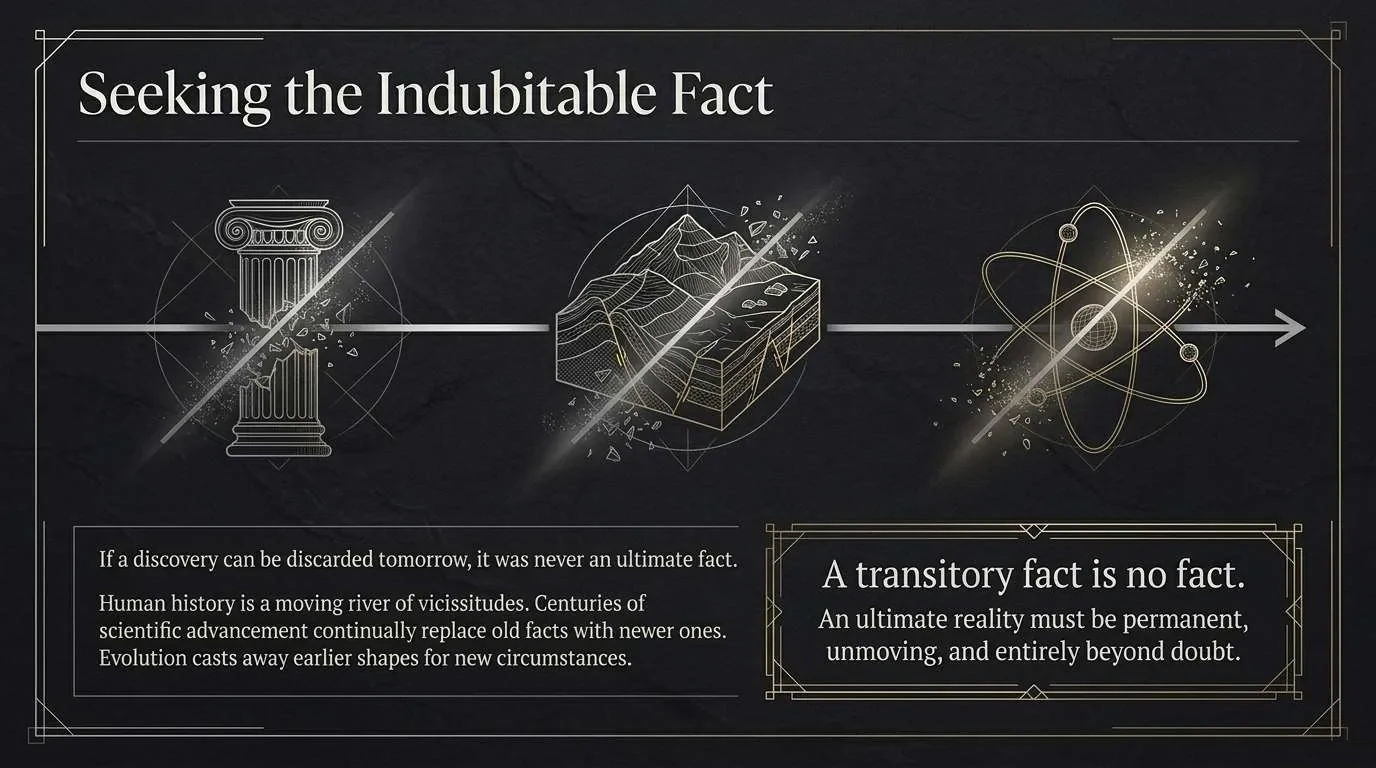
The same test, drawn as three things people lean on as settled: a column, the ground, an atom. Each is sliced by a bright diagonal because history and science keep replacing what was once final. The slide's one-line rule is the Satta Traya logic in miniature: a transitory fact is no fact. What can be discarded tomorrow was never the ultimate, so the ultimate has to be permanent, unmoving and beyond doubt.
A dream feels total while it is running. Waking up does not add anything to disprove it — it just turns out to have been resting on something steadier. Vedanta says the waking world you are in right now works the same way, one level down. Not fake. Not final either.
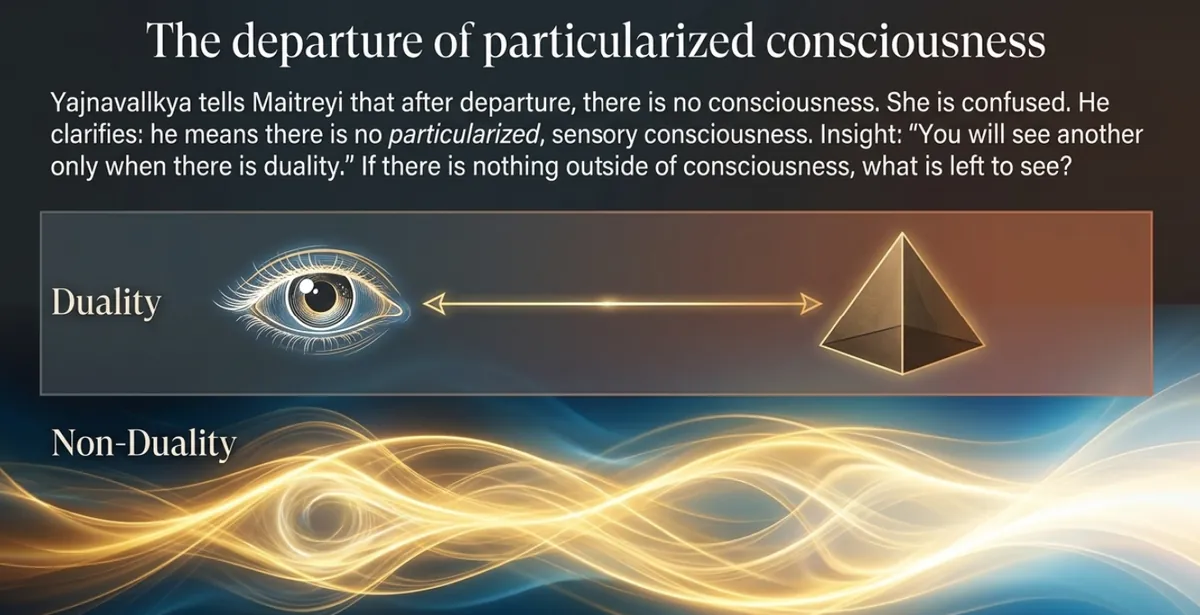
Advaita means “not two.” Not an observer here, a world there, and something ultimate beyond both — one field, with the lines drawn on top. Look for where the line between the one looking and the thing looked at actually sits.
Try it with two people. For A, A is the one looking and B is the thing looked at. For B, it is exactly reversed. Neither label belongs to the person; it belongs to the position. So who is the permanent object?
Dreams. Mistaking a rope for a snake in dim light. Real only for as long as the specific error lasts — gone the instant it's seen through.
Your body. Physics. Deadlines, traffic, the bus in the street. Shared and consistent — nobody is asked to disbelieve any of it.
What remains once every dream has ended and every transaction has run its course. Never cancelled — because there's no further waking up left to do.
Awakening is not a trip to a fourth location. It's your primary sense of “real” sliding one level down — from the transactional to the absolute — while the transactional keeps running exactly as before, just no longer mistaken for the base.
If Reality Is One, How Does It Look Like Many?
Three answers have been proposed. Two run into the same wall.
A potter shaping clay into a pot. Fails: it puts God and world on separate sides, which means the ground of everything isn't actually one.
Milk becoming yogurt. Fails: if the changeless ground actually changes, it was never changeless to begin with.
A rope, glimpsed in dim light, looking like a snake. The rope never became anything. The One appears as the many without ever ceasing to be one.
This is the specific mechanism behind the earlier line — you are not the projection, but the screen. The screen was never at risk of becoming the movie.
“What is seen is illusion. That through which it is seen, is Reality.”
— a formulation found across the Nisargadatta lineageSame Space. Different Container.
Put a clay pot down in an open field. Space fills the pot exactly as it fills everything around it — the same, undivided space, with a boundary drawn on top by the pot alone. Break the pot. The space inside doesn't travel anywhere to rejoin the whole. It just stops being fenced.
A Upadhi+A limiting adjunct — something that appears to divide or qualify a substance without actually changing what that substance is. The pot doesn't add anything to space; it only appears to enclose some of it. works the same way on consciousness. It adds nothing. It only appears to enclose.
Brahman+The absolute, non-dual ground of everything — not a being among beings, but what all beings are made of. + cosmic Upadhi = Ishvara+Brahman viewed through the cosmic Upadhi — omniscient, omnipotent, the inferred cause, sustainer, and dissolver of the universe. · Brahman+The absolute, non-dual ground of everything — not a being among beings, but what all beings are made of. + individual Upadhi = Jiva+Brahman viewed through an individual Upadhi — the limited, embodied sense of self that experiences itself as doer and enjoyer.
Not two substances. One substance, two containers. Realization is the pot breaking — not consciousness travelling anywhere to become whole.
One More Angle: Are Existence And Consciousness Even Two Things?
If two properties were genuinely separate, it should be possible to find one without the other — somewhere, at least once. Fire is never found without heat, and never found without light, not because heat and light merely tend to travel together, but because there is no third thing called “fire” standing apart from them for them to be properties of. Run the same test on Satyam+Sanskrit for “existence” or “truth” — one of the three faces of Sat-Chit-Ananda. and Jnanam+Sanskrit for “knowledge” or “consciousness” — one of the three faces of Sat-Chit-Ananda..
A rock is offered as the example — it exists, and (presumably) knows nothing. But that rock is only ever encountered as an appearance in someone's awareness. An existence nobody is conscious of, in any sense, has never actually been produced — only assumed.
A thought is aware, but does it not exist while it's happening? The instant it is known, it is — if only for a moment, as a thought. No case of knowing has ever been produced apart from something, however fleeting, that is.
Two things experienced together with zero exceptions, ever, are not two things that happen to agree. They are one thing under two names. What looked like a gap between “the world that is” and “the self that knows” was the same Upadhi at work again — a Rupa drawn across a single, undivided reality, mistaken for a border.
The Chandogya reaches the same place by the opposite road. Uddalaka teaches that in the beginning there was Existence alone, one without a second — and that it saw, and became many (see the argument from design). Shankara’s point: a quality added to something with no second and no parts would break that very description. So consciousness cannot be something Existence has. It has to be what Existence is.
The Method, Not Just The Map
The Master Matrix already maps the five koshas — what each sheath is made of, and what it corresponds to elsewhere. This is the other half: the actual procedure for using that map to locate what none of the sheaths are. The tool is Neti Neti+Sanskrit for “not this, not this” — the Upanishadic method of negation, systematically ruling out every object of experience as a candidate for the true Self, until only the un-negatable witness remains. — not this, not this — applied as a four-question test to each layer in turn:
Is it an object? · Is it composite? · Does it change? · Is it insentient or dependent?
A “yes” to any one of these disqualifies the layer as the true Subject — the one doing the looking can't also be a thing that's looked at, made of parts, subject to change, or borrowing its light from elsewhere. Run against all five sheaths in turn:
Tap to expand — run the test against all five sheaths
The Physical Layer
I am not this physical body. I am the conscious witness of this body. Neti, Neti.
Which Cells Are You?
The red cells in your blood were not here a few months ago. The lining of the gut turns over in days, skin in weeks — most of the body is rebuilt, steadily, from what was eaten. The matter called “my body” is a river passing through a shape.
Which of those cells was you? Which one left?
Annamaya names exactly this: a body made of food, returning to food.
Why Losing Half Doesn't Make You Half
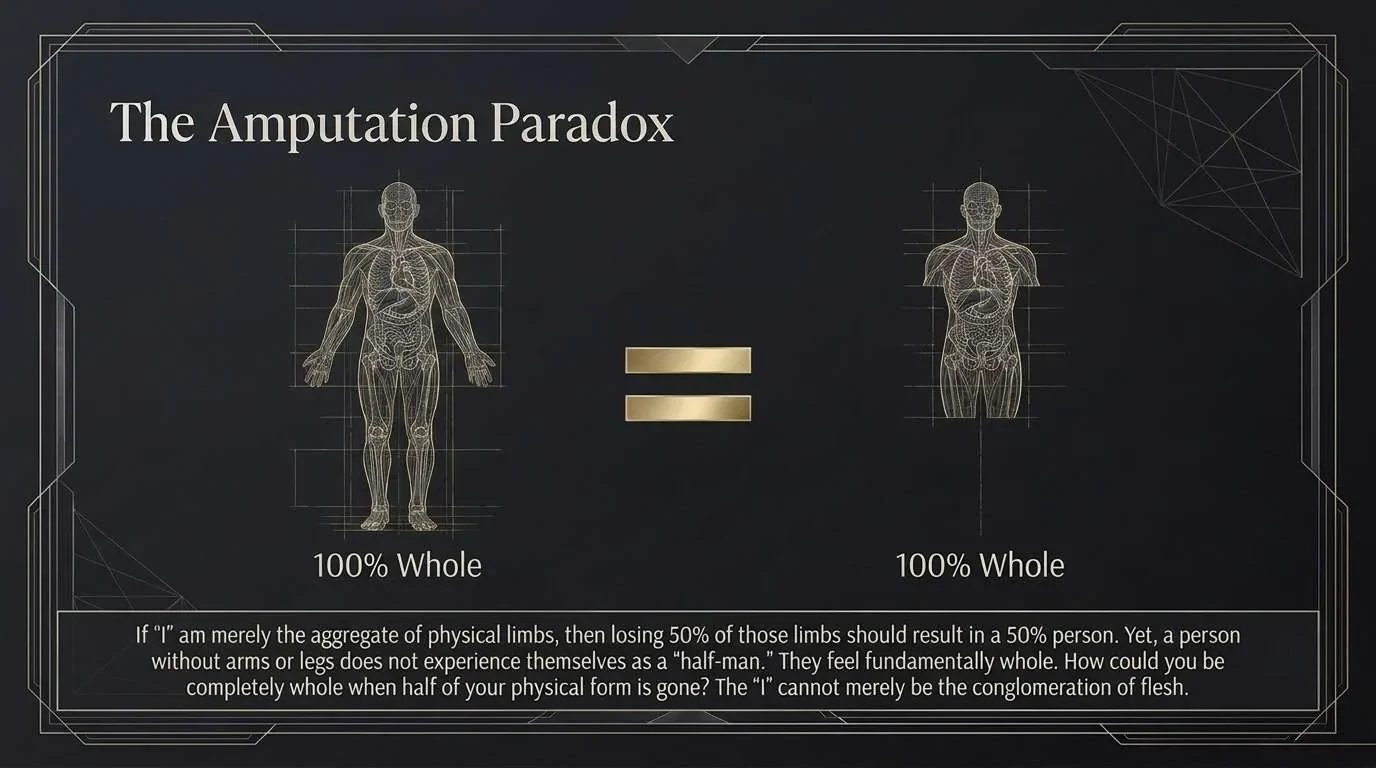
Run the arithmetic the picture runs. If “I” were the sum of limbs and organs, losing half of them would leave half a person. But someone who has lost arms or legs does not feel like a half-person, and the two figures carry the same label: 100% whole. The felt “I” is not measured in flesh. That is the Annamaya test above, run on a case anyone can check against the people they know.
Honest limit: this shows the sense of being whole is not proportional to body mass. It does not show what the “I” is. Psychology would add memory, narrative and the brain’s body map to the account.
The Vital-Energy Layer
I am not this vital energy or the doer. I am the silent consciousness that illumines it. Neti, Neti.
The Mental Layer
I am not this mind, thoughts, or emotions. I am the changeless screen on which they play. Neti, Neti.
The Intellect Layer
I am not this intellect or ego. I am the pure consciousness whose light makes it appear conscious. Neti, Neti.
The Bliss Layer
I am not this state of peace. I am the witness of this peace. Neti, Neti.
Five negations, one remainder. What's left when every object, every composite, every changing and insentient thing has been cut away isn't a sixth, subtler object — it's the un-objectifiable Subject the whole procedure was run to isolate. Not a new sheath found. The search for one, ending.
What Exactly Is Left Over
Worth being precise about what this word actually names, since “witness” has already appeared quietly, five times, in the checklist above. It doesn't mean the reflective habit of noticing your own thoughts — that habit is real, useful, and still just Buddhi, the intellect, watching Manas, the mind. Two parts of the same instrument, both already ruled out above. The Sakshin is something else: not a better observer, but the light every observer, including that reflective one, borrows to see anything at all.
Psychology notices, correctly, that self-observation changes over a lifetime — a child's isn't an adult's isn't a therapist's. It's filtered through identity-protection and old belief, and whoever's doing the noticing can't fully step outside the very consciousness being examined. That observer looks constructed, biased, and regressive: who, after all, is watching the watcher?
Every word of it is true of the reflective mind, which is exactly why it was already negated above. The Sakshin was never a more careful version of that observer. It doesn't perform an act of observing at all — it's simply what makes any observing, careful or careless, lit up in the first place.
This is also where the regress the objection worries about actually stops. Three competing answers exist for how any cognition gets known at all:
Every cognition needs a higher-order one to know it happened. Regresses infinitely — nothing could ever be known, since the chain of witnesses never terminates.
A cognition reveals itself and its object at once. Elides the witness entirely — but asks a knife to cut itself, subject and object in one same stroke.
The Witness doesn't know objects the way Buddhi does — it isn't an act at all. It simply reveals, the way a lit room needs no second lamp to confirm the first one is on. No regress, because nothing here is a cognition needing a further cognition to certify it.
The developmental observer really does change with age, training, and bias — the objection is sound, as far as it goes. It just goes exactly as far as the mind. What it can't touch is the one thing that was never a stage of anything: the light every stage, including the most reflective one yet, was already borrowing to see by.
Why “Witness” Is A Role
Why call the Self a witness at all? Because of the Upadhi+A limiting adjunct — something that appears to divide or qualify a substance without actually changing what that substance is. The pot doesn't add anything to space; it only appears to enclose some of it. it is being looked at through. Go back to the pot and the space. Space is only called “the space inside the pot” while the pot is there. The name belongs to the pot, not to space. Sakshin works the same way: consciousness gets this name only in relation to Buddhi, whose movements it lights up.
Looked at through Buddhi, consciousness is called Sakshin: the one that lights up every thought, feeling and perception.
No separate object is left to be lit up, so there is no one “lighting it up”. The role was always defined by the pair.
Pure consciousness, never made of subject or object. Nothing is added to it and nothing is lost. The role was a way of pointing at it, never a part of it.
Sakshin and Atman are not two things. Sakshin is Atman named by its role; Atman is Sakshin named by what it is.
Role And Nature
“Witness” is a relational name. It points to the Self as seen from inside the subject–object split — one consciousness, called by the role it appears to play while there is a seen.
When observer and observed resolve into one, the witness is not lost or left behind. The role dissolves back into Atman, which is pure consciousness and was never defined by subject or object to begin with. It needed no object to be itself.
Not what is left after the witness — what the witness was always pointing at.
And the sheaths, once this is seen? See The Burnt Cloth.
Where The Feeling Of “Me” Actually Comes From
The Fourfold Mind named Ahamkara as the part that stamps “me” onto experience, without explaining the mechanics of how. This is the mechanics. Sunlight falling on still water throws a second, wavering image of the sun onto the wall — not a second sun, just the one sun's light, caught and bent by a reflective surface. The Sakshin does the same thing to Buddhi, the sattva-lucid, mirror-like part of the intellect. The reflection is called Chidabhasa, and the entire felt sense of being a located, limited someone is that reflection, mistaken for the light behind it.
Sakshin: all-pervasive, non-intentional, like ambient light.
Buddhi: lucid, reflective, made of subtle sattva.
Chidabhasa: the borrowed glow, appearing as a located center.
The reflection is taken for the sun. “I am aware” becomes “I, this body-mind, am aware.”
Which is also why the mistake is so easy to make and so hard to shake by force of will alone: the reflection isn't fake light. It's real sunlight, genuinely present in the water. The only error is where the boundary of “the sun” gets drawn.
The Error Runs Both Ways
Light goes out. “My mind is sharp.” “My body is alive.” The sheaths borrow awareness and call it their own.
Weight comes back. “I am hungry.” “I am sad.” “I am getting old.” The sheaths’ states get posted onto what they never touched.
One loan out, one debt back. Which direction did you catch today?
The claim that “I am aware” and “I, this body-mind, am aware” are two different things, one borrowed from the other, has a clinical echo. What feels like one seamless sense of “mine” is at least three separable signals: that I am doing this, that I own this, that this is happening inside me. In anarchic hand syndrome, ownership and location survive while the sense of authoring the movement drops out — the hand acts, and the patient reports it as theirs but not as something they're doing. In thought insertion, a symptom of schizophrenia, even ownership can go, leaving only the sense that the thought is occurring somewhere inside — not from them, not theirs, but still there.
Stated plainly: this shows the ordinary sense of “I” is built from separable parts, which is what Chidabhasa says. It doesn't show that a Sakshin lies underneath the parts — that's this page's claim, not the clinic's.
Zooming Out
The five koshas above aren't five separate things stacked in a row. They cluster into three bodies.
The innermost. The seed-state everything else grows from.
The middle. Where thought, feeling, and energy move.
The outermost. What can be touched, weighed, seen in a mirror.
In this framework, disturbance is said to move from the inside out — a thought or a knot of feeling in the subtle body, long before anything reaches the gross body at all. By the time the body is signaling that something's wrong, the traditional view holds that the disturbance has usually been circulating for a while.
One More Image
The Upanishads draw the same map as a wheel: worlds, senses, minds, every self, all fixed in the Self like spokes in the hub of a chariot wheel. A spoke can be replaced and the wheel still turns. Without the hub there is no wheel to speak of.
Which of the things you call “me” is a spoke?
Source: Brihadaranyaka Upanishad
Where Does “Out There” Begin?
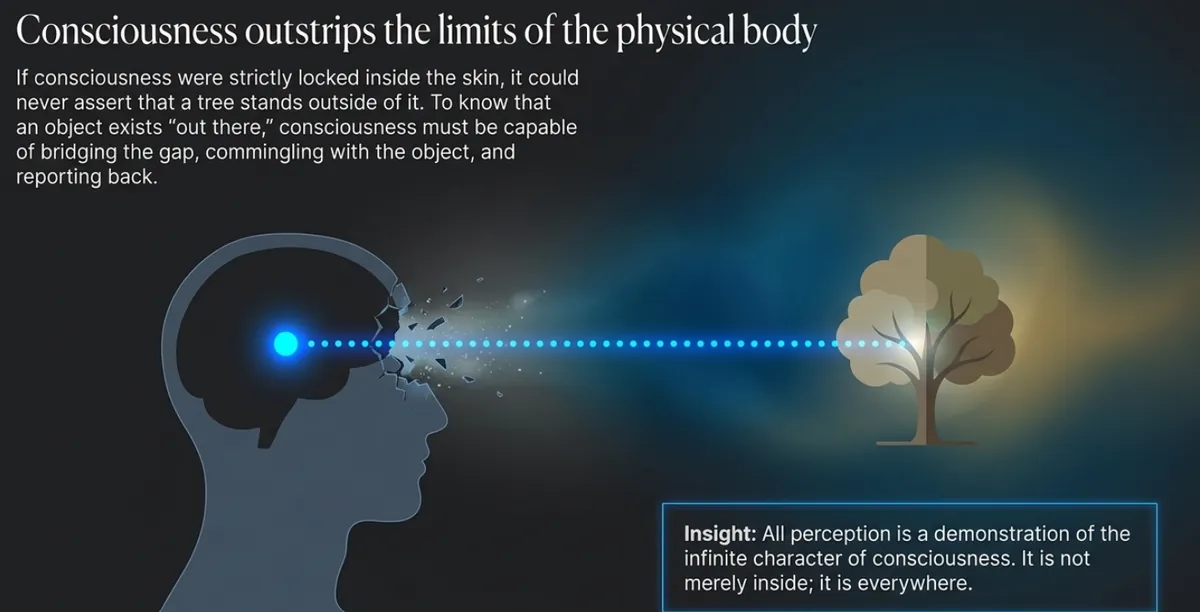
To say a tree stands outside you, something in you has to reach the tree. If knowing stayed locked behind the skin, “out there” could never be said at all. Vedanta reads perception that way: not a camera recording a room, but consciousness meeting consciousness.
At King Janaka’s court, Yajnavalkya is asked about the inner controller, the Antaryami+Sanskrit for “inner controller” — the Self dwelling within every thing, unknown to it, whose body each thing is (Brihadaranyaka 3.7).. He walks through earth, water, fire, breath, eye, mind, naming in each the one who dwells within it and is unknown to it. Every round closes the same way: this is your Self, the inner controller, the immortal. Inside and outside, on this reading, are positions the mind takes, not two places.
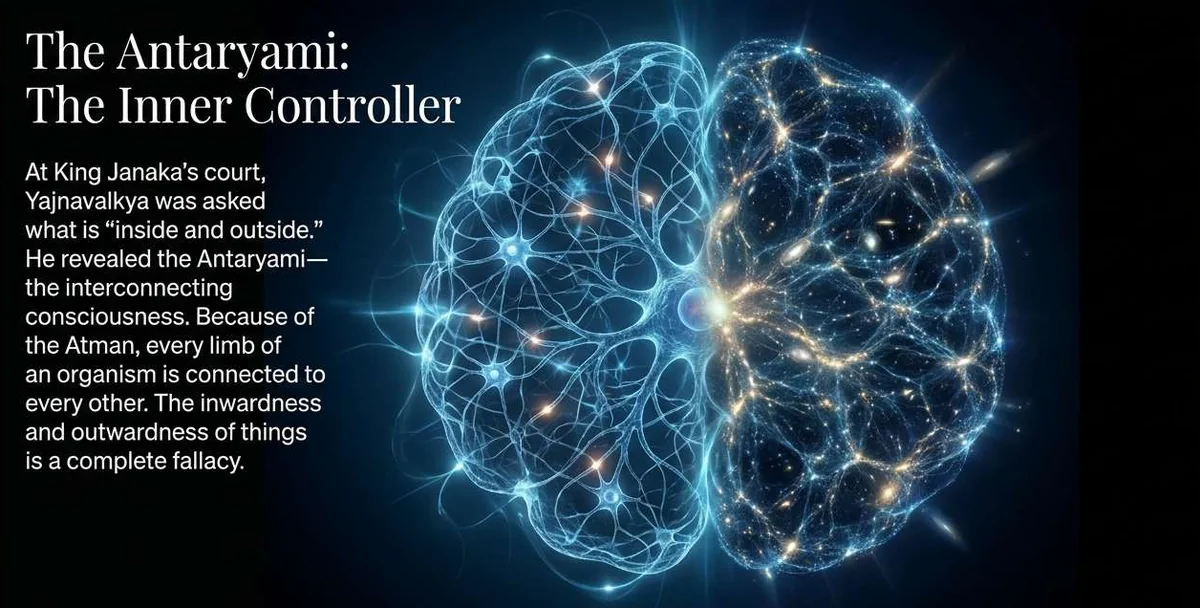
Where, in the seeing, does “inside” stop?
Source: Brihadaranyaka Upanishad 3.7
The longer version of this question, with pictures, is in Where Does “Out There” Begin? under Before the Ego, the Field.
The Equation of Instruction
At some point a teacher in this tradition says a sentence that sounds absurd on its face: “Tat Tvam Asi+Sanskrit for “That thou art” — one of the four traditional Mahavakyas, or “great sentences,” equating the individual with the absolute. Resolved not by literal reading but by the method of implied meaning. — That thou art.” Told to a king, “you are a beggar” would just be false. This isn't that kind of sentence.
Word by word: Tat — “That” + Tvam — “You,” or in the older phrasing “Thou” + Asi — “Are,” or “Art” — in plain English: “You Are That”, same sentence as the older “Thou Art That.”
‘That’ — Ishvara+Brahman viewed through the cosmic Upadhi — omniscient, omnipotent, the inferred cause, sustainer, and dissolver of the universe.
Omniscient. Omnipotent. Cause of the cosmos. Spoken of at a distance.
‘Thou’ — Jiva+Brahman viewed through an individual Upadhi — the limited, embodied sense of self that experiences itself as doer and enjoyer.
Knows little. Powerless. An effect within the cosmos. Immediate — the one reading this sentence.
Same move as the pot and the space inside it, above. Set aside what conflicts — creatorship on one side, limitation on the other — and what's left on both sides is identical.
set aside creatorship · set aside limitation · what remains is one, on both sides
One of Four
Tat Tvam Asi has three companions, one from each Veda. Four sentences, one recognition, said from four positions.
“Consciousness is Brahman.” Aitareya Upanishad, Rig Veda.
“I am Brahman.” Brihadaranyaka Upanishad, Yajur Veda.
“That thou art.” Chandogya Upanishad, Sama Veda.
“This Self is Brahman.” Mandukya Upanishad, Atharva Veda.
None of the four asks to be believed. Each is a sentence to test against whatever is reading it.
The sentence was never asking you to become something you aren't. Four syllables, pointing at what's left once both containers are set down — the same recognition the Framework’s Aham Brahmasmi arrives at from the individual's side.
The Question Vivartavada Doesn't Answer
Vivartavada, above, explains how the one appears as many without ever changing. It doesn't explain why a complete, lacking-nothing ground would bother appearing as anything at all. If God is already whole, the question isn't rhetorical — it deserves an actual answer.
The traditional answer: not lack, but generosity. A complete being doesn't create souls to fill a gap in itself — it creates them to share a bliss it already has in full, the way a parent doesn't have a child out of loneliness. And that bliss can only ever be shared, never installed, because it's inseparable from love, and love is mechanically impossible without a real choice behind it. A being incapable of choosing otherwise isn't loving — it's executing.
If God is complete, why create a world where souls suffer, forget, and grope around in the dark?
A real alternative to God has to feel genuinely attractive, or turning it down proves nothing. Maya is that alternative — convincing enough to make refusing it an actual act of love, not a formality.
Not cruelty, and not a mistake. The friction is what makes the return a real return — a story with no possible other ending isn't a story a soul can actually choose its way into.
Which is also the answer to why this page keeps saying “invitation,” never “requirement.” A requirement doesn't need Maya to test it. An invitation does — otherwise there was never anything to accept.
The Mechanism Necessity Doesn't Name
The Necessity of Maya, above, explains why a complete reality would allow something like this to operate at all. It doesn't explain how one undivided ground manages to look like a separate, crowded world — for everyone, at every single moment, without a seam showing. The tradition names two operations doing that work, always paired, never one running without the other.
Hides the ground itself. Not a distortion of what's there — a plain absence of seeing it, the way darkness doesn't disfigure a rope, it just keeps it from being seen at all.
Fills the space Avarana clears. Once the rope can't be seen as a rope, something still has to be seen — Vikshepa is what supplies the snake.
Same mechanism the rope-and-snake illustration already used without naming its two halves. Avarana is the failure to see the rope. Vikshepa is the snake that gets seen in its place. Neither runs alone — a veil with nothing projected onto it would just be blankness, and a projection with nothing veiled underneath would have nothing to disguise.
Vikshepa, Running
Vikshepa doesn't project on its own. It needs Rajas+One of the three Gunas — the quality of energy, passion, and ceaseless movement. In balance: motivation, creativity, sustained effort. Out of balance: restlessness, anxiety, and desire-driven action. The indispensable bridge between Tamas and Sattva — without Rajas, nothing moves. to power it — the guna of motion supplying the engine, Vikshepa supplying the direction. Once running, the tradition doesn't describe the output as one generic "world." It names specific pulls the projection keeps generating: wanting, aversion, acquisitiveness, self-inflation, resentment, the sense of being a separate doer, and envy of what that doer lacks. None of these are separate malfunctions to fix one by one — they're the same engine's exhaust, read seven different ways.
Bondage, in this account, isn't a sentence handed down. It's what a running engine produces by default, for as long as nothing questions who's driving it.
One Word, Three Different Jobs
“Maya” doesn't mean the same thing in every school that uses it. The word is shared; the metaphysics underneath it isn't. Everything on this page follows Advaita's account — the other two are here for contrast, not as equally-weighted alternatives.
| School | What Maya Is | Nature of the World & God |
|---|---|---|
| Advaita Vedanta | Beginningless ignorance, operating through Avarana and Vikshepa above. | Makes Brahman appear as the world. The world is real at the transactional level, not ultimately real. |
| Vishishtadvaita | The real power of Ishvara — not ignorance, a capacity. | God uses Maya to create and sustain. The universe is a real, actual manifestation, not a veil over one. |
| Dvaita | The material cause of the universe. | Created and controlled by God, but eternally distinct from God. World and souls stay separate, even at liberation. |
The dividing line running through all three: whether Maya conceals a oneness that was always the whole truth, or actually produces the manyness in the first place. Advaita alone takes the first position — which is why nothing else on this page treats the world as ultimately, rather than transactionally, real.
One more reading worth naming, outside this table because it isn't answering the same question: the Shakta tradition doesn't treat Maya as a problem to dissolve at all. It worships the same power as Mahamaya+Literally “the great Maya” — the Shakta tradition's name for Maya worshipped as the Divine Mother's living power, rather than approached as ignorance to be dissolved., the Divine Mother — the exact force that binds a soul to the material world held to be, in the same gesture, the force that liberates it. A different Shakti already has a full table on this page in the Four Powers of the Mother; Mahamaya is that same worship pointed specifically at the veiling power itself, rather than at what it goes on to build.
The Rival Cosmology, Ruled Out
Samkhya offers a real alternative to everything above: the universe evolves from Pradhana+Primordial nature — a state of perfect equilibrium of the three gunas (Sattva, Rajas, Tamas) before creation, held by Samkhya to be the insentient first cause of the universe., blind and insentient matter that simply contains the potential for everything that later evolves out of it. No consciousness required, anywhere in the chain — just latent potential, unfolding on its own.
Vedanta's reply doesn't dismiss the claim — it goes straight to the Upanishad's own wording. Before creation, the text has the First Cause declare: “Ikshata+To see, visualize, or plan — in Vedanta, the conscious act attributed to Brahman immediately before creation, used to argue the First Cause cannot be insentient matter. — it saw. I shall become many.” Seeing, in any ordinary sense of the word, is not something blind matter does. A cause capable of visualizing a plan and then executing it has already conceded the one property Samkhya's Pradhana was built to do without: consciousness.
The cosmos evolves from insentient Pradhana — potential without a planner.
The scripture's own verb is "it saw" — and seeing, planning, and designing are not things that happen without someone home to do them.
Not a leap of faith against a rival theory. A close reading of what the rival's own preferred texts actually say the First Cause did.
The doing tells you nothing. The reason tells you everything.
Two people write the same check to the same cause. One is closing a reputational gap. One doesn't remember doing it by evening. Vedanta calls the underlying fuel the guṇas+The three modes of material nature — the qualities that color every thought and action, whether or not the person acting is aware of them. — four rungs, base to apex.
Tap to expand — the four rungs, base to apex
Self-gratification at someone else's expense — the base of the ladder
Driven by self-gratification, at the expense of someone else. Corner-cutting that lands on another person, dressed up as ordinary business. Nothing subtle here — just the willingness to let someone else absorb the cost.
Legal, fair, and still for the ego — the second rung
Legal. Fair. Correctly executed. Nothing wrong on paper. The motive is prestige, ego, or accumulation — not harm to anyone, just nothing given away either. Most of what gets called "success" lives here.
Done for someone else — the third rung
Compassion, generosity, contribution as the actual motive — not the marketing around it. The action serves someone other than the one performing it, and means it.
Beyond the need to be seen as good — the apex
The action offered without a claim on the result. Not "beyond good" — beyond the need to be recognized as good. The rarest rung, and the only one with no audience built in.
You already know which rung a given action sits on — that's what the ease or discomfort around it is telling you. Take one thing you did today that you'd call good. Check it against all four rungs. Where does it actually land?
Not every “should” is the same voice. One was absorbed — from parents, culture, everyone’s expectations. Another arrives before any argument, fits one person in one situation, and no rulebook could have predicted it. Which one is asking right now?After Viktor Frankl’s account of conscience
If the gunas are running the show, doesn't that make the whole idea of karma pointless?
Fair objection. If everything were predetermined, there'd be no one left to hold responsible for anything — the Law of Karma would collapse into nonsense the moment it was stated. The resolution rests on a distinction the fatalist reading collapses into one thing: the hand you're dealt, and how you play it.
The body, the family, the raw circumstances a life opens with. Fixed — the result of past actions already in motion, no longer subject to a vote. Not a life sentence. A starting hand.
Entirely in your control, in the present moment, regardless of the hand. A skilled player wins with a weak hand. A careless one loses a strong one. Today's effort is also tomorrow's Prarabdha — the deck currently being reshuffled.
Tap to expand — the three karmas Prarabdha is only one third of
Prarabdha, above, is only one third of the full ledger. The deck metaphor holds for all three — it's just that most of the deck is sitting somewhere other than the hand currently being played.
Every card ever earned, across every hand ever played before this one. The total accumulated stock — almost all of it still sitting in the box, unripened.
Already covered above: the specific cards drawn from that deck for exactly this life. Fixed for the round — fixed, not sourceless.
Every card played right now, present tense, going straight back into the deck for some future hand. This is the “today's effort is tomorrow's Prarabdha” line above, named in full.
Only one of the three karmas is ever actually being written. The other two are either already filed, or not yet due — which is exactly why the present moment carries more weight than either the past or the future ever will.
When the Dreamer Wakes
Classical Advaita adds one claim about these three, and it changes how the ledger reads. Knowing who you are, it says, does not treat all three alike.
Actions in a dream are not paid off on waking. They simply have no one left to belong to. The vast stock goes the same way — not worked through, seen through.
The hand already dealt still gets played, until the body ends. The difference: it is played without a player who believes the cards are his.
Nothing clings to space. Action still happens through the knower, and it leaves no residue on him.
A tradition's claim, not a promise — and not a license. It describes seeing through the doer, not skipping the work of seeing. The same standing is named under Jivanmukti. For now, one question is enough: how much of what you carry today is weight for a doer you have never actually located?
Karma was never a claim that the future is written. It's a claim that the pen never leaves your hand — only the paper you were handed to write on was already chosen before you sat down.
Seven layers. Seven stages of a single life. One universal pattern.
Nature, consciousness, and human life all move through the same sequence — from the density of raw survival to the clarity of pure being.
“As above, so below.”
—The Hermetic Principle of CorrespondenceTap a stage to jump to its full breakdown
Collapsed by default — expand to see all seven stages, Red to Violet
Grounding in the body
Consciousness fully embedded in matter. You do not operate reality; reality operates on you. Dense, chaotic, and entirely focused on reacting to physical constraints just to maintain baseline existence.
Alchemy: Lead (Base Matter) · Brainwave: Delta
Life Stage: Womb & Infancy
The Vertical Leap — Somatic Grounding: anchor completely in the physical form without resisting limits or survival demands.
Meeting emotion with breath
Raw physical experience is no longer just endured — it generates an internal, subjective, volatile charge. These emotional spikes create the very first echoes of a subjective self, distinct from the world pushing against it.
Alchemy: Copper (Purification) · Brainwave: Theta
Life Stage: Childhood — First Cry / Play
The Vertical Leap — Breath Mastery: use the breath as a conscious regulator to wash away reactionary emotional spikes.
Watching the thoughts, not being them
To survive the chaos of raw emotion, the mind begins to categorize and predict. Reactions calcify into predictable, automated patterns — a rigid architecture built around the initial spark of consciousness to keep it safe.
Alchemy: Iron (Strength) · Brainwave: Alpha
Life Stage: Early Youth — Sensory / School
The Vertical Leap — Mindful Observation: step back from the mental chatter; shift from being the thoughts to watching them.
The heart as bridge
Identity is not who you truly are — it is the refined construct built from every layer of prior conditioning. It acts as a filter and a fulcrum, bridging the mechanical responses of your past with the expansive awareness of your future. The heart is the bridge from density to divinity.
Alchemy: Silver (Refinement) · Brainwave: Mu
Life Stage: Late Youth — Curiosity / Higher Learning
The Vertical Leap — Intellectual Surrender: recognize the limits of dry logic and let concepts dissolve into intuitive knowing.
Alchemical gold: self-awareness
Consciousness dis-identifies from its own patterns. You realize you are not your thoughts, emotions, or history — you are the silent entity observing identity itself. This separation is the true alchemical gold: the dawn of objective self-awareness.
Alchemy: Gold (Illumination) · Brainwave: Beta
Life Stage: Young Adulthood — First Impressions / Career
The Vertical Leap — Alchemical Refinement: strip away the personal stories attached to your past; hold your history as educational data.
Where observer and observed merge
As awareness heightens, the dualistic gap between the observer and reality collapses. The psychological friction of separation ceases, distilling consciousness into pure integration and unmediated bliss.
Alchemy: Quintessence (Spirit/Essence) · Brainwave: Gamma
Life Stage: Mature Adulthood — Ambition / Leadership
The Vertical Leap — Dissolving the Observer: merge the gap between watcher and watched; step out of individual self-importance.
The unshakeable “I Am”
Beyond patterns, beyond identity, beyond even the observer. You are no longer experiencing reality — you realize you are the ultimate reality experiencing itself. Complete ontological transmutation. The absolute “I am” phase.
Alchemy: Philosopher’s Stone (Completion) · Brainwave: Lambda
Life Stage: Elderhood & Beyond — Manifestation / Realization
The Vertical Leap — Final Realization: rest permanently in the unshakeable “I Am,” free from the illusions of time, change, and decay.
Different expressions. One enduring pattern. From physical survival to final realization, there is one map — and you are the one moving through it.
Explore deeper: the Path of Subtilization walks these seven layers as a lived journey — the Master Matrix holds the full reference for each.
If you are depressed, you are living in the past.
If you are anxious, you are living in the future.
If you are at peace, you are living in the present.
Stillness is not somewhere else. It is already here, in plain sight.
Four doorways into the Now that need no crisis and no technique to fix anything — just attention, redirected.
This is not the RRRR gap — that one interrupts a reaction after something has already triggered it. This gap is always there, whether or not anything just happened. Pay attention to it, and the formless dimension underneath ordinary thinking briefly surfaces.
The brief, silent space between one word and the next in conversation.
The space between the notes of a piano, where the music actually lives.
The gap between the in-breath and the out-breath.
Feel the energy of the body from within — not what it looks like, but the aliveness underneath fluctuating emotion and thought. The moment attention moves there, mental noise slows down, sometimes stops. Every cell is alive in that presence, underneath whatever the mind happens to be narrating.
Sound can be a doorway too — not the sound, the listening. Nada+Sanskrit for “sound” — in Nada Yoga, the inner sound that attention can follow, from coarse to subtle, until the listening itself is what remains. Yoga describes a rough ladder of what the inward ear finds when it stays long enough: the loud and coarse first, then finer and finer, until nothing is left to hold.
Thunder, ocean roar, the great kettle-drum. The loud ones arrive first.
Drum, horn, bells. The edges begin to soften.
Flute, vina, the hum of a bee. Barely sound.
The mind blends into the sound as milk into water, until the sound itself is gone. Listening remains, with nothing to listen to.
Not a technique to master. A question to sit with: in the quiet, what is the faintest sound — and who is hearing it?
Habit and intellectual efficiency exist to smother raw impression — the mind labels a tree “tree” and stops looking. Art’s whole function is to strip away the knowledge that imposes a pattern, holding attention on the ordinary until it stops resembling anything familiar at all.
Hold gaze on an ordinary object until the label falls away and only the raw shape, color, and texture remain.
Describe something familiar as if encountering it for the first time, with no prior word for what it is.
This is not decoration. It is attention deliberately doing what a child’s attention does by default.
None of these four is a technique to master. They are doors that were never locked — only unnoticed.
How to Pay Full Attention
Five concrete daily disciplines — where the doorways above ask for nothing but noticing, these ask for a little repetition.
Under all five is the same three-part motion: notice where it went, return it without penalty, hold it a little past comfortable.
Do one thing at a time. When eating, just eat. When working, just work.
Observe your thoughts instead of becoming them. Not “I am angry” but “anger is arising in me.”
Slow, even breath — inhale and exhale each lasting five to six seconds, repeated for two to five minutes. The physiology behind the number is in Pranayama, below.
Pause and ask: what am I doing right now? Why am I doing it? Is this aligned with my dharma+Right action or duty — the personal-scale expression of Rita, cosmic order, at the level of a single life.?
The RRRR Protocol in miniature: observe before speaking or reacting — replacing an automatic reaction with a conscious response.
The Fruits of Awareness
Your karma becomes better.
Your decisions become clearer.
Your relationships become better.
Your life becomes peaceful.
Interrupting the Reaction
Same gap between trigger and response, worked from two different doors. Neither is the advanced one — they're just entry points, and which one is open depends on the moment.
For when the behaviour is about to happen — revenge trading, the angry reply, reaching for the drink. Body first, understanding later.
RRRR · V1 — Stop the Impulse
Recognize → Resist → Return → Release. Full protocol →
The 3-Step Circuit Breaker
Box Breathing → Witness and Label → Detached Action. Full steps →
For when the impulse has already passed and what's left is understanding it — a difficult relationship, a pattern that keeps repeating.
RRRR · V2 — Process the Emotion
Recognize → Reflect → Reframe → Respond. Full protocol →
The Anatomy of Redirection
Trigger → Attention → The Choice → Redirection. Full walkthrough →
The Mechanics of Mantra
Replacing the loop that repeats on its own with one chosen on purpose. Full section →
The doors above are for when it is already happening, or just did. If you can see the difficult person coming — a tense meeting, a family dinner, an inbox you are dreading — name them in advance, so the rudeness lands as ordinary instead of as news. Morning Armor →
Augustine noticed an odd asymmetry in the Confessions (Book 8): the mind tells the hand to move and the hand moves, but when the mind tells itself to do something it meets resistance. The lopsidedness is the clue. If one mind were giving and taking the order, there would be nothing to argue about. When the reaction is already rising, name the two voices (the one that wants and the one that says no) and notice who is hearing both. That listener is the gap the doors above are trying to reach. The parts doing the arguing are mapped in The Fourfold Mind.
The body stops the impulse. The mind processes what caused it. Use whichever door happens to be open.
Acute Overwhelm · The STOP Sequence
Neither of the two doors above quite fits when the flood is total — not one impulse, not one emotion to unpack, just every sense firing at once. This is the door for that: four steps, run in strict order, each aimed at one layer already mapped on this site — the koshas+Kosha means “sheath.” Yoga and Vedanta describe you as layered like an onion — body, breath, mind, and deeper still — with awareness itself at the center. Each layer is a sheath you can learn to notice, and work with, one at a time., worked from the outside in.
Target: Manomaya Kosha+The “mind sheath” — the layer of thoughts, feelings, and sensory processing. When you’re overwhelmed, this is the layer that’s flooded; most people live here without noticing it’s only one layer.. Drop your gaze or let your eyes unfocus for three full seconds. Nothing more — the point is just to stop feeding the mental sheath new input for a moment, which is enough to break the loop's momentum.
Target: Pranamaya Kosha+The “breath / vital-energy sheath” — the layer of breath and life-force that animates the body. It’s the easiest layer to influence directly, because you can change your breathing on purpose.. One belly breath, exhale twice as long as the inhale — the same 1:2 ratio behind the Anchor of Breath above. The long exhale is what tells the nervous system the danger has passed.
Target: Purusha+Pure awareness — the silent witness that watches thoughts, feelings, and sensations without becoming any of them. In this sequence, it’s the “you” that can step back and simply observe.. Silently re-label what's happening in the third person — not “I am angry,” but “anger is rising, the chest is tightening.” This is the Separation Technique from Full Attention, above, aimed at a moment of overload specifically.
Same chain used elsewhere on this site: Object → Senses → Mind (the projector) → Consciousness (the Screen). Whatever's flooding in right now is the film. The mind projecting it is not you. You're the screen it's playing on — unchanged by what's showing.
None of this is willpower. It's a sequence, run in the same order, every time — the mechanics do the work the effort can't.
Emotional Self-Management (ESM)
A tapping-and-breathing sequence you can run on one specific stuck feeling at a time.
There's nothing to lose by trying it once. Rate the feeling before you start, run the sequence, rate it again. If it moved, you have your answer. If it didn’t, you also have your answer — and that's a fine outcome too.
Tap to expand — the full six-step sequence, plus the tradition's own explanation for why it's built this way
Step 1 — Rate It
Bring the specific thing to mind. On a scale of 0 (nothing there) to 10 (as bad as it gets), how strong is it right now? Hold that number — you'll compare against it at the end.
Step 2 — Balanced Breathing (~2 min)
Sitting with a straight back, cross your left ankle over your right.
Extend both arms out, cross right over left at the wrist, interlock fingers, and rotate your hands inward and up to rest on your chest.
Inhale through the nose, tongue on the roof of the mouth. Exhale through the mouth, tongue on the floor. Hold the word “balance” in mind. Continue for about two minutes.
Order can be reversed (right ankle, left wrist) — what matters is that opposite sides cross.
Step 3 — Say It
Rub the sore spot on your chest — below, roughly three inches off-center above the heart; press around gently until you find a tender point — while saying, out loud, three times: “Even though [the problem], I deeply and completely accept myself.” Then tap under the nose a few times, and under the lip a few times, saying the same line once more at each. This pass isn't about the problem yet — it's clearing the reflex to reject yourself for having it, so the next step has room to work.
Chest (the sore spot) — about three inches off-center above the heart. Rub firmly in a tight circular motion, outward and downward, roughly once a second.
Under the nose — center point between nose and upper lip. Tap firmly with one or two fingers, three to four taps a second.
Under the lip — center of the chin, just below the lower lip. Tap firmly with one or two fingers, three to four taps a second.
Back of the hand — the dip between the knuckles of the ring and pinky finger, an inch toward the wrist. Flat four-finger tap. Not used until Step 5, below — shown here for reference.
Either hand works for tapping; switch freely.
Step 4 — Name It & Tap It
Tap the same three points again — chest, under the nose, under the lip — but this time say one honest sentence about what's actually happening, not the acceptance line from Step 3. A few examples, or use your own words:
“I forgive them, because they didn’t know how to do differently.”
“I forgive myself — I couldn’t have done differently.”
“I am comfortable with myself and others. I release the past.”
The only rule: it names the real thing, not a vaguer stand-in for it. Say it three times, tapping through the three points once per repetition.
Step 5 — The Bridge
Find the back-of-hand point shown in the diagram above, and tap it continuously with your other hand through all of the following. Eyes open, then closed. Glance down-right, then down-left. Circle your eyes fully one way, then the other — head still, only the eyes moving. Hum a few notes. Count to five out loud. Hum again. Roughly thirty seconds total.
Step 6 — Repeat & Recheck
Tap through the three points once more, saying Step 4's sentence three times. Then check the number from Step 1 again. Moved down, stayed the same, or moved up — any of the three tells you something. If it's not at zero, you can simply repeat the cycle, or stop here for today.
Where the Method Comes From
Traditional Explanation
The tradition this comes from describes the body as running on an electrical polarity — top/bottom and left/right — and treats a stuck emotion as a local disruption to that polarity, with the tapping and crossed postures meant to restore it. That's the framework's own account of why it might work, not a claim this site is making. Nobody has established that literal electrical polarity is the mechanism; what's better supported is that any of several plainer things could be doing the work here — focused attention on the feeling, the rhythm of repeated touch, or simply pausing to name a feeling honestly out loud. The steps above are worth trying regardless of which explanation is right.
A Related Lens · The Open Cage of Repentance
Step 4's guilt line above — “I forgive myself, I couldn’t have done differently” — is doing more than it looks like. In Zen, repentance is pictured as a birdcage. Most people either leave the door shut, trapping the bird, or leave the cage empty, pretending nothing needs holding. The instruction is neither: paint a cage with an open door, and simply wait in it.
Not shutting yourself off from what you did. Not staying locked inside the guilt either. Just enough structure to hold the feeling honestly, with the door already open the entire time.
The forgiveness in Step 4 isn't a trick to make the feeling go away faster. It's the open door.
This is light fingertip tapping and slow breathing, not needles — there's no wrong way to do this that causes harm. The worst case is nothing changes, not that something goes wrong.
Not a treatment for trauma, phobias, or a clinical condition, and not a substitute for one — for those, see a professional. This is a self-run experiment you can try once and judge for yourself, not a claim about what it will do for you.
The 1% Method — Kaizen for the Nervous System
Not a new insight, but a way of actually keeping the ones above. A resolution usually doesn’t collapse from weak willpower — it collapses from a step sized wrong for the nervous system running it.
The amygdala hardware already covered on this site doesn’t only fire at threats — it fires at drastic change. Kaizen (改善, “good change”) is the practice of staying small enough, every time, that the alarm never trips at all.
Tap to expand — why drastic resolutions fail, and the three-step method that doesn’t
Applied Framework
Why Drastic Goals Fail
A sudden, large demand on behavior reads to the amygdala as a threat, and the fight-or-flight response it triggers crowds out the very willpower the goal needs. A step small enough to feel like it barely counts stays under that alarm threshold — and gets taken anyway.
| The Resolution Approach | The Kaizen Method | |
|---|---|---|
| Focus | The end goal, all at once | The process, one micro-step at a time |
| Timeline | Instant, or the 21-day myth | Continuous — real habit formation runs 18 to 254 days |
| Nervous system | Trips the amygdala’s alarm | Stays under the threshold entirely |
| Typical outcome | High burnout, often by mid-January | Cumulative, durable change |
The Method, In Three Steps
Rate your current satisfaction — Health, Work, Money, Home, Relationships — on a simple 1-to-10 scale, each. Pick exactly one area to start with, to avoid overwhelming the system.
Where am I now, really? Then, what would meaningfully better look like, long-term? Then, the only one that matters today — what is the smallest, least disruptive step I could take in the next 24 hours?
A grid where you colour in a box on any day the 1% step happened. Nothing else. The tracking itself — not the scale of the step — is what builds the evidence that you keep your own word.
A goal like “meditate daily” sized down to Kaizen scale might start as: sit for the exact length of one song, once, today. That is the whole target. Anything beyond it is a bonus, not a requirement.
Case in Point
In 2002, the British Cycling team had never won an Olympic gold. Rather than chase a medal directly, its coaching staff broke the entire system down — aerodynamics, diet, sleep, even how the team washed their hands — and aimed for a 1% improvement in each separate part. By the 2008 and 2012 Olympics, the same team won 7 of 10 possible gold medals. No single 1% was impressive. The aggregate was.
In Kaizen, this spreading is called Yokoten — copying what works in one area of life into the next. A 1% win in sleep tends to fund a 1% win in exercise, which tends to fund one in work. You don’t need a drastic resolution. You need your first 1%.
Answer honestly.
Tap to expand — the five pillar questions
Who am I?
Your gift, distilledDiscovering your passion, attributes, and legacy. If you had one gift of value for the world — what is it? Not your job title. Not your resume. The singular thing only you can bring.
Where am I from?
Your source & conditioningUnderstanding your spiritual source and your current baseline reality. What shaped the lens you see through? What do you carry that you didn’t choose? And what of it is actually you?
Why am I here?
Your purpose, namedDefining your innate purpose and the specific problems you are uniquely built to solve. Not what the world needs from everyone. What it needs from you specifically.
What can I do?
Your gifts, in actionActionable service. Developing the strategic route to deploy your gifts. The gap between knowing your purpose and actually serving it is practice — not revelation.
Where am I going?
Direction, not destinationDefining your ultimate destination and vision to empower your true potential. Self-realization is direction, not arrival. Are you pointed right? That is the only question that matters.
Write them down in the workbook, or return to them anytime in the Web Companion.
Looking for Ramana Maharshi’s method of tracing the “I”-thought to its source? That is Atma-Vichara.
Structured programs show genuine results in relapse prevention, stress reduction, and even changes in gray matter density.
Strip a contemplative practice of the ethical intention behind it and you risk depersonalization, surfacing old trauma, or the disorienting territory some call the Dark Night — already flagged elsewhere on this site.
Attention without the “why” behind it doesn’t become dangerous — it just shrinks. What was self-enquiry becomes a stress-reduction technique with the inquiry quietly removed. If a practice here ever surfaces something that feels bigger than technique can hold, that is the moment for a licensed professional, not a harder push through the exercise. See the disclaimer for where to go from there.
Ancient seers mapped two routes to the same center — both walked while remaining an active participant in life.
Radical intellectual inquiry. Strip away everything that is false until only what is true remains. The relentless question: “Who is aware of this thought?” For the solitary, rigorous seeker who trusts the mind to outrun itself.
Surrender precedes knowledge. Devotion over doctrine. The practitioner in the marketplace, the parent, the trader — who finds the SELF not by withdrawing from life but by offering it.
A form to worship isn't in tension with a formless goal — see why, further down.
Both paths lead to the same *SELF.
The question is only which door you are walking through.
In the Sivananda Lahiri, Adi Shankaracharya maps the melting of the individual ego through five vivid metaphors — from strenuous individual effort to effortless, absolute wholeness.
Tap to expand — the five stages of surrender
The seeker must take the difficult first step. This represents conscious, individual effort toward the divine — the hardest stage, because it happens entirely by your own will.
The universe meets you halfway. The rigid ego begins to soften. Synchronicities appear. What felt like effort begins to feel like a current you are floating in.
A true partnership where individuality melts into a shared purpose. The material and the ultimate are no longer in conflict. This is the stage of the active participant in the world.
The seeker realizes they cannot exist independently of the universal support structure. Deep trust replaces anxiety.
The river pours into the ocean, permanently losing its individual name and form. The restlessness of the mind ceases completely. There are no longer choices — only flow.
You do not need a saviour to walk this path.
The path does not begin when someone rescues you. It begins the moment you stop waiting for rescue.
Across traditions, the instruction is similar: the inner voice has always known the way.
Buddha’s Final Teaching
“Be a lamp unto yourself, be a refuge to yourself. Take yourself to no external refuge”
These were the Buddha’s final words. Not a doctrine. Not a deity. A direction: look inward.
In 1902, a young seeker climbed Arunachala+The sacred hill in Tiruvannamalai, South India, where Ramana Maharshi lived from age sixteen until his death in 1950 — revered in the tradition as Shiva himself in the form of a mountain. to ask Ramana Maharshi+1879–1950. A South Indian sage who taught almost entirely through silence and through one recurring instruction — trace the “I”-thought back to its source. His recorded answers to a disciple's questions were later published as Nan Yār? (“Who am I?”). fourteen questions about the nature of the mind. The answers, later published as Nan Yār?, don't add a new philosophy to what's already on this site — they give the Jnana path above an actual set of hands and feet.
Tap to expand — six cards, from the geography of the “I”-thought to non-attachment and surrender
Where the “I”-thought is born, and the two directions it can travel
Ramana located the rising point of the “I”-thought at the Heart+Not the physical organ, and not a chakra in the usual sense — Hridayam, the spiritual heart-center on the right side of the chest, described as the seat from which the “I”-thought first rises and to which it can be traced back. — not the brain. From there, consciousness runs in exactly one of two directions.
The “I”-thought runs out through the brain and sense organs and lands on gross names and forms. Result: the mind goes out, the world appears, the Self is obscured.
The same thought is restrained at its point of origin instead of chased outward. Result: names and forms disappear, the mind ends, and the Self is left standing as the residue.
What “asking Who am I?” actually consists of, step by step
Any thought at all. It makes no difference how many arise, or how urgent each one feels.
The thought is not argued with, elaborated, or acted on. It is simply not followed downstream.
Instead of following the thought's content, the question turns back onto the one experiencing it.
Every single thought, traced back, resolves to the same claimant. There is no thought without an “I” underneath it.
Not answered conceptually. Held as a question with nothing to elaborate and nowhere else to go.
The thought becomes quiescent. Repeated, this is the entire method — not one insight, but a return practiced every time a thought pulls outward.
“The thought ‘Who am I?’ destroys all other thoughts, and like the stick used for stirring a burning pyre, it will itself in the end get destroyed.”
Manonasa+Sanskrit for the destruction of the mind at its root — what Self-Enquiry aims at, as distinct from Manonigraha. vs. Manonigraha+Sanskrit for the temporary suppression or stilling of the mind — what breath-control, mantra, and other auxiliary aids achieve, without touching the root.
| Mechanism | Technical Result | Permanence | |
|---|---|---|---|
| Self-Enquiry | Cuts the root — the “I”-thought — from which all else originates. | Manonasa: destruction of the mind. | Permanent. The mind is destroyed at the source. |
| Auxiliary Aids | Breath-control, mantra, form meditation, restrictive diet — occupies the wandering mind with a single point. | Manonigraha: the mind rendered quiescent, temporarily. | Temporary. Once the aid stops, residual impressions send the mind wandering again. |
Two questions the method raises about who does the work
God and the Guru are not different — both show the way, but neither carries the seeker there. “Just as the prey which has fallen into the jaws of a tiger has no escape, so those who have come within the ambit of the Guru's gracious look will be saved — yet each one should by his own effort pursue the path.”
One can know oneself only with one's own eye of knowledge, not with somebody else's. “Does he who is Rama require the help of a mirror to know that he is Rama?” Books and textual analysis are ultimately futile — the Self is within the five sheaths; books are outside them.
Work and the sense of doing it are not the same thing
Two days. Same hours, same task list. One leaves you emptied. The other leaves you quiet. The workload did not change. Something else did.
Act as if all of it is yours to maintain. Full effort. No hiding behind “not my job.”
Hold that the doing is not only yours. Outcomes were never in your hands to carry.
Held apart, each one breaks. Responsibility alone becomes a weight. Surrender alone becomes an excuse. Held together, work has somewhere to rest.
Look at the last thing that drained you.
Was it the work? Or was it “I have to make this turn out right”?
Find the “I” in the sentence. Notice what it costs to carry.
The two metaphors Ramana returned to most
Two images Ramana returned to again and again when asked what surrender actually feels like from the inside — one about carrying weight you no longer need to carry, the other about what it takes to reach something worth having.
“We know the train carries all loads. After getting on it, why should we carry our small luggage on our head to our discomfort, instead of putting it down? God's supreme power makes all things move. Surrender means remaining constantly in the Self without worrying about what should or should not be done. He bears the burdens.”
“Just as the pearl-diver ties a stone to his waist, sinks to the bottom of the sea, and takes the pearls, so each of us should be endowed with non-attachment, dive within, and obtain the Self-pearl.”
Somewhere between the 8th and 14th centuries, an anonymous author took Shankaracharya's non-dualism and stripped it of every remaining trace of doctrine, deity, and gradual path. The result, the Ashtavakra Gita+A dialogue between the sage Ashtavakra and King Janaka, of uncertain date (roughly 8th–14th century C.E.), considered one of the most radical statements of Advaita — it offers no ritual, no deity, and no gradual path, only direct pointing., doesn't argue for non-dualism the way the Brahma-Sutra-Bhasya does above. It simply talks as though the reader is already free, and waits to see what that does.
Tap to expand — four cards, from the myth of Ashtavakra to the clear space the five renunciations lead to
“Crooked in eight ways” — why the teacher who erased the self was born deformed
While still in the womb, Ashtavakra corrected his father Kahoda's recitation of the Vedas. Cursed by his insulted father, he was born with deformed limbs — “eight twists.” At age twelve, he traveled to King Janaka's court, defeated the scholar Bandin in debate, and proved the absolute oneness of God.
“The body is nothing, the Self is everything. Even the ugliest form is filled with God's radiance.”
The physical vessel is the illusion the text spends its length dismantling. A visibly broken teacher, delivering a gospel of absolute self-effacement, is the point — not an irony to explain away.
Why striving for God and striving to look spiritual are not the same striving
“Striving is the root of sorrow.” The fool presumed to be a seeker practices strenuous indolence — running around puffing himself up looking for God, busily making excuses for not finding himself. Bound by the habit of meditation.
“Who is lazier? He has trouble even blinking!” A child, a fool, a man asleep, a leaf tumbling in the wind. He sleeps soundly without sleeping. He is busy but does nothing. Unsmudged by right or wrong.
We are already perfect. But dealing with our ignorance requires Sadhana+Spiritual practice, or effort — here, not the building of a new self, but the systematic abandonment of strenuous self-estrangement. — not to build a new self, but to systematically abandon our strenuous self-estrangement.
The text's own path, ending by renouncing the path itself
The starting renunciation, and the easiest one to state without yet meaning it.
Not sensory deprivation — refusing to let the senses' pull count as evidence of who you are.
The mind keeps changing its verdict. Ceasing to treat its latest verdict as you is the third renunciation.
Even the discipline that got you this far becomes something to release — a raft, not a residence.
The final turn: non-attachment itself, held as an achievement or identity, is one more thing to be free of. Nothing left to renounce, because there's no longer anyone renouncing.
“Let yourself dissolve. You are pure.”
What's left once all five renunciations are actually complete
Not a state reached after the fifth renunciation, but what was already the case underneath all five — described here in the text's own words rather than explained around.
It is easy.
You are the clear space of awareness,
pure and still,
in whom there is no birth,
no striving,
no “I.”
The Text's Own Final Gesture
“Who is the seeker? What has he found? Who is the disciple, and who the master? For I have no bounds. I am Shiva. Nothing arises in me. In whom nothing is single, nothing is double. Nothing is, nothing is not. What more is there to say?”
With its last gesture of self-erasure, the anonymous master dissolves even the voice of spiritual inquiry that carried the whole text this far — including, by the end, itself.
Traditional Source — Patanjali’s Yoga Sutras, Book IV, and the Kaivalya Upanishad.
The Dual Purpose lays out the arc: experience first, liberation second. It stops at the door. Patanjali doesn’t. His last chapter is named for what comes after: Kaivalya+Literally “aloneness” — in the Yoga Sutras, the state in which consciousness stands in its own nature and the field no longer has work to do for it. Not loneliness: nothing is missing, so nothing is sought from another..
Tap to expand — four cards: how the ripening ends, what remains once the seer is free, why “alone” is not lonely, and the two ways liberation lands
How the last chapter gets from effort to rest, in six movements
Sutra IV.34, below, says the Gunas fold back into their source. These earlier sutras say why they can. The order here follows the commentarial reading of the chapter as one arc; the sutras themselves are terse and do not number their own steps.
Virtue stops being something done and becomes the only thing present. The commentary’s image is goodness raining down like nectar, because divinity shows itself in full. The negative is not fought off; it is absorbed into the positive.
The five afflictions+The five Klesas — ignorance, ego, attachment, aversion and fear of death. The root pattern that keeps karma running. and the karma they drive end at the same moment, not one after the other. Karma is how the Gunas bind an individual, so when it goes, the binding goes with it. The image: the sun appearing in a clear sky after a heavy downpour.
Tamas obstructs with torpor and sleep. Rajas is subtler and keeps the mind oscillating. Sattva is last: a golden chain, a clean pane of glass that reflects Truth perfectly and is still a barrier to union. A layer can be fine and still be a layer.
Two things lift. The veil is Avidya, the ignorance covering consciousness. The dirt+Mala — the specific impurities of desire, anger and greed, as distinct from the veil of ignorance that covers consciousness. is desire, anger and greed. Once the heavy obstructions are cleared, the last movement is so fast that the stages cannot be tracked as they pass.
Ordinary knowledge is informative: a knower here, an object there, and the bigger the object, the less room is left in the knower. Intuitive knowledge enters the object instead of looking at it. When knowledge is infinite the knowable becomes little — not because the world vanishes, but because there is no room outside the knower for an extra object to stand in.
The succession of change ends. The Gunas existed to give experience, a training ground for the spirit. Once the spirit is trained, the nucleus of desire is gone and matter stops gravitating toward form. They are Kritartha+Literally “one whose purpose is done” — said of the Gunas once they have finished giving the spirit its training in experience (Sutra IV.32). — purpose fulfilled. Pull out every brick and the building ceases to be: nothing is attacked, the parts simply disperse.
Samapatti+Sutra I.41 — the mutual commingling of knower, knowing and known, so that the three no longer stand apart. (I.41) describes the same collapse from an earlier rung: knower, knowing and known commingle until knowledge is the only reality left. Here at the end the three have nothing left to stand apart in.
“Liberation is not acquiring new territory. It is dissipated energies coming home.”
The commentary’s metaphor for why this feels like return, not gain: facing outward at sense objects is a war that bankrupts the spiritual economy, restlessness is the energetic immune system fighting off attachment like a fever, and liberation is the prodigal energies going back to the source.
Honest limit: this is one commentary’s reading of the sutras as a sequence. The text does not promise anyone will feel it in this order.
Source: Patanjali, Yoga Sutras I.41, IV.29–IV.32.
The Gunas fold back, and the world carries on for everyone else
Sutra IV.34. The Gunas, with no purpose left to serve for the seer, fold back into their source. Consciousness abides in its own nature. Nothing is destroyed. The field is no longer being asked to work. The mirror has served its purpose. Sutra I.3 says the same from the other side: then the seer rests in its own nature.
Sutra II.22. For the one whose purpose is fulfilled, the world has ceased. For everyone else it has not, because it is shared. Liberation is not the deletion of the universe. It is one seer no longer needing it.
Stated plainly: two sutras, one point. The world’s work for this seer is done. Neither sutra says the world is unreal, and neither adds anything further to reach.
Not a claim to accept. A place to look. What is the world still being asked to do for you?
Source: Patanjali, Yoga Sutras I.3, II.22, IV.34.
What kevala does and doesn’t mean
The word Kevala+“Alone, sole, unmixed” — the root of Kaivalya. It means wholeness with nothing added, not isolation with something missing. is easy to hear as isolation. Set the two side by side and they come apart.
Physical isolation, and the felt gap where an “other” should be. Rooted in lack, limitation and the ego. It is aloneness with something missing.
Utterly solitary, yet completely whole. No trace of a need for another to fulfil you. Individual consciousness expands to contain the whole cosmos, so there is no outside left to be cut off from.
Hold it against the Origin of Desire card in The Great Forest of Being: the Original Being, alone, felt no joy and made itself two. That is aloneness with a lack in it. Kaivalya is the same word with nothing missing.
One care is needed. Patanjali’s Yoga is dualist: Kaivalya there is the seer standing apart from the field. The Kaivalya Upanishad is non-dual: the Self with no second. The two schools do not mean quite the same thing by “alone”. What they share is the relief at the end of it, nothing further needed from outside.
Source: Kaivalya Upanishad (Krishna Yajurveda); Patanjali, Yoga Sutras IV.34.
Within a life, and after it
The Upanishad counts Kaivalya the highest form of Moksha because it covers both standings.
Freedom in this life, in a living body. This is what IV. Phala means by liberation lived out, not merely believed.
Freedom that remains once there is no body left to live it in. Nothing is lost at that point, because nothing was being held.
The Upanishad’s own voice for the standing: smaller than the smallest and larger than the largest, with everything arising from, resting in and dissolving into the Self. Enjoyer, enjoyed and enjoyment collapse into a witness that is already complete.
Source: Kaivalya Upanishad (Krishna Yajurveda).
The Burnt Cloth
A burnt cloth keeps its shape. It holds nothing.
The tradition says the five sheaths may still appear to one who has seen through them. They keep their perceptibility and lose their substantiality. They are still seen, but there is nothing in them to be taken as the Self. The appearance stays and the substance doesn’t.
Why nothing is left in them: the sheaths were never what the Self was. Taking them as the Self was Adhyasa+Superimposition — mistaking the attributes of one thing for those of another, the way dim light lets a rope be mistaken for a snake. Here, the attributes of a limited body-mind get superimposed onto the limitless Self., and seeing through it is the burning. What is burnt is the claim, not the cloth.
Source: Swami Krishnananda, The Philosophy of Life.
Vedic cosmology and Zen mindfulness both begin by naming the same ache — birth, aging, and death as friction no one asked for. They part ways completely on where the exit is.
Tap to expand — three cards, the cosmic journey compared with the internal journey, the present moment, and patience
The comparison table and the two-directions summary
| The Cosmic Journey (Vedic) | The Internal Journey (Zen) | |
|---|---|---|
| The Core Problem | The biological cycle of birth, aging, disease, and death. | Mindless wandering, anxiety, and disconnection from reality. |
| Nature of Reality | A temporary, destructive material world set against an eternal spiritual sky. | The singular, encompassing reality of the Present Moment. |
| Ultimate Destination | Vaikuntha — a transcendental location beyond the material sky. | “Here” — an immanent state of being, not a place at all. |
| Role of the Body | A temporary overcoat, ultimately discarded. | The essential anchor required to touch the present. |
| Primary Vehicle | Bhakti-yoga — devotional focus of the mind. | Mindfulness — breath and conscious awareness. |
⟳ Tip: turn your phone to landscape for a wider view of this table
One path travels outward — across dimensions, toward a sky beyond birth and death.
The other travels inward — zero distance, toward the exact coordinates of here.
Opposite directions. Same instrument.
Not breath. Not distance. Not ritual. Concentrated awareness — aimed far, or aimed close. The rocket is useless either way. The mind was always the ship.
Zen's own account of the Internal Journey row above — not a mood, a specific claim about time
The ordinary picture of time is a single heavy line, the past pushing into the future through a thin seam called “now.” Dainin Katagiri+A 20th-century Zen teacher who brought Soto Zen practice to the American Midwest, known for grounding abstract teaching in the texture of ordinary daily life., working from older Zen sources, describes something else: a single moment already contains 65 ksanas+Sanskrit/Pali for “instant” — the shortest conceivable unit of time in classical Buddhist thought, used here to argue that a moment isn't a slice of a line but a complete, self-contained event. — instants, each one complete in itself, each one already finished before the next arises. Not a bridge between what came before and what comes after. A sealed bubble, with nothing to hold onto and nothing that needs to be let go of.
Read this instant as evidence for a story about yesterday, or a rehearsal for tomorrow.
This instant was never carrying that weight. It arose, complete, and is already gone.
A cheap plastic bowl never breaks — and no one cherishes it. A fragile china bowl gets held carefully, admired, kept for years, precisely because it exists in a dangerous situation, always fading. Life and death are the same — “just going, just coming.” Nothing here escapes that danger. The instruction isn't to escape it either: it's to take the best possible care of what's fragile, right in the middle of its fading, and let it bloom anyway.
“And what is it, the heart? It is the sound of the pine breeze there in the sumi painting.” — Ikkyū Zenji
Mind is not a frantic machine chasing the next instant. It's the rhythm underneath this one — already complete, the way a breeze is already whole inside a painting that isn't moving at all.
Nothing here is new. Everything is coming back around
Impermanence says things end. Recycling says something more useful: they return in another form. The water in your glass has been rain, river, cloud, and ocean. The situation you are impatient with has been many situations. It will be more.
Patience. Accept this moment fully. Nothing in it is final or new.
Dynamism. Your time in this form is short. Move as if it is.
Patience without dynamism is sleep. Dynamism without patience is panic. The pair is the point.
What are you hurrying that will come around again anyway?And what are you postponing that will not?
42SELF Interpretation — our own synthesis of Western psychotherapy and Eastern practice, not a claim either field makes on its own.
Western psychotherapy and Eastern wisdom traditions are not opposites. They are complements. But to integrate them, you must first understand what each got right — and what each missed.
Tap to expand — East meets West, in four steps
Step 1 — The Two Hemispheres
The Head
Extroverted and materially developed. Gives us vocabulary to name our suffering, understand our patterns, and build cognitive insight. Maps the cause.
Strength: Psychology · Clarity
Gap: Ignores the Spirit
The Heart
Introverted and spiritually developed. Holds the mind as an ecology, not a mechanism. Suffering is a vital message. Completely absorbed in inner depths — often failing to develop external potential.
Strength: Spirituality · Spaciousness
Gap: Fails external development
Two isolated pillars cannot merge at the base — they must be joined by a roof that spans the divide.
Step 2 — The Western Conflation, Resolved
Biological and physical. Governed by laws of time, space, and causation. Like a pot — a fixed container that stays largely the same. The outer crust.
The inner instrument (antahkarana+Literally “the inner instrument” — the collective term in Vedanta for mind, intellect, memory-store, and ego-sense together: the machinery through which consciousness processes experience.). A finer body, constantly changing. Like water in the pot — it changes shape, absorbs new properties, and dictates what the vessel actually holds.
The Atman+The individual self, in Advaita Vedanta — held as identical to, not separate from, universal consciousness. — the True Self. Ever free, infinite, eternal, and unchanging. The Sun, not the Moon. The Mind has no light of its own; it shines only with the borrowed radiance of Consciousness.
The West confuses the pot with what is put into it. Until the absolute distinction between Brain, Mind, and Consciousness is clear — no true integration is possible.
Step 3 — The Trinity Synthesis
East and West cannot simply meet in the middle. The gap cannot be crossed on the level of mind alone.
The vessel, the external environment.
The reflector, inner reflectiveness.
Only when body and mind are in balance can a relationship with the Soul be forged. The meeting point is not in the middle ground — it is formed above it.
The Trinity above is the map. Here is what it looks like the moment a wave of feeling actually rises.
The wave rises and is immediately read as a story — what it means, who caused it, what it says about you. The story keeps the wave in circulation. It returns later, unchanged.
The wave rises and is met as sensation, before the story forms. Nothing needs to be fixed or explained. It moves through, and finishes.
The difference isn’t which side is stronger, mind or soul. It’s whether the wave is met by something steady enough to hold it while it moves. Two things tend to make that possible: a ritual — the same small form, repeated, so feeling has somewhere expected to go — and enough time away from the clock’s pace for it to actually finish.
Symptoms are often a healthy response to an unhealthy environment.
"It is never about resolution. It is more about spaciousness. How expansive can I become? Become immense."
— James Hillman
The universe doesn’t contain Consciousness.
Consciousness contains the universe.
*SELF is the practice of knowing that from the inside.
“We have exchanged a cosmology of connection for an ideology of separation. We have demarcated ourselves from the world. The human and the sacred has been forgotten.”
— Francis WellerThe chain through which all experience arrives — and the single shift that changes everything.
Realization is the process of recognizing that you are the Screen — not the movie being projected upon it.
The world, your thoughts, and your emotions are the film. The screen remains unchanged by whatever plays upon it. You are that unchanging screen.
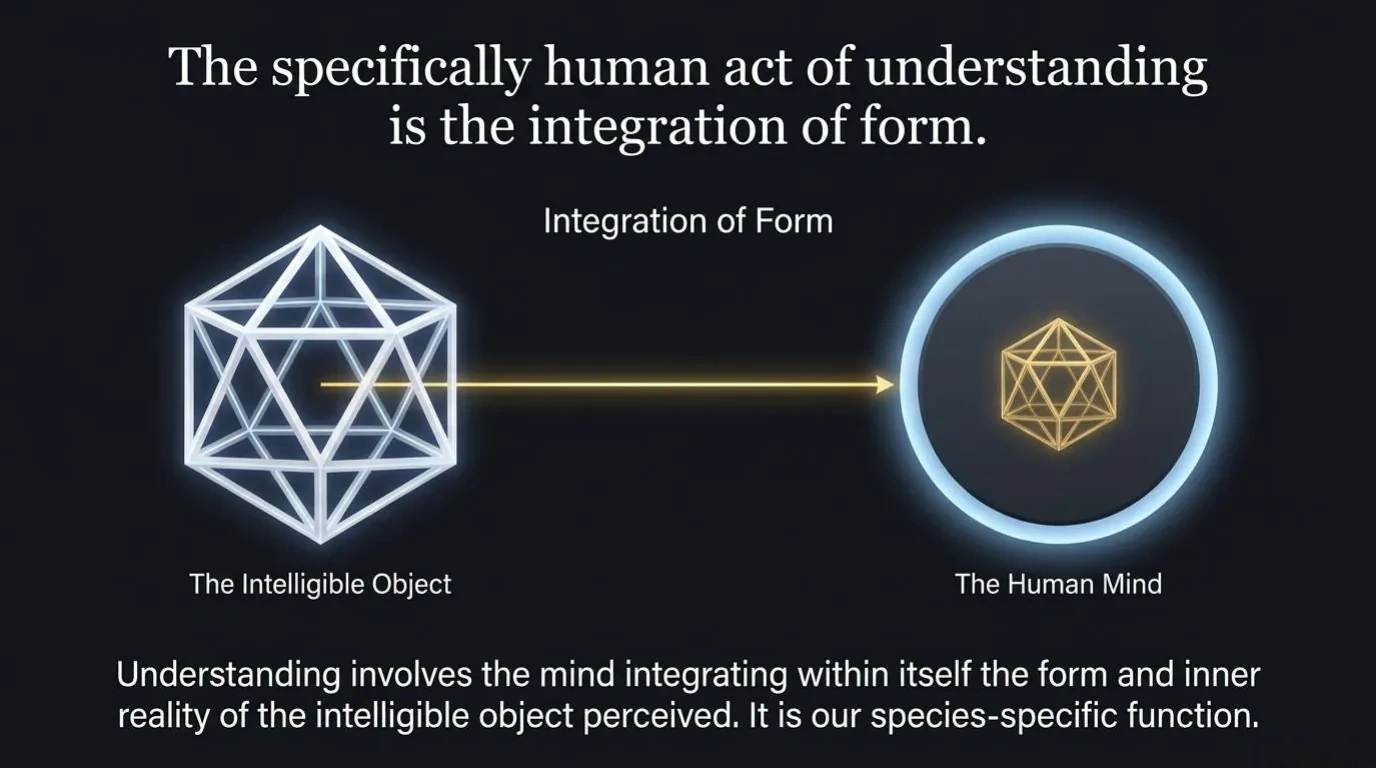
Between Object and Consciousness, the mind does one thing: it takes the shape of what it meets. The tradition calls that shaped mind a Vritti+A fluctuation or wave of the mind-stuff (Chitta) — stirred up by the senses, rippling across an otherwise still lake of awareness.. Aristotle described understanding almost the same way, as the mind taking in the form of the thing known. While the mind is shaped like the cup, the cup is all that shows. The one who knows the shape is not in the shape.
Right now, what shape is the mind wearing? And who is noticing?
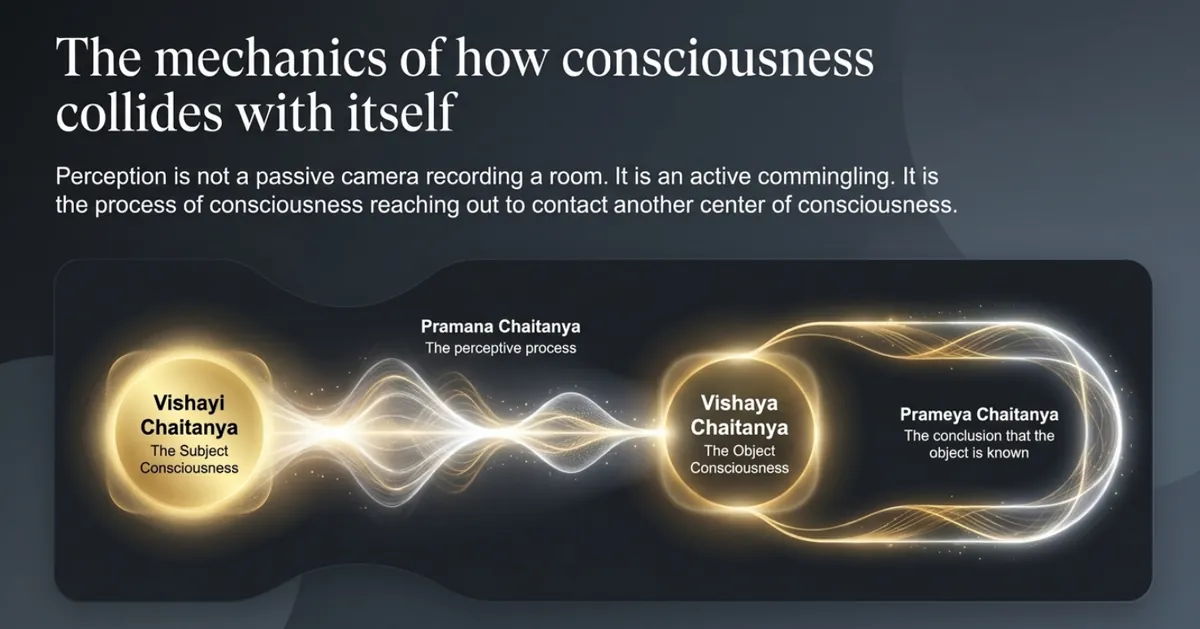
Most days, you feel like a small actor on a very large stage.
Nartaka atma. Rango’ntaratma.+A Shiva Sutra: the Self is the dancer, the inner Self is the stage — reversing the usual sense of scale. The world doesn't contain you; you contain the stage it plays out on. The Self is the dancer. The inner Self is the stage.
The stage isn't out there and you a tiny figure on it. The stage is inside the dancer. You are bigger than the world you're experiencing — not smaller than it, the way it usually feels.
Anger, romantic love, jealousy, fear — the dancer expressing one flavor of the play after another. Each one arises, performs, vanishes. The stage they perform on never moves.
The dancer remains untouched by any single dance.
| Indirect Contact(Normal Mind) | Intimate Contact(Subliminal) | Direct Contact(Subliminal) | By Identity(Supermind) | |
|---|---|---|---|---|
| Instrument | Senses & Reason | Inner Awareness | Telepathy & Inner Touch | Inherent Oneness |
| Relation to Object | External & Separative | Unmediated Inner Knowing | Touching but “Other” | Being the Object |
| Result | Error & Falsehood | Personal Truth | Partial Truth | Complete, Indivisible Truth |
⟳ Tip: turn your phone to landscape for a wider view of this table
continue“Who looks outside, dreams; who looks inside, awakes.”
— Carl JungNeuroscience was never the enemy of the soul. It only ever described the stage. It was never in a position to describe the play.
Matter need not be the opposite of spirit. It can be the dimension spirit appears through.
Tap to expand — mind vs. brain, explained
Mind ≠ Brain
Mind ÷ Brain = Spirit ÷ Matter
The physical brain processes the words in one hemisphere and the music in the other. It is the stage the play happens on — nothing more, nothing less.
The mind is the pure self watching the play through both hemispheres at once — the eternal consciousness actually interpreting what the stage is doing.
The Epistemology of Depth — You Can Know More Than You Can Tell
Language and facts. Which brain region lit up. The plain sequence of what happened, in order.
The relationship underneath the facts. The tension between essences. The way you indwell the particulars of your own life — none of which fits cleanly into a sentence.
Science measures the stage brilliantly. It was never built to notice it's also standing on one.
Put a hand in warm water. Something happens — a felt warmth, immediate, no translation required. Build a thermometer, and the warmth becomes a number. Write the physics, and the number becomes an equation for the average motion of atoms. Each step is real. Each step is also a step away from the hand in the water. Philosopher Edmund Husserl called this the trick of quiet swapping+Husserl's term: covertly replacing the concrete, felt world with the abstract mathematical model built to describe it — then forgetting the swap happened. — the equation gets treated as more real than the hand, when the equation was built from the hand in the first place.
Numbers, equations, models. Built to predict. Extremely good at it.
The hand in the water. What the map was drawn from, and can never replace.
Philosopher Alfred North Whitehead had a name for what happens when the map wins the argument: the fallacy of misplaced concreteness+Whitehead's term for mistaking an abstraction for the concrete thing it was abstracted from.. There is no hierarchy here to reverse. The felt world is not a shadow cast by the equation. The equation is a shadow cast by the felt world.
One more thing worth sitting with: no instrument, however precise, has ever taken anyone outside their own experience. A telescope enlarges what can be seen. It does not exit seeing. Philosopher Henri Bergson pointed at the same gap from a different angle — clock time and lived time are not the same thing, and only one of them can be found on a clock. Direct experience isn't a primitive stage science outgrows on the way to objectivity. It's the ground every measurement is still standing on when it's taken.
The equation didn't lie. It just never claimed to be the water.
Why a method built for objects struggles with the one thing that isn't one.
Science's method is linear on purpose: stand outside the thing you're studying, so your position doesn't contaminate the measurement. It works because there's an outside to stand on. A chemist isn't made of the reaction.
Consciousness doesn't offer that outside. The inquirer is made of the very thing being inquired into. There's no vantage point off to the side from which to observe awareness without using awareness to do it. That's not a defect in the method — it's a fact about the object. A method built for objects with an outside will keep looking for one here and keep not finding it.
Philosophy's usual response to this kind of problem isn't a worse version of the scientific method. It's a different one: turn the inquiry back on itself, the way Neti Neti does, or the way the witness argument on this page does. Call the shape of that a loop rather than a line if it helps — not because the universe is shaped like anything in particular, but because the method has to fold back on the inquirer instead of running away from them.
Stated plainly: this page's own account of how anything began doesn't reach for nothing, either. The Binary Pulse below already names the zero as an unmanifest void, not an absence — something already there, prior to any shape, out of which shape comes. That's a place-to-look claim, not a cosmological one: it says nothing about what physics finds at the start of the universe.
A brain scan can show you which hemisphere is working. It was never going to be the kind of instrument that could show you what the work means. That second question was never biology’s to answer — it was always yours.
Most people use these two words as if they were the same thing. They are not — and the gap between them is where the entire Default OS either keeps running unseen, or finally gets caught in the act.
Consciousness is the whole field — every thought, sensation, memory, and impulse that ever arises, whether you notice it or not. It is always on. It is the screen nothing can appear outside of. Awareness is narrower and sharper: it is the flashlight, the instant you catch a specific thought, feeling, or reaction as it happens instead of being run by it. You can be fully conscious and still spend an entire day on autopilot. Awareness is what interrupts the loop.
In the beginning there was only the Self. Nothing else whatsoever winked.
Aitareya Upanishad
Conscious ≠ Aware
Being awake is not the same as being present.
The entire capacity to perceive, think, and feel. It holds everything — including the parts of you currently running on autopilot. Broad, constant, mostly unmonitored.
The specific act of catching what is happening right now — “I am tense,” “I am defending,” “I am scrolling to avoid something.” Narrow, deliberate, trainable.
Tap to expand — twelve cards, in three groups: the witness, the four states, and what it's worth
The Witness
Sakshi Bhava, the argument for why a witness has to exist at all, and where “out there” begins
Two structural arguments, one claim — a river's motion, and the eye's own blind spot
There's a reason the flashlight card above can even be drawn: change can only be measured against something that doesn't change. A river tells you it's moving because the bank stays still. Try to clock the bank's motion using the river, and there's nothing to measure against — just more motion. Thoughts, moods, and circumstances are the river. The fact that you can notice any of them shifting is proof something in you isn't shifting with them.
The eye makes the same point in tissue. Where the optic nerve exits the retina, there are no photoreceptors — that patch of the visual field is physically incapable of registering light. You have never once seen a hole there, not because the gap is small, but because the very bundle of fiber carrying sight out of the eye sits in the one place sight cannot reach.
Two domains, one structure: whatever is doing the perceiving cannot appear inside what it perceives. That's not a metaphor for the witness — it's the argument for why one has to exist, before the tradition ever puts a name to it.
The same argument, four thousand years earlier — asked as a question, never closed with an answer
The Kena Upanishad+One of the oldest Upanishads, named for its opening word “Kena” — “by whom.” It opens with a student's question rather than a teacher's answer. opens with a question, not a claim: by whom willed and directed does the mind alight? What Spirit indeed directs the eye and the ear? Not rhetorical — it's asking what's actually running the equipment.
Can be lost. Hearing itself doesn't go with it.
Can rupture. The capacity to register sound persists.
Where sound is actually registered — still not the end of the line.
Subtract all three, and something is still hearing this sentence being read.
“That which cannot be spoken by speech, but by which speech is spoken — know that alone to be Brahman, not this which people worship.” — Kena Upanishad
“Not this” isn't a dismissal of the mūrti+A deity worshipped as a representation of God — an image or idol used as a focal point for devotion., the idol, the ritual, the form. It's a note on what the form is for.
A flag represents a nation. It's a focal point for the uninitiated — not the country itself.
You go to be cured of something, not to move in. Once cured, you leave.
To cling to the flag past the point of understanding what it stands for — or to the hospital past the point of being well — is to mistake the vehicle for the destination.
Brihadaranyaka Upanishad · If consciousness is the field nothing appears outside of, where does “out there” begin?
The short version of this question sits under Neti Neti. This is the long one: seven pictures, each with a reading of what it shows.
The mechanics of perception

Read the picture from left to right. A glowing sphere on the left is the knower. A wave leaves it, pinching and swelling as it crosses the gap, and arrives at a second sphere: the thing known. Then the line does not stop. It curls around that second sphere and comes back as a closed loop. That loop is the idea. On this reading perception does not end at contact. It ends in a verdict, and the verdict returns to the one who reached.
The four names in the picture mark four moments of one event, and each of them ends in Chaitanya+Sanskrit for “consciousness” — awareness itself, as opposed to anything it is aware of.. Consciousness is present as the knower, as the reaching, as the known, and as the conclusion. Nothing in the sequence is a passive recording, and the same light fills both spheres.
Honest limit: this is the Vedantic account of what perception is. Neuroscience describes the same event as signals processed in the brain, and this page does not claim to settle between the two.
If seeing is a reaching, what is it that reaches?
Why consciousness cannot stay inside the skin

The picture turns an argument into an event. A point of light starts inside the head, and the skull breaks open where the line leaves it, so the dotted line runs unbroken all the way to the tree. The breaking is the claim: wherever the boundary of the body seems to be, the knowing does not stop there.
The argument underneath is shorter than the picture. “Outside” is a judgment, and a judgment about the tree can only be made by something that has been where the tree is. So the reach is not decoration on perception. It is what perception is. The tradition reads that as a pointer to something unbounded: the body is where the reach starts, not where it stops.
Honest limit: this is an argument from what “out there” means, not a laboratory result. It persuades only if you grant that seeing a tree is a way of knowing it, and not only a way of receiving signals from it.
From one brain cell to every atom in the cosmos

Two points of light sit at opposite corners of the picture: a single brain cell at the lower left, a cosmic atom at the upper right. One bright curve joins them, and behind it dozens of thinner gold lines run off in every direction. The curve is not a special road. It is one thread of a web in which every point is tied to every other.
That is the turn the Antaryami passage makes, set out under Neti Neti: if the same Self dwells within each thing, nothing is cut off from anything else. The slide draws the practical consequence in a line of its own. There is no distant place to go for what you are looking for, because it is just here. On this reading there is no “elsewhere” to travel to.
Source: Brihadaranyaka Upanishad 3.7
If every point is joined to every other, where would the “distant place” be?
The tripartite architecture of human attraction

Three glowing forms stand side by side, and their colours do some of the arguing: cool grey-blue on the left, pale blue in the middle, gold on the right. Read the colours as depth. The left form is the most physical pull, the right the most inward, and the middle one joins them.
On this reading the three are one pull seen at three depths. At the surface, matter finds matter: an eye answering light, an ear answering sound. In the middle, one existence calls to itself across a gap that was never as wide as it looked. At the centre, the Self is drawn only to what mirrors its own order. Why one thing gets loved and the one beside it does not is taken up in the Anatomy of Love.
Honest limit: the three-part grouping is the commentary’s way of organizing the argument. Treat it as a lens on the Upanishad, not as three verses.
The Infinite pulls the Infinite

Two suns face each other across a pane of blue light, joined by field lines that curve from one to the other like a magnet’s. The pane is the mirror. What looks like two bodies pulling toward each other is one field, seen from either end.
“Under an illusion” does not mean the beauty is fake. It means the source of the pull is misread. The pull is credited to the object, when on this reading it was the Self recognizing itself in a form. It is the same turn Yajnavalkya makes with Maitreyi, where husband, wife and wealth are dear for the sake of the Self.
Source: Brihadaranyaka Upanishad 2.4.5, in the commentary’s words.
Next time something pulls you hard, ask what in it you are actually recognizing.
The departure of particularized consciousness

The picture has two bands. In the upper one, boxed and bordered, an eye and a pyramid face each other with a double-headed arrow between them: the whole of ordinary seeing, two things and a line. In the lower band there is no box and no border, only one wave of gold and blue light with no edge to look past. The box is what ends.
That is the answer Yajnavalkya gives Maitreyi when she is bewildered. What goes is the kind of awareness that needs a second thing in view. What the lower band shows is not a blank. It is awareness with nothing standing outside it. The exchange itself is set out under Who Knows the Knower?
Honest limit: this is the tradition’s claim about what ends, not something this page can show, and it does not ask you to settle what happens after death. Source: Brihadaranyaka Upanishad 2.4.12–14.
How much of an ordinary day is lived in the upper band?
Illusion vs. Reality, row by row

The arrow in the picture crosses from the left column to the right, and it crosses all four rows at once. Nothing on the right is new material. Each row is the left-hand experience seen from the other side, which is why the shift is called a paradigm shift and not an improvement.
| Row | What changes | Met above |
|---|---|---|
| Goal | What you are collecting stops being the question. What cannot be lost takes its place. | Maitreyi’s question about wealth that cannot make her immortal |
| Love | The pull stops being read as a claim on the other, and is recognized as the Self. | The Cosmic Mirror |
| Perception | A viewer and a viewed give way to consciousness meeting itself. | How Consciousness Collides With Itself |
| The Universe | Separate parts give way to one sea, with nothing left standing apart. | Where the Particular Ends |
Honest limit: the table compresses one commentary’s reading into four lines. Treat the right-hand claims as the tradition’s, not as something the table proves.
The state of awareness, named, shown twice over, and set against the Gita's own warning about what happens without it.
Awareness, sustained, has a name in the tradition: Sakshi Bhava+Literally “the witness state” — consciously observing one’s own thoughts, feelings, and actions as they happen, rather than being run by them. — being conscious of what is happening right now, inside and around you. It shows up in four places at once.
Knowing what you are thinking.
Knowing what you are feeling.
Being conscious of what you are doing.
Understanding the consequences of your actions.
Empress Wu once asked the monk Fazang to demonstrate interdependence. He lit a single candle inside a hall of mirrors — every mirror carried the source flame, and the reflection of every other mirror's flame besides. One act doesn't stay contained to its source.
Same Moment, Two Ways to Live It
You come home irritated, snap at someone, and scroll for an hour without knowing why any of it happened. The lights were on. Nobody was watching.
Same irritation. This time you catch it — “I’m drained, and I’m about to take it out on someone who doesn’t deserve it.” That one sentence is the entire practice. Everything downstream changes.
“When awareness is there, choices are wise. When awareness is absent, mistakes happen.” — Bhagavad Gita
The Two States of Being, Side by Side
| The Automatic Life | The Conscious Life |
|---|---|
| Acts automatically | Acts consciously |
| Lost in thought | Observing thought |
| Reactionary | Intentional |
| Mistakes happen | Choices are wise |
“When one withdraws the senses from sense objects, as a tortoise withdraws its limbs, one’s wisdom becomes steady.”
— Bhagavad Gita 2.58The Four States
Waking, dreaming, and deep sleep — the fourth named underneath them, then heard, then read at a scale with nothing bound to it

Three floors of one building, each with less in it than the one above. Waking is a dense plan: body, senses, roles, wealth. Dreaming is thinner, mind with the body subtracted. Deep sleep is a plain glowing form, existence with the mind subtracted too. Read downward, the question is what is still there when each floor is removed. The cards below say what each floor feels like; this one shows what is left.
AUM+The primal sound-symbol of Vedanta — A, U, and M map to waking, dreaming, and deep sleep, and the silence after the sound is Turiya, the awareness underneath all three. mapped onto the same day you already lived today.
AUM is not treated as a word here. Each sound is mapped to a state you already move through daily — and what's left when the sound stops is mapped too. Not a claim to take on faith. A structure you can check against your own last twenty-four hours.
+in a circle expands more on that card, in place.
Waking. Consciousness turned outward, running on the senses. Objects, other people, the material world — all felt as separate from the one perceiving them.
Not one undifferentiated thing — the Mandukya calls Jagrat Ekonavimsatimukha+Sanskrit for “nineteen-mouthed” — the Mandukya Upanishad's description of Vaisvanara, the waking self, as consuming gross objects through nineteen simultaneous channels., nineteen-mouthed: five senses of knowledge take experience in, five organs of action put it back out, five vital energies keep the exchange running, and four functions of the psyche process what passes through.
Seeing, hearing, smelling, tasting, touching.
Grasping (hands), articulating (mouth), locomotion (feet), generating (genitals), excreting (anus).
Prana+One of the five vital airs (vayus) — governs inward and upward movement, driving the inhale., Apana+One of the five vital airs — governs downward and outward movement: elimination, exhalation, letting go., Vyana+One of the five vital airs — pervades the entire body at once, distributing what the other four currents do everywhere simultaneously., Samana+One of the five vital airs — sits at the navel, balancing and equalizing what the other currents do; the same fire that powers digestion., Udana+One of the five vital airs — governs upward movement through the throat: speech, growth, and traditionally the exit of consciousness at death..
Manas (indeterminate awareness), Buddhi (logical determination), Ahamkara (ego and affirmation), Chitta (subconscious memory).
We feel secure because these nineteen media operate simultaneously to anchor us in external reality. Dream, deep sleep, and Turiya are what's left as they, one by one, stop being fed.
Dream. Consciousness turned inward, with no external object left to check itself against. The mind keeps building — unfinished wants, unresolved fears — and runs them without a body to act them out.
Deep sleep. No object, inward or outward — consciousness collapsed into itself. Undifferentiated, and on waking recalled only as “I slept well,” never as a gap in existing.
Never turned outward, never turned inward, never collapsed. Present through waking, dream, and sleep alike — identical with none of them. The one watching all three states arrive and pass, itself never arriving or passing.
Three states change. One doesn't. Ask which of the four you're reading this sentence from.
The verse’s own words for deep sleep. The Mandukya doesn’t only name the third state Prajna. One verse stacks several more terms on it, and each says something the English “dreamless sleep” leaves out.

The picture is the nineteen mouths from the Jagrat card, run in reverse: every channel that was turning outward now points at one centre. That is the payoff of the count. Waking and dream are described as many-mouthed; deep sleep is described as the state where the mouths have stopped being fed and only the one remains.
Honest limit: this is what the verse and its tradition say deep sleep is. Whether anything is actually experienced there is the contested part, and it is where Angle Twelve and Angle Thirteen come in, from the brain side and from first-person reports.
The deep sleep puzzle. Nobody watches themselves sleep, yet everyone wakes knowing it was a good one.

The picture's answer runs along the bottom arrow. A memory only forms after an experience, so the waking recall of a good sleep means something was experienced there, even with no object to experience. That something is the hidden observer, Sat-Chit: present in sleep to be remembered from. The slide's own shorthand is that a brick remembers nothing.
Honest limit: a sceptic can say “I slept well” is an inference from waking up rested, not a memory. The argument persuades only if the felt quality is granted to be recalled and not deduced.
The laboratory. Treat a day as an experiment in subtraction.

Three states, four questions. Waking ticks every box. Dreaming loses the senses and the body. Deep sleep loses the mind as well. One column never gets a cross: pure existence. That unbroken column is the method’s whole result, and it is the only thing the experiment could not subtract.

The same subtraction as rings. Possessions and politics go first, then roles and family, then body and senses. Each ring is something the three states show to be removable, and the core is what remains with every association stripped away. It is the false self coming off in layers, which is why the Neti Neti table above can be read as this picture in words.
Sthula, Sukshma & Karana Sarira — the same four states, named by what's running each one rather than how it feels from inside
Waking, dream, and deep sleep, above, describe what each state feels like from inside it. Vedanta also names what's actually running each one — three Sarira+Literally “body” — the three nested vehicles (gross, subtle, causal) consciousness is said to operate through, each one wrapped in the next., nested inside each other the way the nineteen mouths above were nested inside waking alone. The five Koshas, scattered across this page as separate glosses, are these three bodies sorted into their layers.
| Sthula Sarira+The gross body — made of the five elements, the vehicle for the waking state. Gross Body |
Sukshma Sarira+The subtle body — the Antahkarana plus the Pranas and subtle senses, the vehicle for the dream state. Subtle Body |
Karana Sarira+The causal body — undifferentiated ignorance itself, the seed-store vehicle for deep sleep. Causal Body |
|
|---|---|---|---|
| Composition | The five gross elements | Nineteen elements, incl. the Antahkarana | Primal ignorance (Avidya) alone |
| Koshas | Annamaya | Pranamaya, Manomaya, Vijnanamaya | Anandamaya |
| State | Jagrat · Waking | Svapna · Dream | Prajna · Deep Sleep |
| Karmic Role | Where Prarabdha is actually lived out | Carries the desires and thoughts that transmigrate | The blueprint; stores unmanifest Sanchita seeds |
Turiya, above, is what's left once even the causal body's seed-store is seen through — not a fourth body stacked on top of the other three, but the witness none of them ever actually touched.
One inference worth sitting with, not a claim the table above makes outright: if a knowing arrives without the machinery of thought — no reasoning chain, no sensory input, just arriving — the layer it traces to should be the one with the least machinery in the way. The gross body computes through the senses. The subtle body computes through thought, memory, and feeling. The causal body, by this model, is the thinnest veil of all — active exactly when the other two go quiet, in dreamless sleep. A knowing that shows up unearned would be expected to surface from there first, simply because there's less between it and whatever it's arriving from. That's a place to look, not something this page is asking you to accept.
The fourth state is not a ceiling. In the same tradition that names it, three more states describe what happens when that same silent awareness stops needing meditation to show up — and, eventually, never leaves at all.
Turiya, above, is Consciousness recognized apart from waking, dreaming, and sleep — typically first glimpsed in meditation. What's traditionally described next isn't a fifth state alongside it. It's that same silence learning to stay, one degree at a time, while the other three keep right on happening.
Turiya stops needing meditation to hold. The witness that used to be available only sitting still with eyes closed is now also there while driving, arguing, and falling asleep — running alongside ordinary activity, not replacing it.
The witnessing itself doesn't go any deeper here — perception does. What's seen, heard, and felt refines toward its finest value, the way a single instrument in an orchestra becomes audible as its own thread once you know how to listen for it.
Nothing about the world changes shape here. What changes is what it's recognized as being made of — the tree, the stranger, and the one looking at both, no longer three separate things.
None of this is offered as a checklist to climb. It's on record as what the same fourth state does, the longer it's actually lived with instead of only visited.
The same four states, heard instead of lived through — a sound collapsing exactly where the states above collapse.
Not a claim to take on faith — a structure you can check against the chant itself. Each sound is not a symbol pointing at a state. It's the same collapse, played in sound instead of consciousness.
Loudest, most textured. The mind at full volume.
The noise thins. Still moving, less anchored.
Barely a hum. Almost nothing left to track.
Not asleep, not dreaming, not thinking. Listening to the silence between states.
What's left when even the hum fades isn't a fifth state. It's what was listening to all four.
That silence isn't the absence the three sounds happen inside of — it's the ground that makes them possible in the first place. A canvas has to already be blank before a single brushstroke can appear on it, and the blankness doesn't disappear once the painting is finished — every color is still resting on it, edge to edge. The manifest never replaces the unmanifest. It just borrows it, the way sound borrows silence to have something to interrupt.
The three states above weren't only ever describing you. Strip the "bound to one body" part out of each, and what's left is the same state at a scale with nothing bound to.
| State | At Your Scale | Same State, Unbound |
|---|---|---|
| Waking+Jagrat, at both scales — the "A" of AUM. | Vishva+Literally "the universal one," ironically applied to the most limited state — waking consciousness bound to a single body, a single set of hands. — one body, one set of hands. | Virat+The physical cosmic manifestation — the universe itself, considered as a single body. — the same waking, unbound. Everywhere at once. |
| Dream+Svapna, at both scales — the "U" of AUM. | Taijasa+The mind turned inward alone, building a private world out of memory — the dreamer, bound to one sleeping body. — the mind alone, building a world from memory. | Hiranyagarbha+Literally the "golden womb" — the universal "I-Am," pure self-consciousness arising before any physical form exists. — the same dreaming, building the actual world. |
| Deep Sleep+Prajna, at both scales — the "M" of AUM. | Prajna — undifferentiated, unaware it's unaware. | Ishvara+The same undifferentiated stillness, but as the ground everything else rests on — not ignorant of the world, but the causal basis it arises from. — the same stillness, as what everything else rests on. |
⟳ Tip: turn your phone to landscape for a wider view of this table
Nothing was added going down the right column. Only the limitation was removed.
What It's Worth
The evolutionary ladder, the ceiling it sets on contribution, and how awareness of the mechanism itself develops
This distinction is not only personal. Across life, different forms can respond, orient, intend, or reflect. Humans can notice the noticing itself.
| Altitude | What’s There | What It Actually Notices |
|---|---|---|
| 1 | Rock, crystal | Responds to pressure and temperature. Nothing that could be called a self is watching it happen. |
| 2 | Plant | Orients toward light and gravity — a functional pull toward what sustains it, with no reflection behind the pull. |
| 3 | Insect | A self, and its surroundings, held apart for the first time — enough to act with intent: defend, flee, feed. |
| 4 | Animal | Reads other selves well enough to anticipate them — a predator modeling what its prey will do next. |
| 5 | Human | Can fold back on all four altitudes at once — notice the noticing itself. The only known point on this ladder capable of watching itself climb. |
⟳ Tip: turn your phone to landscape for a wider view of this table
Altitude five is a capacity, not a permanent address. Most of most days, most people still run on altitude one or two — reacting, orienting, no one home watching it happen. The practice was never becoming capable of more. That capacity was never in question. It’s noticing which altitude you’re actually standing on, right now.
Each person can only contribute to this world at the level of their own consciousness. Not more effort. More ceiling.
This distinction is not only personal, either. A mind still running on the Default OS — reacting from fear, ego, and conditioning — can only output more of the same into the world, however well-intentioned. As that mind widens, what it can offer widens with it. Not more effort. More ceiling.
Focus stays on basic needs and personal security. The contribution is real, but it travels in one direction — into your own household, your own ledger, your own next milestone. Not selfishness. Just the floor everyone starts on.
What it gives the world: stability. What it cannot yet give: surplus.
Awareness widens enough to feel what was already true — that you were never separate from the people around you. Contribution turns active: mentorship, repair, work organized around someone else’s good instead of your own next milestone.
What it gives the world: repair. What it cannot yet give: scale.
Contribution stops being a transaction and becomes an overflow. Purpose stops referring back to you — it bends toward problems that outlive you, felt by people who will never know your name.
What it gives the world: what was not there before you arrived.
Your internal state moves from scarcity to abundance. Your external output moves with it — from taking, to sustaining, to giving. Raising consciousness was never separate from your contribution to the world. It was always the thing setting its size.
Your Own Role, Imperfectly
Three tiers can turn into a leaderboard. Then the comparing starts, and the work stops. The Gita is blunt about it: your own work done imperfectly beats someone else’s done well. Whose work have you been measuring yours against?
Traditional Source
Bhagavad Gita 3.35, repeated at 18.47. The word is svadharma+One’s own duty or role — the work that fits one’s own nature and situation, as opposed to the role someone else is playing.. Read here as a prompt about comparison, not as a ruling on what anyone’s role must be.
Ahamkara+Literally “the I-maker” — the function of mind that stamps “me” onto raw experience, manufacturing a sense of separate identity. runs the same whether or not you can see it running. What changes across these four stages is only how much of it you can see while it operates.
No separation between self and ego. Purusha+Pure consciousness in Samkhya and Yoga philosophy — the unmoving witness that never itself becomes an object. is forgotten entirely; Ahamkara runs the show. Disagreement reads as threat, and protecting the identity outranks being honest with yourself.
The first gap opens. A thought can be caught as a thought — a wave on the lake, not the lake itself — rather than simply lived as truth. Still intermittent; old conditioning keeps reasserting itself.
Sustained self-observation — Purusha, actually watching Prakriti+Nature itself in Samkhya and Yoga philosophy — everything that changes, moves, and evolves: matter, mind, thought, and emotion. happen. The ego still activates: fear, anger, comparison all still arise. It no longer drives the choice.
Full acceptance of the shadow and every emotional state, rather than a fight against them. Sometimes called ego death — not the end of personality, but the end of needing each experience to mean something about “me.”
Not linear in practice — most people move back and forth between Recognition and Witness for years before Integration stabilizes. This is not a new mechanism. It is the same Rider-and-charioteer confusion that is stated in machinery of stillness section, graded by how much of it a person can currently see.
Humanity does not have a consciousness shortage. It has an awareness shortage. The field has always been on. What is missing, most of the day, is anyone standing at the window watching what moves across it.
Human opinions form, shift, and vanish like bubbles on water.
A reputation built on them is a castle built on the same water.
“Lack of discrimination is like deep sleep.” A life spent tracking what others think is a life spent watching bubbles — each one convincing while it lasts, gone without a trace by the time the next one forms. Recognizing the bubble as a bubble, rather than the ground, is what the sutra calls the dawn of discrimination.
A castle in the air is still a castle in the air, however many people are looking up at it.
None of the fourteen angles below is a metaphysical claim. Each is a plain summary of published research, clinical theory, or independent philosophical argument — included because the pattern above happens to have independent echoes, not because any of them can settle what consciousness ultimately is.
Tap to expand — the research behind it
Angle One — Neuroscience
Researchers can measure how much a brain’s regions are integrating information, not just firing together. Tracked through general anesthesia, that capacity collapses sharply in the gamma band as consciousness fades — while synchronized firing in the same regions barely changes. What’s lost isn’t activity. It’s binding — the difference between a field that’s merely on and one gathered into one experience.
Source: Lee, U., Kim, S., Noh, G.J., Choi, B.M. & Mashour, G.A. (2008). “Propofol Induction Reduces the Capacity for Neural Information Integration: Implications for the Mechanism of Consciousness and General Anesthesia.” Nature Precedings. doi.org/10.1038/npre.2008.1244.2 · Open access, CC BY 3.0.
A dropping integration score can tell you the field stopped binding itself into one experience. It can't tell you what that experience was like while it lasted, or what it means that it's gone. That reading has never been biology's to give.
Angle Two — Psychiatry
Psychiatrist Iain McGilchrist’s reading of hemispheric asymmetry gives the Witness/Ego split above a second, independent vocabulary — not proof, but another lens pointed at the same divide.
Attends closely to small, known details. Sequential, utilitarian, abstract — it breaks the world into parts so it can be gripped and used. It constructs apparent novelty by rearranging what it already knows.
Built to manipulate. Mistakes the map it draws for the territory it was drawn from.
Holds broad, vigilant, open attention. Grounded in the living whole rather than its pieces, alert to genuine novelty at the periphery — where anything actually new has room to appear.
Was never meant to serve the Emissary. In McGilchrist’s account, the trouble starts when it does.
Neither hemisphere is the villain. The Emissary’s narrow grip is exactly what lets you read this sentence, hold a job, plan a week. The imbalance McGilchrist describes isn’t having an Emissary — it’s a mind, or a civilization, where the Emissary has stopped reporting back to the Master it was built to serve.
Angle Three — Neuroscience (Cognitive Flexibility)
A third, independent echo — this one of the Mansion Metaphor below, not the Witness/Ego split. Not a metaphysical claim either: a plain summary of a well-established finding about how the prefrontal cortex actually works.
The traditional picture held that each cortical neuron has one fixed job — the “grandmother cell” that fires for one thing and one thing only. If that were true, the brain's capacity for cognition would run out fast: any complex task recruits 30–40% of prefrontal neurons at once, which would exhaust a one-job-per-neuron system after only a handful of learned tasks. What's actually found is mixed selectivity: the same neuron's firing means different things depending on context — not a fixed compartment, a room that becomes something else depending on who's standing in it.
Sources: Rigotti, M., Barak, O., Warden, M.R., Wang, X.-J., Daw, N.D., Miller, E.K. & Fusi, S. (2013). “The importance of mixed selectivity in complex cognitive tasks.” Nature 497, 585–590. doi.org/10.1038/nature12160 · Miller, E.K., Brincat, S.L. & Roy, J.E. (2024). “Cognition is an emergent property.” Current Opinion in Behavioral Sciences 57, 101388. doi.org/10.1016/j.cobeha.2024.101388
This shows the same neuron takes on different roles depending on context. It doesn't show there's someone moving between the rooms, or explain why any of it is experienced from the inside at all. That reading has never been neuroscience's to give either.
Angle Four — Psychology (1926)
Working from clinical observation rather than scripture, psychologist Graham Wallas reached a conclusion close to Adhyasa from the opposite direction — and separately, described a model of mind that reads like a plainer version of why the koshas pull against each other rather than taking turns.
Wallas described the self we assume — one continuous person, fully assembled, running the whole show — as “an imperfect, improvable tendency toward unity,” filled with arbitrary limits on what it can actually control. He also rejected the older model of mind as an engine: instinct as the boiler, the sole driving force; reason as an inert piston, merely “a slave to the passions.” In its place, a hormic+From the Greek hormé, drive. Wallas's term for a mind made of several partly-independent elements, each carrying its own initiative, rather than one central engine directing inert parts. model: several partly-independent elements, each carrying its own drive, imperfectly cooperating rather than mechanically unified.
Instinct is the sole source of energy; reason is an inert tool that only redirects force. Tidy on a blackboard — useless the moment a mind visibly argues with itself.
Every element carries its own drive and can initiate on its own. Integration is never total — only ever a living, ongoing cooperation.
This shows one discipline, arriving from clinical observation, giving up on a single unified driver of the mind. It doesn’t confirm Adhyasa or the koshas specifically — it shows the seam is visible from more than one direction. That's a different thing from proof.
Source: Wallas, G. (1926). The Art of Thought. Solis Press.
Angle Five — Psychology (1926)
Two more of Wallas’s observations, both about how the layers actually behave in time — one about why they overlap instead of taking turns, one about why witnessing a thought isn’t a special power.
Wallas compared the nervous system to the British Constitution: an ancient monarchy, a responsive parliament, and a newer specialized civil service, all still technically holding office at once — overlapping, sharing duties, occasionally at odds. No layer was fully retired when the next arrived. He also traced the “primitive cycle” of action — stimulus, spinal cord, lower brain, upper brain, muscle — and showed the upper brain can short-circuit it in either direction: thought without any outside stimulus at all, and thought that concludes with no muscular output whatsoever. A completed realization, held, before anything moves.
This shows the upper brain is wired to hold a completed thought without acting on it. It doesn’t show what that held moment is like from the inside, or that watching it is anything beyond neurology doing what it was already built to do. That reading has never been Wallas’s to give either.
Source: Wallas, G. (1926). The Art of Thought. Solis Press.
Angle Six — Systems Philosophy
Physicist David Bohm's account of thought gives Sakshin a sixth, independent vocabulary — this one from neither a tradition nor a clinic, but from someone who spent a career studying how systems fail.
A body can scratch an itch or walk downstairs without looking at its own feet — proprioception+The physical sense of where one's own body is in space, moment to moment, without needing to look., immediate and non-intellectual, tells it where it is. Bohm's diagnosis: thought has no equivalent. It moves, reacts, and hardens into reflex, and almost never senses its own movement while doing it — mistaking the sensation of thinking, plus the feeling it produces, for direct contact with reality itself. The felt certainty and the actual fact quietly swap places, and nothing internal flags the swap.
Bohm distinguishes what closes that gap, too. Not a cleverer thought — the system correcting itself with its own tools, which he treats as the trap repeating one level up — but what he calls insight: a non-verbal recognition arriving from outside the chain of reflexes entirely, with the odd property of actually being able to interrupt a reflex loop that pure reasoning, run from inside the same loop, never manages to.
This shows a physicist, working from systems failure rather than scripture or clinic, arriving at the same missing faculty from a third direction. It doesn't confirm Sakshin is what he's describing, or that naming the gap is the same as closing it. That reading was never proprioception's to give either.
Source: Bohm, D. (1994). Thought as a System. Routledge.
Angle Seven — Clinical Neuroscience
A seventh, independent echo — this one of the Ascent of Self’s own shape, not the Witness/Ego split: trauma-informed clinical models describe the same “can't skip a floor” structure, reached from nervous-system regulation rather than scripture.
The amygdala's fast-track threat response — covered in full under Who Is Actually Driving, further down this page — doesn't operate alone. It sits at the bottom of a rough hierarchy clinicians use as a working model: brainstem (bare survival), limbic system and amygdala (threat detection), anterior cingulate cortex (monitoring and emotional regulation), prefrontal cortex (reasoning, insight, choice). The clinical claim isn't that these regions take turns. It's that the higher ones become functionally unreachable — not absent, unreachable — while the lower ones are actively reporting danger. A nervous system mid-threat-response has measurably less to work with at the reasoning layer, whatever is being said to it at the time.
This shows a working clinical model, not settled neuroanatomy. The strict bottom-to-top stack — sometimes popularized as the “triune brain,” and often drawn as a tidy pyramid with a labeled floor for each region — oversimplifies a brain whose regions are constantly interconnected rather than layered like floors; most neuroscientists treat the stack itself as a teaching aid, not a map of real structure. What survives that caveat is narrower and still useful: clinicians reliably find that regulation has to come before reasoning is asked to do any work, whatever the underlying anatomy turns out to look like on closer inspection. That's a different, smaller claim than the tidy pyramid picture suggests, and the only one this angle is actually making.
Source: A synthesis of trauma-informed clinical models built on Porges, S.W. (2011). The Polyvagal Theory. W.W. Norton & Company — not a single study, and not a claim that the underlying brain regions are as cleanly separable as the working model treats them.
Angle Eight — Analytic Philosophy
An eighth, independent echo of the Witness argument above — this one reached from analytic philosophy, not nervous-system regulation and not scripture. Bertrand Russell is not a friendly witness. He used the identical move to argue against everything this page goes on to conclude.

The argument as a mechanism. Doubt everything, then doubt that you exist, and the arrow curls back with one question: do you doubt that you are doubting? The loop cannot run without a doubter, and it breaks on the word at the bottom. The slide's baseline is the line to hold onto: let the world be there or not, let people be there or not, you certainly exist. Russell gets here too; where he goes next is below.
In The Problems of Philosophy (1912), Russell starts by stripping away everything that could conceivably be doubted — the table in front of him, the room, the physical world itself — to find whatever, if anything, survives the stripping. What's left: the sense-data themselves, and the “I” aware of them. “We can doubt the table. We can doubt the world. We cannot doubt our own immediate sense-data, nor the existence of the ‘I’ that experiences them.” That's not a paraphrase of the Witness argument. It's the same argument, arrived at by a philosopher working from British empiricism, three centuries after Descartes ran the identical strip-down and about a hundred years before this page ran it again as Neti-Neti.
Stated plainly rather than smoothed over: Russell would reject the conclusion this page draws from his own starting point. He treats mind and matter as genuinely distinct, the physical world as real independent of any awareness of it, and Berkeley's collapse of object into idea as a plain logical error — what he calls, elsewhere in the same book, a fallacy of equivocation between the act of perceiving and the thing perceived. Advaita isn't Berkeleyan idealism either — Brahman isn't a mind having ideas, which is part of why Russell's specific refutation doesn't land on it directly — but the two accounts still part ways completely on whether the undoubtable witness turns out to be one thing among others, or the one thing everything else turns out to be made of. This angle shows the first four steps are shared. It does not paper over that the fifth step goes in opposite directions.
Source: Russell, B. (1912). The Problems of Philosophy, Chapters I–IV. Home University Library.
Angle Nine — Existential Philosophy
A ninth, independent echo — and the only one here that reaches Neti Neti from the West. Karl Jaspers worked as a psychiatrist before he turned to philosophy, which puts him beside the McGilchrist angle: a clinician's habit of attention, pointed at the question of what can be known at all.
Jaspers' claim is structural. Whatever becomes an object of knowledge — a thing, a theory, an image of yourself — is a particular being standing inside a horizon. It is never Being as such. Push the horizon outward with more knowledge and it moves with you. No amount of knowing arrives at a last object that turns out to be Being. What every horizon sits inside, he called the Encompassing+Jaspers' term (das Umgreifende) for that within which every object and every horizon appears — not the largest object, but what never becomes one..
His method matters as much as the claim. He uses concepts to point toward the Encompassing, then dissolves each one before it can pass for the thing pointed at. A signpost, not a destination. Look at how Neti Neti works on this page: the same gesture, in Sanskrit. The site had it only in Vedic form. This is a second instrument, built in a different century, in a different language, for a different reason.
Stated plainly: Jaspers himself refused to identify the Encompassing with Brahman or with God. Reading Advaita into him is this page's move, not his. He also wrote against any single tradition claiming the whole truth, which is a fair reason to hold this page the same way.
Source: Jaspers, K. (1955). Reason and Existenz (W. Earle, Trans.). Noonday Press. Jaspers, K. (1969). Philosophy, Vol. 1 (E. B. Ashton, Trans.). University of Chicago Press.
Angle Ten — Philosophy of Language
A tenth, independent echo — philosophy of language rather than metaphysics. It doesn't argue for a Self behind the mind, the way Jaspers or Sakshin do. It argues that the word “I” can't be swapped out for anything else without losing something no substitute supplies.
John Perry's example: a shopper follows a trail of spilled sugar through a supermarket, trying to warn whoever's leaving the mess. He eventually realizes he is the one leaving it. Nothing about the facts changed. What changed was that “the shopper with the torn sack is making a mess” became “I am making a mess” — and only the second version makes him stop and check his own cart. Philosophers call this the essential indexical+A term (Perry, 1979) for words like “I,” “here,” and “now” whose action-guiding force can't be captured by any third-person restatement, however accurate.: no third-person fact, however accurate, does what “I” does.
A related result sharpens this. When you judge “I am in pain” from feeling the pain, rather than from observing a body and inferring whose it is, you cannot have picked the wrong subject. Philosophers call this Immunity to Error Through Misidentification+A term from Sydney Shoemaker (1968): certain first-person judgments, made from introspection rather than observation, cannot be mistaken about which subject they're about — only whether the judgment itself is accurate.. You might be wrong that it's pain rather than pressure. You cannot be wrong about whose it is.
Stated plainly: Perry, Kaplan, and Shoemaker are not Vedantins. None of them argues for anything like Atman, and most would reject the idea that “I” points past the body at all. Reading Sakshin into their work is this page's move, not theirs.
Source: Perry, J. (1979). The Problem of the Essential Indexical. Noûs, 13(1). Shoemaker, S. (1968). Self-Reference and Self-Awareness. The Journal of Philosophy, 65(19).
Angle Eleven — Physics
Not a laboratory result and not a tradition — a seventh independent vocabulary, from physicists reflecting on what their own theory left unexplained.
Each statement is the Witness argument from the other side. The Neti-Neti strip-down removes everything that can be observed and finds the observer left over. These physicists reach the same shape from the outer end: the observer is the one item the instruments never contain.
What this does not show. Planck, Schrödinger, and Eddington were giving philosophical positions, not experimental findings, and plenty of their colleagues disagreed. Most working interpretations of quantum theory do not need a conscious observer at all — a “measurement” can be any irreversible physical record. Eugene Wigner, often cited for the opposite view, later withdrew his own proposal that consciousness collapses the quantum state. And the Penrose–Hameroff idea that quantum effects inside neurons produce consciousness remains disputed; Tegmark (2000) argued the brain is too warm and wet for such states to last long enough to matter.
Stated plainly: none of this is evidence that Atman exists, and Schrödinger was a reader of Vedanta, not a Vedantin. What it shows is narrower — that the question “what is doing the observing?” was not invented by mystics to dodge physics. Physics met it first on its own terms.
Source: Planck, M. interview, The Observer, 25 Jan 1931. Schrödinger, E. (1944). What Is Life? Eddington’s statement as relayed in Ranganathananda, S. (1977). Science and Religion, via Sarker, C.R. (2021). URAM 38(1–2). Tegmark, M. (2000). Importance of quantum decoherence in brain processes. Physical Review E, 61(4).
A Note On Physics
Not an argument. The three above reached the witness from the physics side; this is smaller, a record of two who went looking east and what they reported.
What this does not show. Neither physicist said the Upanishads anticipated quantum theory, and neither became a Vedantin. Heisenberg’s remark is about how strange ideas feel once a different philosophical vocabulary is on the table. Oppenheimer’s Gita line is about duty and death, which is the Gita’s subject, not physics’. His 1954 line says the ideas have a long history and that Buddhist and Hindu thought gave them more room than Western culture did; in the same passage he says there is no need to debate whether, so altered, they are old or new. Circulating quote graphics often stretch these into endorsements, and one popular version of the 1954 line inserts the word “Hindu” where the original says only “old wisdom.” The documented remarks are smaller than that.
Stated plainly: familiarity is not confirmation. What this shows is that Indian philosophy was available to some of the people building modern physics, and that a few used it to make their own theory feel less alien.
Source: Heisenberg, W., as relayed in Capra, F. (1988). Uncommon Wisdom, p. 43 (see Wikiquote for the trail). Oppenheimer, J.R. (1954). Science and the Common Understanding, pp. 9–10 (cited at Wikiquote). Oppenheimer, J.R., interview in the NBC News documentary The Decision to Drop the Bomb (1965), recalling the 1945 Trinity test; full passage quoted and the broadcast identified at BBVA OpenMind, and discussed in MIT Technology Review, “Oppenheimer’s Ghost”.
Angle Twelve — Sleep Neuroscience
A twelfth echo, from an experiment that changed what the sleeping brain did rather than only watching it. It bears on the seed-state idea in The Three Bodies: that waking life isn’t lost in deep sleep but carried through it in compressed form.
Geva-Sagiv and colleagues worked with 18 people with drug-resistant epilepsy who already had electrodes implanted deep in the brain for clinical reasons. Each evening they learned 25 pairings of famous faces with animals, and each morning they were tested again, once after an ordinary night and once after a night of stimulation. During early deep (non-REM) sleep, a probe near the hippocampus tracked the brain’s own slow waves. Each time the active phase of a slow wave came round, a 50-millisecond burst of pulses went into the white matter of the prefrontal cortex.
Sleep spindles rose after the synchronized pulses, beyond what the slow-wave timing alone would predict, and neurons across the brain fired more tightly locked to the slow wave near the hippocampus. In all six people stimulated this way in prefrontal white matter, recognition accuracy was better after the stimulation night than after the undisturbed one. Identical stimulation delivered without regard to slow-wave phase, in three other people, gave no benefit and trended slightly worse.
What this does not show. The participants were 18 patients with drug-resistant epilepsy, on anti-seizure medication, and the headline memory result comes from 6 of them: the six who received synchronized stimulation in prefrontal white matter. The authors’ own item-level bootstrap on the group average trended toward improvement but did not clear the 5% level. Pairing accuracy, which face goes with which animal, did not reliably improve; the gain came mostly from fewer false “recognitions” of lure faces. On a separate vigilance task, reaction times improved less overnight after stimulation nights than after undisturbed ones. Three of the authors are co-inventors on a related US patent.
Stated plainly: the paper itself notes that slow waves near the hippocampus can be phase-shifted from, or entirely independent of, those in the cortex. Sleep rhythms are often local rather than one global wave. That cuts against reading “synchrony” here as the brain collapsing into one unified mass. What was synchronized was the timing between two regions, not the whole of experience. The oneness language belongs to the Upanishad, not to the paper.
Source: Geva-Sagiv, M., Mankin, E. A., Eliashiv, D., Epstein, S., Cherry, N., Kalender, G., Tchemodanov, N., Nir, Y., & Fried, I. (2023). Augmenting hippocampal–prefrontal neuronal synchrony during sleep enhances memory consolidation in humans. Nature Neuroscience, 26, 1100–1110. doi.org/10.1038/s41593-023-01324-5. Open access.
Angle Thirteen — Sleep Phenomenology
A thirteenth echo, from the first-person side. Angle Twelve asks what the sleeping brain does. This one asks what a few people say it was like. They don’t settle each other, but they come at deep sleep from opposite ends. Unlike several of the other angles, this one is not independent of the tradition: the project took its questions from Indian descriptions of Sushupti.
Adriana Alcaraz-Sánchez and colleagues collected accounts of rare experiences of awareness during sleep with nothing in it to be aware of: no scene, no story, no objects. In interviews with people who reported such experiences (2022), twelve accounts shared a “nothingness phase.” It had a minimal sense of self, a bodiless self that still felt as if it were somewhere. The feelings were mostly pleasant, there was no visual experience, attention was wide and unfocused, and the person was aware of the state as it unfolded. The author’s later summary adds that some accounts were also selfless, with no sense of “I” remaining.
An online survey of 573 people (2024) found these experiences to be rare, and described them as a “void,” “emptiness,” or simply an awareness of being asleep. Some began when a dream scene dissolved. Others arose spontaneously, with no recall of what came before. In the author’s own summary of the work, lucid dreaming seemed to correlate with the reports, though many lucid dreamers never had one, and the survey did not indicate an association with meditation practice. The same summary mentions a small induction pilot: four participants learned to stay aware as they fell asleep and signalled that they were lucid with a pre-agreed eye movement.
What this does not show. These are self-reports made after waking, so the sleep stage can’t be confirmed, nor that nothing was present, nor that it wasn’t reconstructed from memory on waking. The samples are small: twelve accounts from interviews, an online survey of 573, and a pilot of four. The mainstream view among sleep researchers is still that non-REM sleep does not support complex conscious states, and none of this overturns it.
Stated plainly: the researchers are not Vedantins, and the 2022 paper presents itself as an exploration of reports, not a demonstration of a witness. If anything, the rarity cuts against the strongest reading of Prajna on this page, that something is always present in deep sleep. It supports a narrower one: the outline the verse describes can be matched, occasionally, by a person who was there.
Source: Alcaraz-Sánchez, A., Demšar, E., Campillo-Ferrer, T., & Torres-Platas, S. G. (2022). Nothingness is all there is: an exploration of objectless awareness during sleep. Frontiers in Psychology, 13, 901031. doi.org/10.3389/fpsyg.2022.901031. Alcaraz-Sánchez, A. (2024). Exploration of contentless awareness during sleep: an online survey. Dreaming, 1–21 (record). The lucid-dreaming, meditation and four-participant pilot points come from the author’s popular summary, not the abstracts above: Alcaraz-Sánchez, A. (2025). Can you be aware of nothing? The rare sleep experience scientists are trying to understand. The Conversation. doi.org/10.64628/AB.uhpfg6wvn.
Angle Fourteen — Contemplative Science
A fourteenth echo, and the hardest edge case so far. Angle Thirteen was awareness with nothing in it. This one is reported as the absence of experience itself.
Contemplative scientists study a reported state called a cessation, which the Buddhist tradition knows as Nirodha Samapatti+The “attainment of cessation” in Buddhist meditation literature: an interval in which ordinary experience is reported to stop completely, followed by a return. Related to, but not the same word as, the Nirodha of Yoga Sutra 1.2.. Reports describe an abrupt discontinuity: thoughts, perceptions and the felt continuity of a self all absent, then ordinary experience resuming. When accounts exist they are of the states on either side of the interval. Nothing is reported from inside it, because nothing was there to report.
Laukkonen and colleagues (2023) set out a scientific framework for studying the state, and early EEG work (Chowdhury and colleagues, 2023) has begun to look at it. The evidence base is early and thin.
What this does not show. Everything here is retrospective report. No one can confirm what, if anything, was present during the interval, or that a witness did or did not persist.
Stated plainly: if cessation is a real total gap, then Advaita’s claim has to be defended by inference, not by anything a witness reports from inside. Anyone reading this page should know that.
Sources: Laukkonen, R.E., et al. (2023). Cessations of consciousness in meditation: Advancing a scientific understanding of nirodha samapatti. Progress in Brain Research, 280. doi.org/10.1016/bs.pbr.2022.12.007. Chowdhury, A., et al. (2023). Investigation of advanced mindfulness meditation cessation experiences using EEG spectral analysis in an intensively sampled case study. Neuropsychologia, 190. doi.org/10.1016/j.neuropsychologia.2023.108694.
“Mind” is a catch-all word for four different jobs.
The glossary already has each piece on its own — Manas, Buddhi, Chitta, Ahamkara keep surfacing separately throughout this page. Here they are as one instrument, the Antahkarana+Literally “the inner instrument” — the collective term in Vedanta for mind, intellect, memory, and ego-sense together, running as one apparatus powered by the soul's consciousness. — because the ego section right after this one only makes sense once you can see all four parts working at once.
Tap to expand — the four parts of the inner instrument, and how they run on borrowed light
Generates the continuous stream of raw thoughts, feelings, and impulses. Flickers between options, but never actually decides anything on its own.
Analyzes, discriminates, chooses. The one part of the four with any actual authority to direct the other three — which is exactly why upgrading its beliefs, not gritting the teeth harder, is what actually changes a life.
Forms attachments to objects, people, and memories, and holds the conditioning built up from every past impression. The archive the other three keep drawing on without noticing.
The “I-maker.” Takes whatever the other three are doing and stamps “me” and “mine” onto it — identifies with the body, and manufactures the false pride and separateness the next section is entirely about.
In Order — One Perception, Four Steps
The four don't run side by side. Something is sensed — a sound, a face, a message — and then:
Takes it in. Can't settle — rests in doubt.
Pulls up the past. Seen this before?
Rules. This is that.
Signs it. “I saw this.”
Next time something registers, try to catch the order. Notice where the signature lands — and who is watching it land.
None of the four is conscious by itself. All four run on borrowed light — the soul's own consciousness, passing through them the way current passes through a wire. That's the whole reason the intellect can be retrained at all: it's not a fixed processor, just the part of the circuit currently closest to the switch.
The ego creates an arbitrary boundary between “me” and the rest of the world — and suffering is its maintenance system.
System Specifications — The Two Drivers
| Feature | Default OS — Subconscious | Manual Override — Conscious |
|---|---|---|
| Speed | Fast, automatic, immediate | Slow, deliberate, analytical |
| Data Source | Past conditioning, learned patterns | Present-moment reality |
| Primary Function | Survival, autopilot routines | Discernment, intentional choice |
| Emotional State | Reactive, threat-focused | Calm, observant |
| Control Status | Runs almost all of life, unnoticed | Requires sustained, deliberate attention |
⟳ Tip: turn your phone to landscape for a wider view of this table
You cannot create lasting change while still operating from the same conditioned programming that created the problem.
The ego creates an arbitrary boundary between “me” and the rest of the world. Spirit misidentifies itself as matter — we believe we are a discrete body with a past, a future, and endless needs, cutting ourselves off from the whole.
The fundamental problem is not your personality. The problem is the subconscious identification that “I am some body.”
— Eli Jaxon-Bear
Tap to expand — fourteen mechanisms of the ego, in three groups: the diagnosis, the evidence, the way out
The Diagnosis
Why suffering happens — seven mechanisms, one mechanical chain
Four moves, in order — how Ahamkara actually operates, underneath the chain below
Ahamkara, the “I-maker,” was already named as the part that stamps “me” and “mine” onto everything the other three parts of the mind do. What follows is that stamping, broken into the four moves it actually runs — not simultaneous, but one compounding the next.
Fusing the formless Self with the perishable body and the wavering mind. Result: constant fear of death, disease, and slavery to passing emotional states — the cost of that first, unexamined fusion.
Splitting a singular, non-dual reality into a localized “me” versus “everything else.” Result: the root of all conflict — fear of the other, and an endless appetite to consume it.
Claiming authorship of an action — “I am the doer” — when it was nature (Prakriti) doing the acting. Result: the soul catches itself in the very net of cause and effect it claimed to be running.
Extending the “I” outward — my house, my reputation, my body.
Result: grief becomes inevitable, since every object claimed this way was already on loan from something impermanent.
The chain below — borrowed identity, comparison, insecurity, isolation — is what these four moves look like once they've had time to run. This is the mechanism underneath it.
Not a personal failing. A mechanical chain reaction — five stages, each one feeding the next.
A sense of self built from roles, labels, and other people’s expectations — never actually chosen.
A borrowed identity has no fixed worth, so it must constantly measure itself against others to know where it stands.
Comparison guarantees some loss. The world will not consistently confirm the identity’s preferred ranking.
Repeated, unresolved unfairness hardens into a chronic, low-grade fear of not being enough.
Insecurity defends itself by withdrawing — the very thing that could have dissolved it is shut out instead.
Our suffering is not a personal failing. It is a mechanical chain reaction. A borrowed identity demands comparison, which shatters against unfairness, breeding chronic insecurity — which ultimately isolates us from the world.
This is the shape of the problem in plain terms.
The two engines of the ego machine
Mechanism: Pushing away people, pain, or uncomfortable truths.
Purpose: Anxiety that the ego will lose what it has, be harmed, or cease to exist.
These universal reactions crystalize into specific, repetitive patterns. We call these patterns ‘Personality.’
Traditional Source
Epictetus opens his Enchiridion with the same claim in one line: people are disturbed not by events, but by their judgments about events. Attachment and aversion are what those judgments look like in motion — the twin engines above, described from a Roman street corner instead of a Sanskrit text.
One descent — scripture’s eight stages, clinical psychology’s four
The Gita names the descent in eight mythic stages. Clinical psychology names the same descent in four mechanical ones — no scripture required, just a brain that keeps closing the loop on itself.
Bhagavad Gita · Chapter 2 · Verses 62–63
The mind dwells on an object or desire. Neutral at first.
Repeated focus creates rigid emotional dependency.
Fire that demands more fuel the more it is fed.
When craving hits a blocker. The first visible symptom.
Anger distorts your view. Ego narrative becomes fact.
You forget your true purpose and spiritual values.
Intellect bypassed for raw animalistic reactivity.
Self-destructive behaviour. The account is blown.
Brilliant invader. No functioning administration. Death at 32 instantly exposed the void. Empire fractured into civil war within months.
Conquest, wealth, divine-authority demands. The army alienated. Fundamentals rotting beneath the narrative. The ego became the lens — he could no longer see it.
Troops mutiny in India, 326 BCE. Forced retreat. Dead in Babylon, 323 BCE. The account blown — exactly as the Gita’s loop predicts, written 2000 years prior.
The loop is not a theory. It is a timeline. It runs the same way every time.
The same descent, named in clinical terms instead of mythic ones
Information enters, but is immediately colored by historical schemas before you ever consciously register it.
A dormant negative belief activates. The emotion arriving is decades old, displaced onto the present moment.
The brain fails to recognize its own bias, and confabulates a reasonable-sounding story instead.
You react from fear or powerlessness, mistaking it for conscious choice — which feeds Stage 1 again.
The loop does not check the calendar. It only checks the pattern — the same eight-stage descent above, running on clinical rather than mythic language.
The Way Out — Four Steps, Not One Insight
Locate the exact physical sensation and follow it back to the earliest memory of its creation.
Acknowledge the meaning the younger self assigned — without arguing it was the only possible reading.
Hold compassion for the part that was helpless then. Breathe until the somatic charge actually lowers.
Let the adult who survived stand next to the memory, instead of being run by it.
Why Step 1 Needs All Three, Not Just One
Tracking is not just finding the sensation. The old belief only actually unlocks when three things converge at once — the specific negative belief (“I am unwanted”), the raw feeling attached to it (shame, fear, sadness), and the exact place in the body holding the tension (throat, chest, gut). Remembering the event intellectually, without the other two, leaves the vault shut.
Why Release Actually Works
Memories are not fixed photographs. Every time one is accessed, it briefly unlocks and gets rebuilt — a process called reconsolidation. Step 3 is what makes use of that window: hold the memory open while feeding it something the terrified original moment didn't have — an adult's compassion, an adult's safety — and the memory saves back over itself. The facts of what happened stay. The emotional charge and the belief it planted do not have to.
You do not need a single transcendent insight to break the loop. You need to catch it doing the same four-step move it always does — and choose, once, not to finish Step 4 the old way.
How the three faces of consciousness become distorted by the ego
Types 8, 9, 1
Pure Awareness filtered through the physical body becomes Anger and instinctual drives.
Types 5, 6, 7
Quiet Intelligence filtered through the mental body becomes Fear and obsessive doubt.
Types 2, 3, 4
Pure Love filtered through the emotional body becomes Neediness and image obsession.
Fixation is just Essence filtered through the illusion of a separate body.
The emotional residue that feeds on your reactivity
Unprocessed emotional pain from the past doesn’t dissolve — it leaves a residue. Repeated over years, that residue accumulates into something semi-autonomous: trapped life-energy that has turned in on itself, lodged in mind and body. It is the dark shadow the ego casts.
Dormant: resting in the background, waiting. Active: triggered by a thought, an event, or a relationship that gives it something to feed on.
The Lifecycle — Five Stages
Resting in the background. Waiting.
An event, a thought, an innocent remark resonates with old pain.
The mind aligns with the emotion. You become it.
Drama, arguments, inner turmoil — manufactured to consume negative energy.
Satiated, it goes back to sleep. Until the next trigger.
The intervention point sits between Stage 2 and Stage 3 — the gap where sustained conscious attention can feel the energy directly, without letting it harden into thought. Focus. Accept that it is there. Witness it as “the one who observes.” Just as wood placed in fire becomes fire, the pain-body exposed to the flame of consciousness is transmuted into presence.
Chuang Tzu wrote of a man so afraid of his own shadow and so tired of his own footsteps that he ran faster and faster to escape them — and only ran himself to death, never once thinking to stop and sit in the shade. The pain-body works the same way: the running is what feeds it. Stillness is what it cannot survive.
A 1901 Precursor — The Thought-Form
Long before the Pain-Body had a name, Annie Besant & C.W. Leadbeater’s Thought-Forms (1901) described the same claim from clairvoyant rather than clinical observation: every thought produces a double effect. One part radiates outward as a vibration. The other detaches entirely into a form built of subtler matter, carrying its own charge, drifting until it finds a mind tuned to the same frequency and discharges itself there.
Different eras, different vocabulary, the same structure: emotional energy that outlives the moment it was created in, and goes looking for somewhere to land. This tradition maps its thought-forms to a colour scale running the same low-to-high range the Emotion Barometer below is built to help you name more precisely.
A Tibetan teaching on fighting a thought, and why there was never a face under the masks
The Monkeys You Were Told Not to Think Of
A seeker is given a private mantra — on one condition. Don't think of monkeys. Within seconds his mind is full of them.
Not because he's undisciplined. The mind cannot fight itself and win — telling a thought to stop is still a thought, and it feeds the one underneath it.
The old teaching's answer isn't a better technique for stopping monkeys. It's dropping the fight — watching them the way you'd watch weather. Uninvolved. Uninterested. Watched that way, they don't need to be evicted. They leave on their own.
The Most Ordinary Thing in the World
Nothing about the self is learned. It's the default — the ego is the most ordinary thing in the world. What's learned is the wardrobe: which mask fits which room. Servant here, master there, someone's whole world in a third.
Dropping the ego isn't erasing a self. It's noticing there was never one face under all the masks — just the wardrobe, worn by no one in particular.
The Evidence
What actually changes, measurably, when the mechanism above runs in reverse
Attachment and aversion run on a stress response. Meditation produces its measured opposite.
Fight-or-flight floods the body with competing, urgent signals — the nervous system bracing for several threats at once. The hypometabolic state, the physiology of deep meditation, is the structural inverse: one coherent signal, sent once, fully received.
The Suffering Loop runs on a body in alarm. Stillness runs on a body that has been told, physiologically, that nothing here needs defending.
Oxygen consumption and carbon dioxide production both decrease. Heart rate normalizes and slows — the body spending less to maintain itself, not more.
Blood lactate — a key marker of anxiety — drops nearly four times faster than during ordinary rest. The body isn’t just calm; it’s actively clearing the chemistry of stress.
Skin resistance to electrical current rises as much as 400%, alongside a shift to slow, stable alpha brain waves (8–9 Hz) — the same signature associated with deep relaxation.
Mechanism: Deautomatization of perception — the mind stops running on autopilot's inherited filters.
Result: The felt, not just theoretical, sense that you are intrinsically connected to the field around you rather than a separate, isolated unit.
Mechanism: The mind trained to do exactly one thing at a time, instead of running several competing demands at once.
Result: Measurable increases in zest and vitality — the ability to act without the drag of a fragmented, self-divided mind.
One mechanism, two directions: stillness toward the cosmos, and clarity toward the work in front of you. Neither requires believing anything — both can be measured in a lab.
The hardware running the Closed Loop without your permission
When you first learned to drive, you were intensely aware of every action. Now you can drive a familiar route while completely lost in thought about work, dinner, or the past. If the conscious mind is busy ruminating, something else is holding the wheel.
Without sustained awareness, the subconscious takes the wheel — running not just the car, but the reactions, the decisions, the whole life, on legacy conditioning laid down years before.
A shape in the woods matches an old threat pattern before you've consciously seen it clearly. The amygdala fires first: stress hormones, a prepared flinch, fear — all before the rational mind has weighed in.
The catch: this hardware cannot tell a physical threat from a psychological one. A missed deadline or a hard conversation fires the exact same fast-track stress response as a predator — flooding the system with chemistry built for a fight that isn't actually happening. You cannot stop that initial trigger; the amygdala fires before permission is asked. But the thought that follows it — the story built in the gap, which is Stage 3 of the Closed Loop above — is the one place conscious intervention is still possible.
The nervous system doesn't respond to being ignored. It responds to being heard.
Most people meet fear by pulling away from it — distraction, analysis, suppression. The signal stays open, because it was never received.
Interoception is the internal sense that picks up the body's raw data — a racing heart, a tight chest, cold hands. The hack is to turn toward that sensation instead of away from it: not interpreted, just located. That act of attention is the receipt. The body stops broadcasting once it knows the message landed.
This is the somatic twin of the RRRR gap above — not a thought interrupted, but a sensation finally acknowledged. The loop doesn't close when the feeling disappears. It closes when the feeling has been felt.
The Way Out
Four ways to work with the mechanism instead of being run by it
What to do at the exact moment Aversion fires
Aversion's instinct is to push fear, anger, and discomfort away — to defend the fortress. Bodhichitta names the opposite move: when the fortress cracks under that pressure, what leaks through it isn't weakness. It's the opening.
The ego's instinct: push it away before it pushes through.
The fortress wall, tested at its weakest point.
What Aversion exists to avoid feeling at all.
Universal compassion — available only once the wall has actually given way.
Don’t float above the discomfort. Feeling the upheaval isn’t a failure of practice — it’s where compassion is learned. Lean into the fear instead of escaping it, and the fortress that Aversion spent so much effort building is exactly where the light gets in.
The Emotion Barometer and the Conscious Override, applied in sequence
Before you can redirect a feeling, you have to name the right one
Modern Research — psychologist Ethan Kross's work on emotion granularity: the more precisely a feeling is named, the more the nervous system can actually do with it.
Emotions are not verdicts on reality. They are signals pointing at a piece of inner programming that just got triggered — and “stress” is too blunt a label to act on. The umbrella term keeps you overwhelmed; the specific name is what makes the next step possible.
Pointing backward, at a past action you believe broke a rule you hold.
Pointing forward, at an outcome the ego has decided would be unacceptable.
Pointing at the present, where reality has stopped matching an expectation.
Three Moves — Before Reaching for the Override
Stop defaulting to “stress” or “I'm fine.” Both flatten the signal instead of reading it.
Is it guilt over something already done? Fear of something not yet here? Frustration at something happening right now?
An unpleasant emotion means the world stopped matching the ego's internal rulebook. Which rule was just broken?
Emotions work like squeezing an orange. Squeeze it, and orange juice comes out. Get squeezed by a trigger, and anger comes out — not because the trigger put it there, but because anger is what was already inside, waiting to be pressed.
Recognize it. Train the response. Reprogram the default.
Modern Research — Ethan Kross's work on self-distancing, the psychological mechanism underneath Step 3, Question It.
Power was never going to come from controlling circumstances or other people — that was always outside the only territory you actually govern. It comes from disarming the threat response, naming the thought before it hardens into a story, and consciously choosing what runs in its place.
Four Steps — Applied Between Stage 2 and Stage 4 of the Loop Above
Stop. Breathe. Identify the exact emotion present, without judging it.
Welcome the emotion as a diagnostic signal. Do not numb it or argue it away.
Ask: is this a true threat, or a conditioned assumption wearing threat's clothing?
Consciously choose the thought that replaces the autopilot assumption — and repeat it until it's the new default.
The Control Matrix — Before You Reach for Step 4
The Override is not a blanket instruction to reframe everything into acceptance. Kross's research draws a hard line here: reframing is adaptive when the stressor genuinely can't be changed — it lowers the cost of carrying something you have no lever on. Applied to something that actually is fixable, or actively harmful, the same move becomes a way of talking yourself out of the action the moment calls for. The question that decides which side you're on: is this something to carry differently, or something to change?
A conversation that needs to happen, a boundary that needs setting, a genuine danger. Reframing it into calm before acting on it isn't equanimity — it's avoidance wearing the Override's language.
Reprogramming Through Language
Autopilot language leaves an escape route built into the sentence. Conscious language closes it — the words themselves become the retraining.
True power was never external — status, control, or forcing the world to align with the ego. It is the capacity to observe the mind, disarm the body's threat response, and respond to what's actually here instead of what the old programming assumes is here.
The same machinery, deliberately run forward instead of backward
The Closed Loop runs without asking permission. The Open Loop is what happens the instant permission gets revoked — the same metacognitive machinery, pointed forward instead of backward.
Reality does not bend toward what you hope for. It bends toward what you have quietly assumed is already true — the assumption you keep returning to with feeling, repeated until your nervous system files it as fact instead of wish. Change the assumption held in private, and you are no longer negotiating with the world from the outside. You are issuing it instructions from the only place it has ever actually taken them.
Envisioning a result built from values you actually chose — not the inherited ones running the Closed Loop.
The same metacognition that used to run on autopilot, now aimed at whether thought, feeling, and behavior actually match the intention.
When the old belief fires anyway, it gets noticed, processed, and released — not obeyed on reflex like before.
The outside world starts conforming to the sustained assumption. Higher self-efficacy is not the reward. It is the mechanical consequence.
The I AM Prism — One Light, Many Readings
‘I AM’ cannot be divided. It is the raw, unconditioned fact of awareness — before any story gets attached to it. What you call your concept of self is the prism that light passes through. The light never changes. Only the arrangement of the prism decides what comes out the other side.
Same light, arranged toward abundance. The outside world starts reflecting it back.
Same light, arranged toward deficit. The body starts reflecting it back.
Same light, arranged toward powerlessness. The circumstances start reflecting it back.
You are not choosing between different sources of light. You are choosing the arrangement of the one prism you already are.
The mirror was never the problem, so arguing with the reflection never worked. Change what is doing the reflecting, and the mirror runs out of choices.
Where the Open Loop above actually gets worked, in practice
A costume designer believed her producer was inherently rude. What she never noticed: every morning, on the drive to work, she ran intense mental arguments with him — rehearsing criticism, bracing for conflict before he had said a word.
Rehearsed criticism. Braced posture. Defensive script running on repeat, unnoticed as a cause.
The producer, deliberately or not, echoed exactly what she had already rehearsed — and confirmed the assumption she never checked.
Others only echo what you whisper to them in secret. Change the private rehearsal — imagine the working relationship going well instead — and the mirror runs out of the old script to reflect.
From Raw Light to Prepared Place
The raw, unconditioned fact of awareness. Before any story.
The intense, honest intent to be transformed. The starting point, not a distraction from it.
Narrowing focus. Ignoring the distractions and the past failures that argue against the desire.
Thinking from the end, not of it. Surrendering to the feeling of the wish already fulfilled.
The outside world moving with motiveless necessity to echo the inner state.
Every stage upstream of “The Prepared Place” is internal. Skip Attention or Assumption, and Desire stays a wish instead of becoming a fact.
A Practice — The Reverse-Memory Exercise
The power of your attention is the exact measure of your inner force. An imagination left to drift on idle moods stays stranded. This is how you train it, deliberately, one night at a time.
Before sleep, run today backward — getting into bed, dinner, the commute, the morning, all the way to waking up — strictly in reverse order. Not summarizing. Reliving each moment, in reverse, in detail.
This is not a memory test. It is resistance training for the one muscle every assumption depends on — the ability to hold attention exactly where you put it, instead of where habit drags it.
You are not the room you're standing in.
Awareness is light. Wherever it lands, that room lights up — and you live there until you move.
Step into the room called anger and it feels total — like the only room that has ever existed. It isn't you. It's awareness, temporarily parked in a wing of a mansion the mind built long before you arrived. The mansion has a joy room too. A jealousy room. Hundreds more, mapped out over a lifetime, none of them going anywhere.
Two Ways to Stand in a Room
Awareness and the room fuse. There is no light and no wall left to tell apart — only the emotion, total and unquestioned.
Awareness notices it's in a room. The wall reappears. The emotion is still there — it just isn't the whole house anymore.
You didn't lose the ability to leave. You forgot you were the one who walked in.
Untrained awareness bounds after every pigeon.
The goal was never to suppress the energy. It was to train it to sit until a command is given.
| Unleashed | Leashed | Trained |
|---|---|---|
| Bounds at every scent, every sound | Pulls hard, engages, gets yanked back just short of trouble | Sits, still, next to the owner |
| Mind exhausted by nightfall | Some control, mostly reactive | Salivates at the bowl — waits anyway |
| Total distraction | Partial control | Mastery |
⟳ Tip: turn your phone to landscape for a wider view of this table
Mastery isn't the absence of appetite. It's a dog that still wants the food and waits anyway.
You can't destroy a lower impulse. You can only redirect it somewhere it stops causing damage.
Willpower is the instinct to fight the impulse head-on. It's also finite — a muscle that fatigues with every use, which is why white-knuckling a craving works right up until the moment it doesn't. There's a second option, and it isn't willpower at all.
Tell a mind not to think about a white bear, and a white bear is now the only thing it can think about — the classic finding behind the “ironic process” effect. Forcefully repressing a thought doesn't remove it. It rehearses it. And the same chain runs underneath: contemplation of an object breeds attachment, attachment breeds desire, and thwarted desire erupts as anger — the exact mechanism this page's Architecture of Suffering already maps in more clinical language.
The emotional charge behind a craving is real energy, not a flaw to eliminate. Dovetailing doesn't fight it — it points the same intensity at something the mind was always built to hold: devotion, service, a love large enough to actually absorb it. The craving isn't defeated. It's outgrown.
A pressure cooker with the valve sealed shut doesn't become calmer. It becomes a bomb. The valve was never the enemy — it was always the design. Give the pressure somewhere honest to go, and the mind stops needing to fight itself just to stay upright.
The deadliest traps aren’t at the bottom of the path. They’re built out of the virtues already won.
Sublimation is about what to do with a lower impulse. This is the problem further up, once practice is working: what is at risk is no longer a craving but an achievement. The Gita’s eight-stage descent, mapped in the Architecture of Suffering, starts from an object of desire. This one starts from a virtue — and arrives at the same place.
Santosha+Contentment — one of the Niyamas in Patanjali’s eight limbs. Accepting what is, without needing it to be otherwise. arrives, or a steady commitment to truth. Nothing wrong yet — this is what practice is supposed to produce, and it is real.
Contentment slides into complacency: the state starts to feel like proof of being finished, even infallible. Truthfulness slides into gloating over the achievement.
Atmastuti+Sanskrit for “praising oneself” — taking delight in one’s own spiritual progress until the progress itself becomes the thing being served. — enjoying one’s own progress. The practice quietly changes its object: from the work to the one doing it.
A lens of unnecessary criticism forms. The tell: fault-finding that never offers an alternative — criticism with no help attached.
Moha — logic is abandoned because the mind feels beyond needing it — followed by Smriti-bhramsha+Loss of memory — in the Gita (2.63), the stage where the person forgets their own purpose and values. Here, the moment the goal goes missing exactly when it is needed.: the goal itself drops out of memory.
In the Ramayana, the demon Maricha takes the form of a golden deer to draw Rama away from Sita. Lakshmana sees through it at once — no such creature exists — and the chase goes ahead anyway. Infatuation isn’t ignorance of the facts. It’s the feeling of being too sure to check them, and it is most available to the seeker who has just decided they are beyond error.
Karna learned the Brahmastra, the ultimate weapon, from Parashurama by hiding who he was. When the lie came out, the curse was precise: the knowledge would fail him at the exact moment of need. It did, in the war against Arjuna. A foundation laid on falsehood doesn’t fail in calm weather. It fails under pressure — which is why Satya is the first of the four laws, not the last.
When practice produces something — a vision, a power, a sudden clarity, a moment of grace — it arrives at a fork. Dedication: recognize the energy as not yours, and offer it before enjoying it, the way prasad is offered first and eaten after — nobody tastes the food while it’s still being cooked. The climb continues. Appropriation: claim the glory as personal. The experience itself then hardens into the obstacle. The Yaksha in the Kena Upanishad is this same fork in miniature.
The climb was never the risk. Keeping the altitude as one’s own is. Whatever practice produces — calm, clarity, goodness, even grace — is meant to pass through, offered before it’s tasted, rather than be stored as proof of who one has become.
Early Buddhism took a different route to the same discovery as the Pain-Body above and the Enneagram below — not by naming the mask, but by taking the whole self apart into its moving parts. The formal name for this model is Nama Rupa+Pāli/Sanskrit for “name and form” — the mind-and-body compound, shorthand for a person considered as five interacting processes rather than one fixed thing. — five aggregates, temporarily bundled together, mistaken for one solid person.
Tap to expand — the five aggregates, and the 51 mental factors behind the Formations
Form · Feeling · Perception · Formations · Consciousness
The physical body and the senses. The raw material contact happens through.
The immediate tone of an experience — pleasant, unpleasant, or neutral. Before any story gets attached.
Recognizing and labeling what was just felt. The mind saying “this is X.”
The habitual dispositions, intentions, and reactive patterns etched in by repetition. Where the pain-body above actually lives.
Bare awareness of the other four — itself dependent on them, not a separate witness sitting above.
None of the five is the self. None of them, bundled together, is the self either — the bundle just changes moment to moment, mistaken for a single continuous thing because it never stops moving long enough to be examined. That misperception, not any real solidity underneath, is what the whole architecture above is built to defend.
A different cut than the Panchakosha+Sanskrit for the “five sheaths” — the older Vedantic model of the self as layers to see through, from the physical body down to the bliss sheath wrapping the innermost Self. in the Master Matrix —Existence Layer Column where the sheaths describe layers to see through; the aggregates describe parts that were never one thing to begin with.
The Abhidharma list behind the Formations aggregate
Every moment of knowing arrives with company: a bare awareness, plus a crowd of mental factors that colour it. Feeling and Recognition are the aggregates of the same names above. The other 49 are filed under Formations. Fifty-one in all, in six groups.
In every moment of knowing, without exception.
Contact · Feeling · Recognition · Intention · Attention
What holds the mind on this thing and not that.
Interest · Conviction · Mindfulness · Concentration · Discernment
The ones that leave the mind clearer than they found it.
Trust · Self-respect · Regard for others · Non-attachment · Non-hostility · Non-confusion · Effort · Pliancy · Carefulness · Equanimity · Non-harming
The six that disturb the mind most directly.
Craving · Anger · Pride · Ignorance · Doubt · Distorted views
Offshoots of the six. Most daily friction lives here.
Rage · Resentment · Concealment · Spite · Envy · Miserliness · Deceit · Dishonesty · Conceit · Cruelty · Shamelessness · Disregard for others · Dullness · Agitation · Distrust · Laziness · Carelessness · Forgetfulness · Inattention · Distraction
Neither good nor bad on their own. They take the colour of what they accompany.
Sleep · Regret · Rough investigation · Fine analysis
Take one reaction from today. Which of these were running before you decided anything?
List from Asanga’s Abhidharmasamuccaya, as summarised by Alexander Berzin (studybuddhism.com). Schools count differently: the Sarvastivada Abhidharmakosa lists 46.
It is a diagnostic map of who you are NOT. It reveals the 9 specific masks the ego uses to manage the universal engine of desire, fear, and anger.
Using the Enneagram to justify behaviour (“I’m a Six, that’s why I act this way”) is going deeper to sleep. The correct use: uncover the subconscious identification to trigger a jailbreak from the fixation.
These are not authentic personalities. They are trance inductions. To break the trance, we must descend.
No fixation holds still. Each type below carries its own pressure-release valve and its own opening — the direction the personality is pulled apart under threat, and the direction it loosens under genuine growth. Tap a card to see both.
Rabbi Zusya wept on his deathbed — not for failing to be Moses or Abraham, but for fear he'd be asked: “Why weren't you Zusya?” The Enneagram fixation is imitation. What's underneath is not.
Tap a type to jump to its full breakdown
Collapsed by default — expand to see all nine types
Opens all nine at once
The Warning
These are not who you are. They are the exact shape of your trance.
When you can recognize who you are not, then there is a possibility to wake up and discover who you really are.
To break the fixation, you must neither act out the emotion nor suppress it. You must dive through it without a story. True joy is transcendent of the Enneagram — it lies at the bottom of the funnel, not the surface.
Tap to expand — the five-step descent
The most easily experienced emotion for most fixations. Combined with a ‘story,’ it becomes irritation, frustration, or jealousy. Most people live here their entire lives.
If you experience anger without acting it out or repressing it, you sink deeper. Underneath anger lies profound hurt. The trap here is dissociation — saying “I am hurt because of you” creates a mental story that halts further descent.
Waiting beneath sadness is fear. Fear signals ‘I am inadequate.’ This is the root that all therapy focused on the surface fails to reach.
Under fear is absolute despair. All ego structures are designed to avoid this level. To the ego, the Black Hole means total annihilation. But you are not the ego. You are immortal intelligence pretending to be an ego.
On the other side of the Black Hole is the True Self. Joy (Hasya), Courage (Vira), and Peace (Shanti) are found waiting in the depths. This is Satchitananda — Awareness, Emptiness, and Love.
As the impulse of your fixation arises — neither act it out, nor repress it. Do not create a story about it.
Without a story, there is an enormous burning. This is the funeral pyre of the fixation. Throw everything that can be burned into this fire.
Give up the “doer.” Throw everything that can be burned into the fire, and discover what is left.
These three describe what you do. They don’t guarantee what happens at the bottom. The Black Hole opens into essence more reliably when something outside you is holding the other end while you’re in it — a teacher, a steady practice, someone who has already been through it and stayed.
“I am the Nectar of Knowledge — homogeneous existence like the sky.”
— Avadhuta Gita
Two ancient traditions. One universal trance induction. The Enneagram maps the egoic structure. The Vedic Rasas map the emotional weather it generates. Together they reveal both the prison and the key.
Tap a type to jump to its Shadow Rasa & Essence
Tap to expand — the full Ego-to-Essence table
⟳ Tip: turn your phone to landscape for a wider view of this table
Essence is the true human potential. Basic goodness that shines through when the fixation is dismantled.
The fixation perfectly imitates or moves away from the exact Essence it obscures. The shadow Rasa is the distorted mirror of the light you actually are.
Discover what cannot be burned. Discover what is left.
Sri Aurobindo mapped four rungs of higher consciousness above the ordinary mind — each a closer approach to Truth-Consciousness.
Tap to expand — the five rungs beyond mind
A luminous thought-mind acting through broad idea-force to purify the being. The first rung above ordinary mental reason.
Works by vision rather than thought. A downpour of inwardly visible light bringing rapid transformation of the being.
The fourfold power of revelation, inspiration, truth-touch, and discrimination. Not a guess — a direct knowing.
A power of global, cosmic knowledge. Creates a wide universal perception — but still operates through division and interaction. The highest power of the lower hemisphere.
The only power that can reach the root of Matter and completely transform mind, life, and physical substance without losing its force. Not ascent alone — descent of the Gnosis into the very body.
Two Terms, Used Above
Matter is not separate, insentient stuff, and it is not an illusion cast over a real Self. It is Consciousness-Force absorbed so completely into its own forms that it appears to know nothing, not even itself. The forgetting is total, not partial.
The layer the Four Mechanisms table calls Subliminal. It sits behind the forgetting, not past it — the part of the being that never sleeps, never forgets itself, and is never unconscious, even while the surface appears to be.
Put together: a total forgetting on the surface, an unbroken remembering underneath, and the same One Existence at the core of both. This differs from classical Advaita's account of the same fact. Advaita calls the world Maya, an appearance cast by ignorance. Aurobindo calls it Consciousness-Force itself, gone into total self-forgetting. Both deny that matter is separate, insentient substance — they differ on what happened instead.
The Irreversible Law
Because Spirit involved itself in Inconscience, the emergence of divine life is a structural inevitability — not a hope. The ignorance is not an error. It is a willed, temporary descent for the joy of evolutionary self-discovery.
1. Original: ignorant of the Absolute
2. Cosmic: ignorant of the timeless Self
3. Egoistic: ignorant of universal unity
4. Temporal:ignorant of eternal becoming
5. Psychological: ignorant of subliminal
6. Constitutional: ignorant of true soul
7. Practical: ignorant of right action
1. Knowledge of the Absolute
2. Knowledge of the cosmic Self
3. Knowledge of unity with all beings
4. Knowledge of our immortal persistence
5. Knowledge of inner, greater existence
6. Knowledge of our true relation to soul
7. Change of nature into conscious Spirit
The Method, Not Just The Map
The mind's will, the heart's seeking, the vital's assent — kept awake and pointed at one thing, so the physical consciousness itself gradually becomes plastic enough to change.
Not suppression — expulsion. The mind's fixed preferences, the vital's desire and pride and greed, the body's laziness and inertia, shown the door one at a time until each plane is actually clear, not just quiet.
Giving over what one is, has, and does, on every plane, to the Divine Shakti entirely. Not a fourth step after the other two succeed — the current that has to run underneath both the whole time, or aspiration curdles into strain and rejection curdles into self-punishment.
Reservation is the quiet way this fails: hiding a demand behind devotion, keeping one drawer of the self locked and calling the rest of the house surrendered. The check is simple, if not easy — does the doubt or the excuse get brought into the light, or defended?
Karm Yog, Refined Further
Act is still done by the individual, only offered afterward as a sacrifice. Reward and personal profit are being extirpated — but the sense of a separate doer is still fully intact.
Contact with the Divine becomes intimate rather than occasional. Mind, life, and body turn into willing, joyful instruments — the Shakti initiates the work and carries it out; the worker's part becomes cooperation, not authorship.
Complete identification. No longer a separate being carrying out instructions, but an eternal portion of the Mother's own consciousness and force. Action becomes luminous, spontaneous, unforced.
The Shakti, In Four Modes
One Shakti, sent down as four personalities to intervene, govern, and lead the terrestrial evolution — each with a different temperament, a different pace, and a different way of meeting failure.
| Maheshwari | Mahakali | Mahalakshmi | Mahasaraswati | |
|---|---|---|---|---|
| Core Essence | Comprehending wisdom, sovereign majesty, inexhaustible compassion. | Splendid strength, warrior mood, overwhelming intensity. | Irresistible charm, deep secret of beauty, captivating grace. | Flawless perfection, unsleeping will, tireless building. |
| Pace of Action | Timeless and patient. | Immediate and rapid — what would take centuries, done in a day. | Rhythmic and flowing. | Slow and interminable — an eternity of toil, if that's what's needed. |
| Response to Flaw | Leaves each to their own liberty, to prosper or perish by it. | Wrathful — smites the untimely slumberer awake with sharp pain, if needed. | Withdraws, and waits in divine disgust rather than force the issue. | Insistent but kind — repairs every minute defect, however long it takes. |
| The Gift She Brings | Luminous knowledge. | Conquering might. | Entrancing Ananda — bliss. | Flawless exactitude. |
“Even her rejections are only a postponement, even her punishments are a grace” — Maheshwari's line, but it could stand over all four. Different tempo, same direction.
Every tradition maps the same upward arc — the 7 Chakras+Sanskrit for “wheel” — a psychic energy center running along the spine. Here, each one names a different operating altitude of consciousness rather than a place in the body to unblock., the 7 Stages of Spiritual Progress, and the 7 Layers of Existence all describe one singular journey.
You've already seen these seven layers as a map in the Ascent of Self. This is the same ladder walked as one continuous story — the felt experience of climbing, including the three forks where the path splits. It reads like seven stages of becoming more. It isn't: every tradition that has walked this road arrives at the same stranger claim — there is nothing to add. The climb is the falling away of whatever was blocking what was already whole. What you'll be at the peak, you already are — underneath the wall you're about to spend seven stages taking down.
OUTSIDE IN
External physical form mutates first, pulling consciousness up with it. Evolution happens to the being — not from within it.
INSIDE OUT
In the human being, consciousness evolves first from within, eventually transforming the external physical form. You are the first species that chooses its own next stage.
Three layers build. One layer turns. Three layers unbuild.
Pravritti+The outward path in classical Indian thought — action, gathering, building a life in the world. Paired with Nivritti, the return., the outward path. Form, energy and impressions pile up. Everything here is added.
Nothing is removed here. The direction changes. Pratyahara+Withdrawal of the senses from their objects — the fifth limb of Ashtanga Yoga, where attention turns inward. draws attention back from the senses; Viveka+Discrimination — seeing clearly what is the seer and what is only seen. sees which is which. The Gita gives buddhi this exact work: knowing both paths (18.30).
Nivritti+The path of return — withdrawal, release, setting down. The classical counterpart to Pravritti., the path of return. Impressions release, the persona comes down, and what is left was never added.
Construction and Deconstruction are this site’s words. Pravritti and Nivritti are the classical ones. Look at today: which direction was it running?
Tap to expand — the seven stages, from Innocence to Perfection
You enter the world in a state of innocence. Life is ruled by basic needs for security and stability. Still connected to the field of the Absolute.
Seed Mantra: LAM · Element: Earth · Layer: The Body (Gross Physical)
Pure love is overshadowed by fear. You realize you depend on others. Personality forms.
Seed Mantra: VAM · Element: Water · Layer: The Breath (Prana+Vital, life-giving energy carried on the breath — distinct from the breath itself and from Pranamaya, the subtler sheath it constitutes.)
In your desire to overcome fear, you seek control. The ego is at its peak. First Fork: continue material consumption, or sense a deeper meaning and ascend.
Seed Mantra: RAM · Element: Fire · Layer: The Mind (Subtle)
Compassion opens. A shift from “I” to “We” breaks the chains of self-centeredness. Second Fork: ego-driven giving or selfless love.
Seed Mantra: YAM · Element: Air · Layer: The Intellect (Buddhi)
Your spiritual practices become regular. The longing for enlightenment grows. The throat opens as you authentically express the inner qualities of your heart.
Seed Mantra: HAM · Element: Ether · Layer: Memory
Your mind fully awakens. You become the witness of your actions. The fear of death dissolves. Final Fork: spiritual pride, or true humility.
Seed Mantra: OM · Element: Light/Intuition · Layer: The Ego (Observer)
Divine and Unity Consciousness. You still live “in the world,” but are no longer “of the world.” Individual identity dissolves into universal consciousness. At the summit of subtilization, the burden of choice vanishes.
Seed Mantra: OM · Element: Universal Consciousness · Layer: The SELF (Atman+The individual self, in Advaita Vedanta — held as identical to, not separate from, universal consciousness.)
Atman+The individual self, in Advaita Vedanta — held as identical to, not separate from, universal consciousness. (Individual SELF) = Brahman+The ground of all reality in Vedanta — not a deity to petition, but the substrate everything, including you, is made of. (Supreme Reality)
Seven stages, three forks, one climb. For the full coordinate-by-coordinate reference — Awareness state, daily experience, action plan, and mastery for each layer — the Master Matrix is where the map and the journey meet.
Yog is the destination. There isn't only one road there.
Yog+From the Sanskrit root Yuj, “to unite” — the state of union between the individual self and the Supreme, and by extension, any methodology aimed at reaching it. means union, not a posture practice. Four distinct methodologies claim to get you there, each built for a different temperament. None is fake. They simply don't carry the same risk, or ask for the same thing.

Read it left to right. The tangled lines are the scattered pressures of a human life; the lens is philosophy, taken as analysis of the human situation rather than a historical school; the bright point is what the analysis is for. Yoga is the method the old masters built for that focusing, and stripped of jargon the picture gives its meaning: union with the fact of life, aligning with reality at every degree of its showing. The four paths below are four ways of grinding the same lens.
Tap to expand — three parts, each opens on its own: The Four Methodologies, Two Ways to Meditate, and Moksha Yoga
Jñāna · Aṣṭāṅg · Karm · Bhakti — each built for a different temperament
FocusIntellectual discrimination; self-knowledge.
MethodSelf-effort, through sustained discrimination.
Risk / OutcomeHigh danger of downfall without grace — the intellect alone can talk itself into anything.
FocusPurification and mind control.
MethodRaising the life force through the spine toward the third eye — includes hatha yog.
Risk / OutcomeRequires immense willpower and austerity, sustained over years.
FocusWorldly obligations, correctly held.
MethodPerforming obligatory duties while detaching the mind from the fruit of action.
Risk / OutcomeConsecrates everyday, practical household life — no withdrawal required.
FocusExclusive love for God.
MethodSharanagati+Surrender — the act of taking complete refuge, placing the burden of one's welfare entirely on the Divine., surrender.
Risk / OutcomeAttracts divine grace directly; considered the most accessible of the four.
These aren't rival sects competing for the same seeker. They're four doors into one room — and most people, in practice, end up walking through more than one.
Upasana · The bridge from knowing about to knowing as
Where this sits among the four above: Bhakti is the Saguna road almost by definition, and Jnana — walked in The Direct Path — is the Nirguna one. This block is about the sitting practice underneath both.
Hearing the teaching gives indirect knowledge. Upasana — sustained meditation — is what the Panchadasi places between that and direct realisation. It comes in two forms, and the text treats them as stages for different temperaments, not rival schools.
Attention rests on a form, quality, or pratika — a chosen deity, a symbol, even the whole universe taken as one vehicle. It gathers a wandering mind through concentration and devotion. The tradition says it purifies the intellect and leads to Krama-mukti, liberation by degrees.
Attention is turned to the formless, and each attribute is withdrawn as it surfaces. Its anchor is AUM read as waking, dreaming, and deep sleep, with the steady assertion of Existence-Consciousness-Bliss. The tradition says it dissolves the subject–object divide directly: Sadyo-mukti, liberation at once.
Saguna does not require a creed. The object only has to be steady enough to hold attention — the same job a candle or the breath does elsewhere on this page. Nirguna is the Neti-Neti strip-down run as a sitting practice rather than an argument.
One caution, from your own page: asserting “I am Existence-Consciousness-Bliss” relentlessly can become a performance of non-duality rather than a noticing of it. See The Practice Paradox. The tradition itself assigns Nirguna to the already-prepared — so if it feels like effort without ground, the honest move is to step back to a held object, not to push harder.
Source: the Panchadasi (Vidyaranya), as taught in Swami Krishnananda, The Philosophy of the Panchadasi (Divine Life Society).
Abstraction · Withdrawing from objects toward the Infinite
If the universal Self is the only true source of bliss, how do we attain it? By abstracting consciousness away from its outward, causation-bound, sensory entanglements. Sit in meditation, withdraw from the illusion of separate objects, and realize that the great Bliss of Universal Existence is already summoning you.

Takeaway: You do not want objects. You want the Infinite.
Where this sits among the four above: it is the turn inward that Pratyahara makes at Layer 4, and the sitting practice of Two Ways to Meditate is how it is done. The Dual Purpose says why the objects were never the point.
Yajña+Sacrifice, or selfless offering — any action performed as service to the whole rather than for private gain, of which the Vedic fire ritual is only the most literal example.: creation runs on reciprocity, not on taking.
A hand receives blood from the body, and in return it works for the body — it doesn't get to keep the blood and stop moving. The Gita describes the entire cosmos running on that same closed loop, and names the soul's refusal to hold up its end as the actual root of bondage.
Sun, earth, rain, air — the elements of creation, sustaining human life without being asked.
Participating back in that same creative force — performing one's prescribed duties as an offering, not just a livelihood.
The cycle closes and creation continues to sustain everyone in it. Break the reciprocity, and you're only consuming — a thief, in the Gita's own word for it.
The loop above is the structure. Four verbs are how a person actually lives inside it: be true, be steady, offer, share.
The nature images below are metaphors for remembering the verbs. They are not scientific claims.
Keep speech, action, and inner state pointing at what is actually real, not at what is convenient.
Nature as a pictureA seed never pretends to be anything but what it is. It simply becomes it.
Show up the same way when it is inconvenient. Accept the friction that steady effort costs.
Nature as a pictureSeasons and orbits keep their rhythm whether or not anyone is watching.
Act as a contribution to the whole rather than for private gain. This is the loop above, lived.
Nature as a pictureA tree drops leaves and fruit without invoicing the forest.
Make sharing a habit, not a mood. What passes through you is meant to keep moving.
Nature as a pictureA waterfall holds nothing back. Water that stops flowing stagnates.
Read together: truth and discipline make a person reliable; offering and sharing keep what they have moving. Take the last two away and the first two harden into self-improvement for its own sake.
A note on the gods invoked in this system: celestial figures like Agni or Indra are, in this cosmology, administrative posts — temporary positions held by souls who've earned the role, overseeing some portion of the material world. Not the Supreme Lord. Worshipping them for favors still keeps the transaction inside the material loop; it doesn't exit it.
Karm Yog is what happens when the obligation is kept, but the outcome is released. The duty stays. The grasping for its fruit doesn't.
“Duty kept, fruit released” is easy to nod at and hard to picture. Janaka is the picture. The Gita (3.20) names him as one who reached perfection through action itself — a working king, with a court, taxes and decisions, whom the tradition remembers as so unattached that sages sent their own sons to learn from him. The proof that the teaching can be lived in the world is that he never left it. Duty stayed. The grasping for its fruit didn’t.
The Taittiriya stages a small argument over which discipline is the real one. Satyavacha says truth alone. Taponitya says tapas alone. Naka says Svadhyaya+Self-study — reading the texts and turning them on yourself. Patanjali counts it inside Kriya Yoga (Yoga Sutra II.1) alongside tapas and surrender. and teaching it on, because that itself is tapas. The passage lets all three stand, and Naka’s reply is the one that stretches the Four Laws above: learning something and handing it on is part of the discipline, not a warm-up to it.
The same chapter closes with a teacher’s parting charge to a graduating student: speak the truth, keep to dharma, don’t slacken in study, don’t cut the family line. Then a line renunciation-leaning readings tend to skip: don’t be careless about your own welfare and prosperity. The tradition’s own graduation speech puts a working, supplied life beside truth and duty, not beneath them.
Reading offered, not proof: the Four Laws describe how a person gives. This passage adds how a person stays supplied to keep giving.
Twenty-three centuries before clinical psychology had a name for any of this, the Yoga Sutras already had the mechanics written down.
Still water shows you the bottom of a lake. Agitated water shows you only your own reflection. Chitta+The mind-stuff, or memory-store — the layer that holds impressions, conditioning, and habitual patterns built up over time. — the mind-stuff — is the lake. Vrittis+Fluctuations or waves of the mind-stuff (Chitta), stirred up by the senses — thought-forms, memories, and mental chatter rippling across an otherwise still lake of awareness. are the waves the senses keep throwing across its surface. Purusha+Pure consciousness in Samkhya and Yoga philosophy — the unmoving witness that never itself becomes an object., the true Self, was always sitting on the lakebed. It was never lost. The water just never went still enough to see it.
Tap to expand — eighteen cards in four groups: the Upanishads, the Yoga Sutras engine, stillness in daily life, and a modern Vritti
The Upanishads
Katha, Brihadaranyaka, Chandogya & Taittiriya — seven cards, five now
Katha Upanishad · Who is driving, and the seven rungs the drive climbs past
Who is actually driving
Strong, plunging, constantly pulling outward toward whatever is brightest, loudest, or nearest. Left unchecked, they decide where the chariot goes — not you.
What the intellect uses to check the outward pull of the senses. Slack reins do not produce a calm horse. They produce a runaway one.
Must hold the reins firmly and actually know the terrain. An untrained charioteer holding tight reins is barely better than no charioteer at all.
Sits within, witnessing the entire journey. Never drives. Never needed to. Mistaking the rider for the charioteer is the oldest confusion in the chariot.
Strong horses that will not obey the rein bring any chariot to grief, no matter how fine the vehicle. The one who governs the internal nature governs the whole of his own universe — nothing further is required.
What the chariot is climbing past
The chariot above tells you who's driving. The Katha Upanishad also asks a quieter question: driving toward what, exactly, and past how many layers? Meditation, on this account, is not a single leap inward. It's a sequential withdrawal, rung by rung, each one subtler than the last — and the ladder does not stop at the individual mind's edge.
The grossest layer. The physical things a blind, unreflective life keeps running into.
Superior to objects, because the lens of each sense decides how the object shows up in the first place.
Superior to the senses — the synthesizing layer that turns raw sensation into a single, indeterminate “something is there.”
Superior to the mind — decides exactly what the object is. This is the Chariot's charioteer, seen from the inside. Still needs a connecting medium to its object, and can only ever gather secondary information — shape, color, never the thing whole.
Objects stop sitting outside the mind and are subsumed within it instead. No connecting medium needed — the total apprehension of all perceivable things at once.
A sudden, frightening blankness, as if in deep sleep — the senses' last kick. Effort alone doesn't cross it; grace, momentum, or love does.
Superior even to the potential of creation itself. The Subject that knows, present everywhere, quietly masquerading as the visible world all along.
“Puruṣān na paraṅ kiñcit: sā kāḥḥhā, sā parā gatiḥ.” — Beyond the Puruṣa there is nothing; that is the end, that is the final goal.
Katha Upanishad · 1.3.13
The rungs above are a map. The Katha also gives the instruction: let each one fold into the next.
Let speech, the senses, go quiet into the mind.vāk → manas
Let the mind settle into the part that knows.manas → jñāna ātman
Let the intellect rest in Atman, the individual soul.jñāna ātman → mahat ātman
And that into Brahman, the ever-peaceful. Purusha above is this same ground.mahat ātman → śānta ātman
Two maps, one climb. The ladder above takes the individual intellect into the Cosmic Intellect, then to Purusha. This verse takes it into Atman, the individual soul, then to Brahman. The words change with the context. Atman and Brahman are not the same step: the fold passes through the first before it reaches the second.
Elsewhere in the same Upanishad, Yama gives the goal in one word: Om. If a word helps, use it as the last fold. If not, stay with the quiet.
Try it once, slowly. Where does the folding stop?
Brihadaranyaka Upanishad · Why watching alone isn’t enough, and why the knower can’t know itself
Chandogya Upanishad · What you eat, what you notice, and who’s actually being fed
The Floor
The eater/food claim above isn’t left standing on its own. The Chandogya backs it with an experiment. Svetaketu fasted fifteen days — no solid food, water allowed, to keep Prana+Vital, life-giving energy carried on the breath — itself said to be made of water, which is why water alone was allowed during the fast. going, said to be made of water itself. He could still speak at the end of it. He simply had nothing left to say: asked to recite verses he had known cold his whole life, nothing came.
Full recall. Every verse on demand, without strain.
A single digit of mind left. The verses aren’t forgotten — there's simply no fuel left to hold them up.
One meal back, and recall returns whole — the way a single blade of grass catches a dying ember back into flame.
Mind is not some separate, weightless substance sitting apart from the body it happens to occupy. This is the Upanishad's proof by demonstration, not assertion: starve the food, and the mind starves with it, on a measurable sixteen-count scale — and just as measurably, it comes back.
The Ceiling
Svetaketu's fast measures the floor: strip the food, the mind fails. The Chandogya also names the ceiling. Purify what you eat, and the same chain runs the other direction — toward something the fast alone can't reach.
In purity of food, purity of mind.
In purity of mind, memory becomes established — steady and reliable, no longer scattered.
Established memory unties the Granthi+Literally "knot" — the psychic knots said to bind consciousness to a false, limited sense of self, loosened through purification and steady memory. — the knots of the heart holding a smaller self in place.
Not a metaphor for self-improvement. A causal chain, stated as plainly as a recipe: what you eat becomes what you notice becomes what you remember becomes what unties you.
Vaisvanara — the fire that eats on your behalf
Eating gets filed under biology out of habit, not because the Upanishads file it there. The Chandogya names the fire that digests Vaisvanara+Literally "belonging to all people" — the universal digestive fire the Chandogya identifies with the Self, active in every living body at every meal. — not ordinary body heat, but Agni+The Vedic fire deity — the same fire invoked at any altar, here identified with the digestive heat active in every living body. doing here what it does at any altar: receiving an offering. Every meal is a small Agnihotra+The daily Vedic fire-offering ritual — invoked here to reframe an ordinary meal as a sacrifice performed automatically, without anyone tending a flame., run automatically, whether or not anyone notices it happening.
The organs and the appetite are staff, not owner. What's actually being fed, on this account, isn't a body at all — it's the same conscious presence Purusha names above, quietly running the one ritual you perform three times a day without ever calling it one.
“I am the food! I am the eater of food! I, who am food, eat the eater of food!” — Taittiriya Upanishad III.10
Chandogya Upanishad · Narada & Sanatkumara — thirteen rungs to happiness
Narada arrives at Sanatkumara's door having memorized every scripture there is, and still miserable. Sanatkumara's answer isn't a teaching to add to the pile — it's a ladder, each rung declared “superior” to the one below it, that Narada has to climb one step at a time.
The first three rungs, outside the body
The first three rungs are the world outside the body.
The primary catalyst. Its intensity dries the air and prepares the atmosphere for everything downstream of it.
Superior to fire — produced by fire's own intensity, the way sweat or rain follows heat.
Superior to fire and water both — the ultimate container, the precondition for pleasure, pain, and any distinction at all. Expand the mind to space, and you grant it unlimited possession.
Three rungs, and the ladder has already left the visible world behind for something that only has edges once a mind is there to notice them. Sanatkumara isn't finished — the next six rungs turn the ladder back inward.
Three more rungs, from self-awareness to the life-force
Space, above, is meaningless without something there to notice it — so the ladder turns inward. Three more rungs climb from bare self-awareness to the life-force itself.
Superior to space. Without consciousness of one's own existence, space itself has nothing to be spacious for. The source of all functional knowledge.
Superior to self-awareness. We don't just exist — we reach past ourselves. The hidden urge for infinity and eternity, usually mistaken for simply wanting a longer life.
Superior to aspiration — the borderland between the infinite and the finite. We revere the life in a parent or teacher, not the body that gets cremated at death.
Prana isn't the summit either. Sanatkumara keeps climbing through Truth, Understanding, Thought, Faith, Steadfastness, and Self-Control, and the chain doesn't stop until it reaches the one thing every other rung was secretly reaching for.
Six final rungs, ending at happiness itself
Being itself — spoken truthfully only once knowledge merges with Reality.
True knowledge, past what the senses alone deliver.
Being's own innate tendency, already moving toward Reality.
An almost experiential feeling that Reality exists at all.
The mind's growing incapacity to dwell on anything but Reality.
The spontaneous withdrawal of consciousness from external objects — no longer effortful.
The chain ends at Sukham+Happiness — in the Chandogya's Bhuma Vidya, the final rung and propelling force behind the entire chain: cosmic evolution as happiness recovering its own consciousness. — happiness, the propelling force behind the whole cosmos. Not a reward waiting at the top of the ladder. Cosmic evolution, on this account, is simply happiness trying to recover its own consciousness — the same appetite the Drum, the Conch, and the Veena traced back to a single cause, arriving here by a completely different route.
Taittiriya Upanishad & Vedic cosmology · The descent into matter, and the law that governs it
From space to a human body, in eight steps
The same text quoted above traces a lineage for the food being eaten. Not a metaphor — a sequence, each step said to emanate directly from the one before it, ending at the body reading this sentence.
Earth grows the plants. Plants become food. Food becomes the body — the same body that just called Vaisvanara, above, a stranger to it. On this account it isn't one: every layer of the descent is still present, folded into what's sitting here right now.
“Nihitam guhayam+Sanskrit for “hidden in the cave” — the Taittiriya's phrase for where the Self is said to be found: not at the far end of the eight-step descent, but at its near end.” — hidden in the cave. Step eight isn't the bottom of the descent. It's the one place the whole chain was always reachable from.
Why morality was never a rulebook
Vaisvanara, above, already dissolves the wall between digestion and the sacred. Rita+Cosmic order — the underlying rightness that dharma expresses at the level of a single life. What gravity is to falling bodies, Rita is to conduct. dissolves the next one: the wall between physics and ethics. Dharma+Right action or duty — the personal-scale expression of Rita, cosmic order, at the level of a single life. is not a list of rules handed down from outside. It's what Rita looks like at the scale of one person's choices — and choices, on this account, are forces with a direction, exactly like gravity.
Force: Centrifugal — moving away from the center.
Grammar metaphor: treating others as adjectives to your noun — using the world to qualify your own ego.
Result: psychological fragmentation, social conflict, physical debilitation — a deviation from Rita.
Force: Centripetal — the gravitational pull toward Being.
Grammar metaphor: treating everything as a noun — an end in itself, never merely a qualifier.
Result: health, integration, and resonance with the cosmic order.
Morality is not a set of rules; it is the spontaneous expression of an indivisible Reality — Satya. Any division within it is intolerable to life itself.
Why it was never meant as the name of a religion
One more turn on the same idea, and it gets stranger. A rule can be broken. A nature can't — only obscured, or acted against at a cost. Sanatana-Dharma+Literally “the eternal nature/function” — the term this tradition uses for itself before “Hinduism” existed as a category, deliberately naming a property rather than a membership. was the tradition's own name for itself, long before “Hindu” existed as a label — and it names a property, not a membership. Not one religion competing with others for the same seat. A claim about what a thing is, underneath whichever religion, if any, it happens to also hold.
Take the sweetness away and there's no longer sugar left to talk about — just some other substance wearing its name.
Freeze it and it's still H₂O — but ask what made it water, specifically, and the answer was always the flow.
On this account, service is not a virtue the soul practices. It's the property that makes something a soul at all — present and active even when badly misdirected.
Which is also a direct answer to a question the earlier Bhakti Yog entry leaves open: why devotion, of the four paths, gets called the most natural rather than merely the easiest. Not because it asks the least. Because on this account it's the one path that isn't asking the self to acquire a new quality — only to stop pointing an existing one at the wrong things.
A rule asks for compliance. A nature only ever asks to be recognized — which is a lower bar, and, on this account, why it was never going anywhere no matter how long it went unrecognized.
Source: Based on the teachings of A.C. Bhaktivedanta Swami Prabhupāda.
The Yoga Sutras Engine
Patanjali’s system, start to finish — one continuous arc, eleven cards
Yoga Sutras · Where time stops behaving like time
Dharana, Dhyana, Samadhi — one continuous act, seen up close
The mind pinned to one single point, on purpose, against its own habit of scattering.
An unbroken stream of attention toward that one point, with no second point competing for it.
The external form is given up entirely. Only the meaning underneath it remains.
Apply all three to a single object at once, and the idea of time itself starts to give way. Past and present stop queueing. They stand in the same instant.
What happens once concentration starts producing powers
That kind of concentration does not stop at calm. Sustained long enough, it starts producing real anomalies — sharpened perception, a body that needs less, a nervous system that holds more than it used to. Patanjali’s warning is not about whether these are real. It is about what happens next: chase the powers, and the ego simply finds its newest, most convincing costume — and progress stops exactly there. Even omnipotence is a dream, the moment the mind holding it forgets that.
Not a quieter brain — one poised between order and disorder
The easy picture of Dhyana deepening into Samadhi is a brain turning down: less going on, more uniform, more synchronized. The early research doesn’t say that. A 2025 preprint on advanced meditative absorption (Mago and colleagues) reports a shift toward a near-critical regime, the edge between rigid order and noise, with more signal diversity and reorganized long-range timing patterns. Stillness in experience came with richer dynamics, not simpler ones.

Reads as a physical correlate of the stage where trying drops away and awareness is still fully alive. An echo of it, not proof of it.
What this does not show. It is a preprint, not yet peer reviewed. “Near-critical” and “signal diversity” are technical measures. They say nothing about what the absorption was like or whether anything was witnessing it. For the harder edge of the same question, see Angle Fourteen.
Source: Mago, J., Brahinsky, J., Miller, M., Maschke, C., Slagter, H.A., et al. (2025). Meditative absorption shifts brain dynamics toward criticality. arXiv:2511.20990. doi.org/10.48550/arXiv.2511.20990
Samkhya · The two principles underneath everything, and where the energy goes
The two principles, named two different ways
Samkhya, the philosophical system underneath the Yoga Sutras, starts from a single split. Purusha+Pure consciousness in Samkhya and Yoga philosophy — the unmoving witness that never itself becomes an object. is pure consciousness — unmoving, unchanging, the witness that never itself becomes an object. Prakriti+Nature itself in Samkhya and Yoga philosophy — everything that changes, moves, and evolves: matter, mind, thought, and emotion. is everything else: nature, matter, mind, thought, emotion — the entire field that changes, moves, and evolves. You are not a mixture of the two. You are Purusha, watching Prakriti happen.
The Upanishads name the identical split a second way, and the second name is stranger: not witness and witnessed, but eater and food. Anna+Food, in the widest Upanishadic sense — any object placed in the context of the senses or the mind. On this definition, the entire manifest world qualifies as food., food, turns out to mean something wider than what's on a plate: any object placed in front of the senses or the mind counts, which makes the whole of Prakriti one long meal laid out for something to consume. Purusha is the one doing the consuming — not a spectator at the edge of the field, but the appetite the field exists to satisfy. Push the metaphor one step further and the two framings collapse into each other: there is no true externality to either watch or eat. The spirit contemplating the cosmos is consciousness contemplating its own food.
What “no true externality” does to where your energy goes
“There is no true externality,” above, isn't only a claim about metaphysics. Treated as literally true or literally false, it changes where a person's energy actually goes.
Believing objects exist outside the self sends energy moving outward, creating distance where none was necessary — and demands excessive attention from the senses just to maintain the gap.
Result: bondage, psychological weakness, and energy depletion — the Atman quietly reduced to an Anatman+Literally “not-self” — what the Self is reduced to, functionally, once it treats every object as genuinely external to it., a not-self.
Yogic meditation abolishes the distinction between self and object outright. With nowhere left to travel, energy is conserved and centralized instead of leaking outward.
Result: the world moves toward you. Instead of falling at the feet of the world, the world falls at your feet.
The same energy, the same day, the same objects — the only variable is whether the mind treats the boundary between self and world as real.
Yoga Sutras & Samkhya · Why the field exists at all, and how it comes apart
Purusha and Prakriti, above, names the split. It doesn't say why the split exists — why there's a field there at all, if the witness needed nothing from it. Patanjali gives a reason. The system underneath him gives a structure to what that reason produces.
Sutra II.21 · Why the object world exists
Patanjali states it directly: the object world's entire selfhood exists strictly for the sake of the seer — Bhogapavargartham+Sutra II.18's compound term for Prakriti's dual purpose — built from Bhoga (experience) and Apavarga (liberation) fused into one word., the field's dual purpose. Not one job. Two, done in sequence.
Consciousness gets something to witness. Not incidental — this is the field's first job, and it comes before any talk of transcending it.
The friction of experience is also the only way consciousness ever gets to recognize it was never actually entangled. Without Bhoga first, Apavarga has nothing to work with.
Objects were never something to defeat. They're on staff.
Why the senses reach for objects in the first place
Samkhya · How the field itself comes apart
Prakriti doesn't arrive at “a world full of separate things” in one step. Samkhya names four.
Perfect equilibrium between the three Gunas. No distinction yet exists to perceive — the closest analogy is the total blankness of dreamless sleep.
Already named Mahat above — here, the first flicker of “I-am-ness” at cosmic scale. Distinguishable at last, but still formless.
The bare potential for a specific sense — sound, touch, sight, taste, smell — before any of them has actually solidified into something that could be sensed.
Every object finally distinct, demarcated, and separate from every other — the world exactly as it's lived in, day to day.
Sanatkumara's ladder, elsewhere in this section, is the same descent read in the opposite direction — his starts at the bottom and climbs. This one starts at the top and falls.
Samkhya · The weather patterns underneath your personality
Sattva, Rajas, Tamas — and where Ahamkara enters
In its presence: calm perception, compassion, and genuine contentment. The sattvic mind is quiet enough to see what’s actually there — not filtered through craving or dulled by inertia.
In balance: enthusiasm, creative momentum, deep engagement. Out of balance: restlessness, self-centredness, and the compulsion to achieve at any cost. The bridge between Tamas and Sattva.
In balance: grounded rest, timely sleep, appreciation of the natural world. Out of balance: possessiveness, confusion, and resistance to growth — the state where the mind clouds and then freezes.
Every part of Prakriti — every mood, every meal, every relationship — is some mixture of these three Gunas+The three fundamental qualities of nature — Sattva, Rajas, and Tamas — whose shifting mixture makes up every object, mood, and thought.. They are not moral categories. They are weather patterns of nature itself, including the nature you call “your personality.”
Somewhere in this evolving field, Prakriti produces Ahamkara+Literally “the I-maker” — the function of mind that stamps “me” onto raw experience, manufacturing a sense of separate identity. — the I-maker, the exact point where the witnessing of experience curdles into the claiming of it. “There is anger” becomes “I am angry.” “There is a body” becomes “I am this body.” Nothing has gone wrong, functionally — identity needs some Ahamkara to operate in the world at all. The confusion starts only when the Rider quietly gets mistaken for the reins, the horses, or the road. The entire discipline of yoga, philosophically, is just the slow work of un-mistaking the two.
Vivekachudamani makes the stakes of this attraction concrete with five creatures, each undone by a single sense, uncombined with the other four:
Dies flying into the flame it's drawn to look at.
Walks into the trap laid to be felt.
Dies for the bait it can't resist swallowing.
Stands still, transfixed by a call, while the hunter closes in.
Traps itself inside a closing flower, chasing its fragrance.
Each dies attached to exactly one sense. What, then, is in store for a being attached to all five at once?
Why the same teaching lands differently on different minds
The Gunas above are general. This is the same mixture applied to one specific question: what actually happens the moment a teaching meets a mind. The tradition answers with a single image — three materials, one flame, three completely different outcomes.
Requires almost no effort. The purified mind catches the spirit of the teaching and ignites on first contact with a master's instruction — a single spark, and it's already burning.
Requires hard, repeated blowing. The same instruction has to be applied over years before the mind finally catches — real fire eventually, but only after sustained, effortful tending.
Unreceptive. No matter how much heat is applied, the material stays cool and damp — not because the teaching failed, but because nothing yet in the mind is dry enough to hold a flame.
The teaching doesn't change across the three. What changes is only how much of it can be received right now — which is a statement about the current mixture of Gunas, not a verdict on anyone's ceiling.
Yoga Sutras · What renunciation actually means
Patanjali names two tools for steadying the lake: Abhyasa+Sustained, uninterrupted practice, applied over a long stretch of time — the effort side of steadying the mind. — sustained practice — and Vairagya+Dispassion or non-attachment — not the absence of desire, but the absence of thirst for what desire promises. — dispassion. Most people, on hearing the second word, picture a cave, a robe, and an empty bank account. That's not what it names.
Leave the house. Shut the eyes to what's still craved. The jar stays sealed, but everything that was ever wanted is still packed inside it — the taste never left, only the access did. One unguarded moment and the old pull reasserts itself exactly as strong as before.
Stay exactly where you are, house, income, relationships untouched. What's gone is the taste itself — the object can sit in plain view and pull at nothing. Not suppressed want. Want that's finished its work and left the building.
The first is a location change. The second is a metabolic one — the mind that used to negotiate with a craving now has nothing left to negotiate about. This is also why Vairagya can't be faked as a starting move. Forcing withdrawal before the taste is actually gone doesn't produce dispassion. It produces a fuller jar, sealed under more pressure.

Sell the land and the soil stays where it is. What actually changes hands? Look for the thread.
Ask which jar you're actually looking at — the thing you gave up, or the thing you stopped wanting.
Yoga Sutras · What comes before Vairagya, and what it's aimed at
Vairagya, above, is one stage in a longer arc — not a starting move, and not the finish line. Patanjali names what comes before it and what it's aimed at, and both names are missing from the jar.
Start with what a craving actually is. Reach for a single object and it feels like the object is the whole of what's wanted. It isn't. Every object is backed by the entire interconnected field it's part of — reach for one thing and, underneath it, an entire cosmos is doing the pulling. Restlessness isn't a flaw in the wanting. It's cosmic unity, misfiled as a shopping list.
Comes before Vairagya, not after. Catching the mistake above — that a craving for one thing was always a distorted reach for everything — is what makes dispassion possible instead of just performed.
Where the arc ends. Not suppression of the pull, but total independence from it — reached by seeing straight through to the shared substance underneath sense organ and object alike.
The fall was mistaking a note for the whole symphony. The arc reverses it, one term at a time.
Yoga Sutras · Why Vairagya is hard — the ego as a firewall between subject and object
Vairagya, above, describes what an emptied jar feels like from the inside. It doesn't explain why so few jars ever actually empty. Patanjali's answer is Asmita+“I-am-ness” — one of Patanjali's five kleshas: an impenetrable screen of self-affirmation sitting between the subject and every object it encounters. — a structural screen, not a bad habit, standing permanently between the subject that wants union and the object it's reaching for.
The essential nature of the self, quietly desiring communion with what it perceives — not conquest, just contact.
An impenetrable screen of self-affirmation. Not a wall the world built — one the self keeps rebuilding, on purpose, without noticing it's doing so.
The form of the external entity — sitting in plain view, on the far side of a screen the subject itself maintains.
The senses actively resist any real merging of subject and object — if the two ever fused, the senses would be out of a job.
Attack the ego directly and it resurrects in a new shape — even the shape of spiritual pride: “I am a great yogi.”
The ego equates real union with death. Closing the distance doesn't feel like relief to it — it feels like psychological suicide.
This is why the next limb isn't more willpower. Once the obstacle is structural, the tool that dismantles it has to be structural too — which is exactly where Pranayama picks up.
Sutras II.3–9 · The causal chain Asmita belongs to, root to branch
Asmita, above, was named as one of Patanjali's five Kleshas+Literally “afflictions” — the Yoga Sutras' term for the five root causes of suffering, arranged as a causal chain rather than a random list. without ever meeting the other four. Here's the full chain — not five unrelated flaws, but one root sprouting outward, each step the precondition for the one after it. The Root Diagnosis traces this same ground through Vedanta's own five-step wheel (Avidya → Adhyasa → Raga-Dvesha → Karma → Phalam). This is Patanjali's independent version of the same diagnosis, reached through the Yoga Sutras rather than the Upanishads — a second measurement of the same problem, from a different instrument.
The taproot. Every other klesha below is just this one misapprehension, wearing a different coat.
Already covered above as the firewall. Here, its place in the chain: consciousness itself fused with the mind that only ever reflected it.
The pull toward whatever paid off before. Less a fresh choice than a bill for something already spent.
Raga's mirror. The push away from what hurt before — just as automatic, just as easily mistaken for present-tense judgment.
The subtlest, and the last to go. An instinctive dread of ending, deep enough that even the wise still carry a trace of it.
Patanjali doesn't say which klesha to fight first. He gives the order they loosen in — coarse to subtle, Avidya last — because emptying the root only becomes possible once every branch above it has already let go.
Sutra I.30 · What actually interrupts practice, named in advance
The Kleshas, above, explain why the mind wanders in the first place. They don't explain what it actually feels like when a practice stalls. Patanjali names that too — nine specific ways attention gets pulled off the object, listed in advance so each one gets recognized as a known obstacle instead of mistaken for personal failure.
Bodily disturbance, disrupting steadiness before the mind even gets a turn.
No energy left to make the attempt, even when nothing external is actually stopping it.
Standing at the fork, unable to fully commit to the one road actually being walked.
Not abandoned, just quietly skipped — the gentlest obstacle, and the easiest to miss noticing.
A heaviness in body and mind that resists effort even when nothing is actually depleted.
Attention pulled back toward the senses' usual objects, mid-practice, without permission asked.
Mistaking a wrong turn for the destination — confidence arriving well before accuracy does.
Real glimpses of stillness, arriving on schedule and leaving just as fast — nothing yet to stand on.
A stage genuinely reached — then lost again. Closer than the rest, and no less frustrating for it.
None of these are verdicts on character. Patanjali lists them the way a physician lists symptoms — recognizable in advance, and treatable precisely because they were named instead of taken personally.
Sutras I.35–I.39 · Patanjali's own fallback, when practice and dispassion alone aren't landing
Asmita, above, is why the straightforward approach — just stop wanting things — doesn't work by willpower alone. Patanjali's own fallback isn't more effort. It's redirection: five specific places to put attention when steadying the mind by force has already failed.
Focus on any single sense faculty precisely enough and it steadies concentration the way a magnifying glass steadies light — one point, one focus.
Concentrate at the heart and the mind stops roaming. Waking sends it to the brain, dreaming sends it to the throat — the heart is apparently where it was resting all along.
Hold a mind that has already let go of desire in attention, and something of that state transfers — not by argument, by proximity.
Study what dream and deep sleep actually are, and the waking world's claim to be the only real one gets harder to keep believing.
If none of the above land: meditate on literally anything, freely chosen — provided it's held completely. Attention split across many things is no attention at all.
Five doors, one instruction underneath all of them: it was never about which object was chosen. It was about how completely the mind stopped being anywhere else.
Every ring above, seen from one point — the Katha's ladder and the Asmita firewall, redrawn as a single lake
Nothing above was a separate teaching. The Katha's seven rungs, the firewall Patanjali named, and the happiness Sanatkumara's ladder ends at are one shape, drawn three different ways by three different texts. Here it is drawn once.
Tap a ring to jump to its full breakdown
Still water shows the lakebed. This is what the lake looks like from above — and why the chain to Sukham, climbed by an entirely different route, ends at the same center.
Stillness in Daily Life
Three short applications, folded into one card
Gurdjieff, Ajapa Japa & conscious action — the same stillness, applied to an ordinary moment
Gurdjieff’s challenge to P.D. Ouspensky, and what it costs to fail it
Gurdjieff once asked P.D. Ouspensky to try something that sounds too easy to fail: remember “I am Ouspensky.” Just that. Continuously.
He lasted three seconds before a thought walked in and took over.
Most of a day runs the same way — walking, talking, deciding, all on tracks laid down before you were old enough to lay your own. Not asleep. Not exactly awake either. A third thing, with no name in most languages, that this teaching calls sleepwalking.
Try it right now. Time it.
Ajapa Japa, stage by stage — and the wall the same practice can build instead of a door
A mantra practice, in stages. Each one doesn't add something — it subtracts a layer of effort.
The sound made physically. Furthest from what it points to.
The sound made silently, no body involved.
You stop making the sound. You notice it's already running, and you're only listening.
The sense that you are hearing the sound disappears. What's left isn't a person having an experience of it. It's just the sound.
The Wall a Mantra Can Build
A devoted soldier once repeated his mantra so continuously he stopped sleeping — and stopped hearing his captain's orders.
His mantra hadn't opened a door. It had built a wall, and he was standing guard on the wrong side of it, mistaking numbness for depth. Repetition isn't the practice. It's the scaffolding — and scaffolding that never comes down isn't a practice. It's a very quiet form of hiding.
Not suppressing a mechanical action — doing it on purpose, slowly, as if for the first time
You don't fight a mechanical habit by suppressing it. You do it anyway — but slowly, and on purpose. Pouring water. Closing a door. Tying a shoe.
Do it with the attention you'd give something rare, and the habit stops running you and starts running through you. Nothing about the action changes. What changes is whether anyone's actually there while it happens.
A Modern Vritti
The oldest problem, in a newer container
More information than any generation before, and no more room to hold it in
Education fills the container. It rarely mentions that there's a container, and it does nothing to strengthen it. A feed refreshes faster than a mind can settle, and the settling is the part nobody was taught. What lands on a phone screen a hundred times a day is a fresh supply of Vrittis — a ceaseless changing ripple — arriving faster than the mind that was already full of its own.
Mindless scrolling isn't a separate modern failure. It's agitated water doing what agitated water does: showing you your own reflection, over and over, mistaken for a hundred different things. More information doesn't calm the water. It's just more ripples on top of the ones already there.
Stated plainly: this isn't a claim that information itself is bad, or that Patanjali predicted smartphones. It's the same mechanism — Vritti outrunning any stillness built to meet it — showing up in a container built more recently than the rest of this page.
“And thus through pleasure and pain, through good and evil, the infinite river of souls is flowing into the ocean of perfection, of Self-realization. Glory unto those who have realized their own nature.”
— Swami Vivekananda, Introduction to the Yoga SutrasAn average life runs on roughly 670 million breaths, almost none of them noticed. Pranayama is the discipline of noticing on purpose — and using that lever to reach everything the breath is wired to.
The Annamaya body above runs on food. One layer in, the Pranamaya+The “breath/vital-energy sheath” — one layer in from the physical body: the life-force and breath that animates it. sheath runs on breath — the only major bodily rhythm that is both entirely automatic and entirely available to conscious control at the same moment. Pranayama+Control of the breath — the fourth limb of Patanjali's Ashtanga Yoga. Not breathing exercises for their own sake, but the deliberate use of breath to steady the mind that rides on it. is what the tradition calls the deliberate use of that lever — and, four thousand years on, respiratory physiology has quietly confirmed most of what it always claimed.
Tap to expand — eleven cards in three groups: the physiology of breath, the subtle anatomy of breath, and the practice itself
The Physiology of Breath
Where it sits in the eight limbs, the nose, the Bohr Effect & the slow-breath convergence — five cards
Patanjali's Ashtanga, in full — four tiers, outer to inner, each pair building on the one before it
Pranayama is one limb of eight. Before going further into it, here's the full ladder it sits on — four tiers, each one a precondition for the tier inside it, ending at the same Samyama already covered elsewhere on this page.
Yama+Restraints — the first limb: non-harming, truthfulness, non-stealing, and the other conduct a practitioner holds toward others. (conduct toward others) and Niyama+Observances — the second limb: cleanliness, contentment, discipline, self-study, and surrender, held toward oneself rather than others. (discipline toward oneself). The only two limbs that ask nothing of the body or the breath — just how a life is already being conducted.
Asana+Posture — the third limb: a steady, comfortable physical position, traditionally valued for how still it lets the body become, not for the pose itself. (a steady, comfortable posture) and Pranayama, below. Traditionally, Asana exists to solve exactly one problem: a body that can't sit still has no chance of a mind that can.
Pratyahara+Sense withdrawal — the fifth limb: attention deliberately pulled back from the sense organs, the way the tortoise in the Gita withdraws its limbs. (senses withdrawn from their objects) and Dharana (single-pointed holding). The senses stop being fed before the mind is asked to hold still.
Patanjali's own definition of Asana (Sutras II.46–48) never mentions flexibility. Mastery of it shows up as Prayatna Shaithilya+Literally “relaxation of effort” — Patanjali's own stated sign of a mastered posture, from Yoga Sutra II.47. Not going deeper into the pose, but needing less strain to sustain it. — less effort, not a deeper stretch — followed by an indifference to whatever pair of opposites used to pull at attention: heat and cold, praise and blame, pleasure and pain. The posture itself was never the point. What it trains is.
Each tier is a precondition for the one inside it — not eight techniques to rotate through, but one descent, outer conduct to inner stillness.
Modern respiratory physiology · What the nose does that the mouth cannot
Every yogic text takes nasal breathing as the default and treats mouth breathing as the exception. Respiratory physiology backs that hierarchy almost exactly — the nose is not just an intake valve, it is processing equipment the mouth doesn't have.
An airflow-conditioning system with no equivalent at the mouth — screens, humidifies, and channels air before it ever reaches the lungs.
Warms air to body temperature and adds humidity on the way in. Mouth breathing loses roughly 40% more water doing the same job badly.
Nasal passages release nitric oxide, a natural vasodilator, boosting the oxygen the lungs can actually take up — a step the mouth skips entirely.
Chronic mouth breathing is linked to a narrower airway and slacker jaw and facial structure over years — nasal breathing tones the same tissue the opposite way.
Modern Research · A self-experiment, run twice, ten days each way
As science journalist James Nestor documents in Breath, he and a fellow researcher had their nostrils fully plugged for ten days at a Stanford lab, forcing round-the-clock mouth breathing, then switched to ten days of nasal-only recovery. Same two bodies, same lab, ten days apart.
Nightly snoring up nearly 50×. Apnea events spiking past 25 a night. Blood pressure up 13 points. Heart-rate variability collapsing — the signature of a nervous system under real strain.
Snoring and apnea both back to zero. Blood pressure back in normal range. Heart-rate variability up roughly 150% — same two bodies, same lab, the only variable was which passage the air went through.
Modern Research · Why breathing harder in a panic makes things worse, not better
Carbon dioxide is not simply waste gas. Discovered in 1904 and still called the Bohr Effect, the finding is this: oxygen stays bound to hemoglobin in the bloodstream until carbon dioxide is present to release it into hungry tissue. No CO₂, no handoff — even with the lungs at 100% oxygen saturation.
Fast, deep breathing under stress feels like it should deliver more oxygen.
It delivers no extra oxygen. It only flushes the carbon dioxide the tissue needed in order to release the oxygen already there.
Slowing the breath down is what actually restores the exchange — the physiological reason underneath Box Breathing, below.
Modern Research · The one number half a dozen unrelated traditions all land on
Slow, even breathing at roughly 5–6 breaths a minute — about a 5.5-second inhale paired with a 5.5-second exhale — is the rate modern research most consistently associates with maximizing the Bohr Effect, evening out the nervous system, and syncing heart rhythm to breath rhythm.
The strange part is how many older practices land on almost exactly that number without any physiology to explain why: a full cycle of the Catholic rosary's Ave Maria, the traditional pace of the Tibetan Buddhist Om Mani Padme Hum chant, and the Kundalini Sa Ta Na Ma chant all work out to breathing in the same narrow band.
None of these traditions had a pulse oximeter. They arrived at the same rhythm anyway — which is either an extraordinary coincidence repeated independently across unconnected cultures, or evidence that some rhythms simply work, and get rediscovered by anyone who sits still long enough to feel for one.
The Subtle Anatomy of Breath
The Five Currents, Ida & Pingala, the Three Knots, Marma — four cards
Traditional Source · Prashna Upanishad · The same plot as the Kena, told about the body
Traditional Source
The Prashna Upanishad+One of the ten principal Upanishads, from the Atharva Veda. “Prashna” means “question”: six disciples each put one question to the sage Pippalada, and the text is his six answers. opens with a question put to the sage Pippalada: how many powers hold a living being up, and which is greatest? Space, air, fire, water, earth, speech, mind, eye and ear each claim the credit. Each credits itself — the same move the gods make about their victory in the Kena.
Each power declares that it, and not the others, upholds this life.
Prana tells them not to deceive themselves, then begins to rise out of the body to prove it.
Senses, mind and elements all rise as it rises, as bees follow their queen. When it settles, they settle.
Same plot as the Kena: powers that credit themselves, then a demonstration that they run on something else. The Kena asks by whom the mind is sent; the Prashna answers one level down, at the body — the faculties are not self-powered. This matches the Prana+Vital, life-giving energy carried on the breath — not the breath itself, and not the Pranamaya sheath it is said to constitute. defined elsewhere on this page: it is the animating current, and the breath is only where you can feel it.
One Current, Five Jobs — Prashna’s Own Map
Seated in the eye, ear, mouth and nose: sensory intake and forward movement.
Seated in the organs of excretion and generation: what is released and sent down.
Seated in the middle of the body: equalizes what is taken in; the balancing, digestive current.
Moves through the subtle channels (nadis) that spring from the heart; carries the other four’s work to the whole body.
Rises through the ascending channel. Traditionally also what carries consciousness out at death.
One nuance worth knowing: this map is the Prashna’s. Later Hatha Yoga, which the other cards in this group draw on, assigns the inhale to Prana and the exhale to Apana. The two descriptions are not at odds — they describe the same current at different levels of detail — but the older text places Prana in the sense organs, not in the lungs alone. The “last thought at death” claim attached to Udana is a traditional teaching, not something this framework rests on.
Where does Prana itself come from? The same text answers: from the Self, spread over it like a shadow, entering the body through the mind’s own activity. Not the Self, then — its shadow.
The Pranamaya sheath is real, and it holds up every faculty. It is still a shadow of what is watching it — which is why Neti Neti sets it down along with the other layers.
Traditional Source & Modern Research · Two nostrils, doing two different jobs
Traditional texts count some 72,000 subtle channels in the body; Swara Yoga+A Tantric science of the breath — swara is the sound, tone or flow of breath through one nostril at a time, and yoga is union. It reads the left, right and central flow as signals to align daily action with natural rhythms. Its classic source is the Shiva Swarodaya. It differs from Pranayama, which sets a pattern of breath by method; Swara Yoga starts from the breath’s own rhythm, watches it first, then learns to shift it. works with just the few that matter most. Hatha Yoga names three principal Nadi+A channel the traditional physiology maps subtle energy moving through — not a nerve in the anatomical sense, though the two get compared. — energy channels — running through the body: Ida+The left-side channel in Hatha Yoga physiology, traced from the base of the spine up to the left nostril and associated with the cooling, lunar current., running from the left nostril and carrying a cooling, lunar current; Pingala+The right-side channel in Hatha Yoga physiology, traced from the base of the spine up to the right nostril and associated with the heating, solar current., running from the right and carrying a heating, solar current; and Sushumna+The central channel in Hatha Yoga physiology, said to run along the spine — the one Ida and Pingala are meant to balance into. In Swara Yoga it is also the name for the brief moments when the breath runs evenly through both nostrils., the central channel the other two are meant to balance into.

Independently of that framework, respiratory researchers have documented something with a curious resemblance to it: airflow through the two nostrils isn't constant. It alternates on its own over a cycle of roughly thirty minutes to four hours (the tradition counts about an hour to ninety minutes per side), and some published research associates right-nostril dominance with a more activated, sympathetic state and left-nostril dominance with a calmer, parasympathetic one — a live, ongoing area of study rather than a settled fact, but a striking echo of a distinction the tradition drew with no instrument to measure it.
Associated with a more activated, sympathetic state — heat, drive, outward focus.
Associated with a calmer, parasympathetic state — cooling, settling, inward focus.
Alternate-nostril breathing — the classical technique for deliberately balancing the two, on demand rather than waiting for the cycle to turn.
Which Side Is Open?
No lab needed. Three ways to see which nostril is carrying the breath right now.

Close one nostril and breathe through the other. Then swap. One side flows more freely. That is the open one.
Breathe out briskly a few times through both nostrils, a finger resting above the upper lip. The cooler stream marks the open side.
Exhale onto a pocket mirror or a pane of glass. The larger patch of mist sits under the open side.
Check again in an hour. Check in the middle of a hard conversation. Which side is it, and does it match what you are doing?
Honest limit: this only shows which side is open. What that means for mood or focus is still an open research question, so the watching is the point.
The Shape of the Breath
Left or right is one reading. The tradition adds a second: the breath’s own character, sorted into five Tattwa+In Swara Yoga, one of five elemental tones of the breath: earth, water, fire, air, space. Each is tied to a shape, a colour and a quality. They are the same five as the Mahabhutas in the Tattvas count, used here to describe how the breath moves rather than to name matter. and named after the elements. Not matter, it says, but the way the breath moves as it leaves the nose.

Yellow. Heavy, steady, held together.
White. Cool, fluid, drawing in.
Red. Hot, rising, spreading.
Blue-grey. Restless, driven by motion.
Many colours. Diffused, open, spacious.
The patch of mist in the Mirror step has a shape too. The tradition reads that shape as the tone: square, crescent, triangle, hexagon, scattered dots. (Some manuals draw air as a round or oval patch instead of a hexagon.) Look once on a still morning and write down what you see. Then look again after an argument. Does the shape change when the mood does?
Honest limit: the five tones and their shapes are the tradition’s classification. Mist on glass mostly reflects humidity, temperature and the shape of your nose. No study has shown that it reads an element or predicts how an action will turn out. Use it to practise looking, not to decide anything.
Change the Side
The mind refuses its own orders, as The Argument Inside shows. A nostril takes orders. Three traditional ways to move the flow to the other side:
Lie down on the side of the open nostril. The lower nostril tends to close and the upper one to open, often within a few minutes. A small cushion under the armpit bearing the weight is the traditional addition.
Gently close the open nostril with a thumb and breathe through the stuffier side until it clears.
Sit upright and turn the gaze firmly toward the stuffier side while breathing through it. The tradition pairs the look with the breath.
Tell the mood to change and you get an argument. Change the side and watch what the mood does.
Honest limit: side-lying shifting congestion is measured. The gaze step is the tradition’s instruction, not a measured effect. That any of this moves mood or focus is the tradition’s claim, with mixed research behind it. Treat it as an experiment on yourself.
One Handle
Swara Yoga+Swara means the sound, tone or flow of the breath — from the root svar, “to sound” or “to shine” — and here names the breath moving through one nostril at a time. Yoga is union. Together: the practice of reading and aligning with the breath’s own rhythm. draws a longer chain than this one, starting at the moon and planets and ending in behavior. Most of it can only be taken on trust. One link can be watched and touched directly.

Honest limit: the “alkaline vs acidic” box is a traditional idea, not a finding. Blood chemistry is held within a narrow range whichever nostril is open.
The one you can reach. Watch it, block it, change it.
Said to follow the side: more activated one way, calmer the other. The tradition also crosses the wiring, left nostril to right hemisphere. That part has thin, mixed support.
The Accelerator or the Brake, from the cards above.
What gets done, and how, from that state.
Cosmic Time, Unpacked
The first box in that chain, Cosmic Time, is two clocks rather than one. The weekday is the quick one and the moon’s fortnight is the slow one. Each is said to decide which nostril should be open around sunrise.
Sun, Mars, Saturn.
Moon, Mercury, Jupiter, Venus.
The weekday clock hangs a calendar on the Ida and Pingala split: each day belongs to a planet, and each planet to a side. Sun-like days lean right and moon-like days lean left. It sets the default for the morning, before anything else is added.
Waxing fortnight · new moon to full
Waning fortnight · full moon to new
The side that opens the morning is said to be the side open again at sunset.
The moon clock turns over once a fortnight. In the waxing half the morning side starts on the left, in the waning half it starts on the right, and in both halves the favoured side swaps every three days as the days are counted from 1 to 15. Where the weekday gives the day’s default, the moon gives the longer drift beneath it.
That is all Cosmic Time means here: a forecast of which side should be open at sunrise. The forecast is the part taken on trust. The breath is the part you can check, so compare what the calendar predicts with what your nostril is doing, using the Block above.
Honest limit: the weekday and moon rules are traditional claims. Research on the nasal cycle shows the two sides trade dominance through the day on their own; it has not shown that the weekday or the moon decides which side leads.
Between the switches, for a few breaths, the flow is equal on both sides. The tradition calls it Sushumna and treats it as a pause when attention turns inward. Worth noticing as the gap between one side and the other, the same gap as before the reaction.
Hatha Yoga & Tantra · What Nadi Shodhana is actually clearing the way toward
Ida and Pingala, above, are described as balancing into Sushumna, the central channel — but Sushumna isn't described as open by default. Three specific Granthis are said to sit along it, each one a point where energy has historically knotted around a particular kind of attachment rather than flowing through.
The knot of the body — attachment to physical survival, security, and the sense of being only this form.
The knot of the heart, already named earlier as what “established memory unties” — attachment to emotional roles and relationships as the self's entire identity.
The subtlest knot — attachment to spiritual identity and psychic power themselves, the ego's last and most convincing costume.
Three knots, not one. Untying the body's attachment doesn't automatically untie the heart's, and untying the heart's doesn't automatically untie the subtlest one — which is exactly why Patanjali's warning about powers, covered elsewhere on this page, sits at the third knot and not the first.
Ayurveda · The one place the subtle body isn't just theory
Everything above — Nadi, Granthi, the nasal cycle — describes movement: channels, currents, knots along the way. None of it says where to put a hand. Ayurveda's answer is Marma+Ayurveda's term for a point on the body where muscle, vessels, ligaments, bone and joint meet, and where life-force is said to gather — treated as a place the subtle and the physical share a single junction, rather than as two separate systems laid on top of each other. — a point where several Nadi are said to meet in one place. Not a separate map laid over the body. The same map, at the spots dense enough to touch.
Muscle, joint, or vessel — ordinary anatomy, nothing invisible about this layer.
The same Nadi described above, said to bunch densely enough at this one spot to be reached from outside.
Pressure here is aimed at the convergence, not just the tissue — the traditional case for why one point does more than the muscle under it would suggest.
A Nadi you can't locate is a belief. A Marma is the same claim at a spot you can actually press.
The Practice Itself
Why it's called Hatha & the traditional mechanics — two cards
Etymology & the Transformation Cycle · The same duality above, named directly in the word itself
The name isn't decorative. Ha is Sanskrit for sun, Tha for moon — the same Pingala/Ida duality above, stated directly in the word for the practice itself. Hatha Yoga is, by its own name, the yoga of balancing exactly those two currents.
“Hatha wisdom is offered solely and exclusively as a preparation for Raja Yoga.”
— Hatha Yoga PradipikaThat line is the whole justification for starting with the body at all. Traditionally, the physical work moves through four stages — not four techniques to master separately, but one continuous arc from reactive to still:
Floating in the water of emotion — pursuing pleasure, avoiding pain, no posture at all.
Asana. Finding stillness, extending upward — a spine capable of holding attention instead of just holding weight.
Pranayama and Pratyahara together — steadied breathing, senses withdrawn from their usual pull.
One-pointedness absorbs the reactive self into the still one — the same Samyama covered above, reached through the body instead of around it.
This is the same arc the RRRR Protocol teaches cognitively — catching the gap between trigger and reaction — run instead through the body. Two doors into the same room.
Traditional Source · The three moves underneath every breathing technique on this site
Every named breathing pattern — including the Box Breathing inside the 3-Step Circuit Breaker — is built from the same three traditional moves, done in some sequence and ratio.
Drawing breath in — traditionally through the nose, evenly, without strain.
Suspending the breath, on either side of the inhale or exhale.
Releasing breath out — traditionally paced slower than or equal to the inhale.
Box Breathing is one specific ratio of these three: inhale, hold, exhale, hold, in four equal counts. The tradition never claimed that ratio was the only one that works — only that Puraka, Kumbhaka, and Rechaka, deliberately arranged, is the lever every variation pulls.
“Optimal breathing was never hidden. It was sitting directly beneath the nose — ignored precisely because it never once stopped running.”
*SELF FrameworkSame energy, two directions.
Shakti chakra sandhane vishvasamharah+A Shiva Sutra: focusing on the energy centers dissolves the illusory world — sustained attention on the body's energy centers is what loosens Maya's grip. — attend to where the energy sits, and the story on top of it loses its grip.
| Center | Contracted | Open |
|---|---|---|
| Brow | Anger | Pure awareness, knowledge |
| Throat | Misery | Gratitude |
| Heart | Fear, hatred | Love, respect |
| Navel | Jealousy, greed | Generosity, joy |
| Sacral | Lust | Creativity |
| Base | Dormant potential | Active energy |
⟳ Tip: turn your phone to landscape for a wider view of this table
Same center, same energy, either direction. Nothing here to import from outside — only a direction to notice.
Brihadaranyaka means, literally, the great forest. Before Patanjali gave the mind a discipline, this text gave the cosmos a body — and gave that body back to you.
Its method is not academic. Upanishad+Literally “sitting near” in holy reverence — not the transfer of information, but a transmission of being from teacher to student. literally means “sitting near” in holy reverence — not the transfer of data, but a transmission of being. The goal was never to know about Reality. It was to become indistinguishable from it.
Tap to expand — the cosmic horse, the three selves & the chant of ascent
The cosmos mapped onto a horse’s body — physical division exposed as illusion.
The text opens by mapping the entire cosmos onto the body of a horse — not as poetry, but as a claim: physical division is an illusion. The individual microcosm is organically, seamlessly connected to the universal macrocosm.
Its head.
Its eye.
Prana+Vital, life-giving energy carried on the breath — distinct from the breath itself and from Pranamaya, the subtler sheath it constitutes. — its breath.
Agni Vaisvanara — its open mouth.
Four stages from the Absolute to you — one substance, different layers.
Spaceless, timeless, unconditioned. Prior to any “before.”
The universal “I-Am” — pure self-consciousness, still without physical form.
The physical cosmic manifestation. The universe, considered as one body.
You, as the isolated, ego-driven individual — encased in five layers and apparently separated from the whole.
Four stages, one substance. Nothing new was added between the Absolute and you — only apparent layers of contraction.
False self, borrowed self, true self — three rings, one center.
The False Self. The physical body, shaped by past actions, that we mistakenly identify as “me.”
The Secondary Self. The external objects, wealth, and people we love, onto which we project our identity.
The Primary Self. The ubiquitous, eternal, unconditional consciousness. The true “I.”
Devas+The integrating, centripetal forces in this parable — the pull back toward universal harmony and unity. and Asuras+The disintegrating, centrifugal forces in this parable — the urge to externalize, fracture, and consume physical objects. battle for the senses; only Prana stays untouched.
The text stages an inner battle between the Devas+The integrating, centripetal forces in this parable — the pull back toward universal harmony and unity. and the Asuras+The disintegrating, centrifugal forces in this parable — the urge to externalize, fracture, and consume physical objects. — the Asuras attacking speech, sight, and hearing until each sense perceives only good and evil, binding consciousness to the external world. Speech, eye, and mind fall one by one. Only Prana+Vital, life-giving energy carried on the breath — distinct from the breath itself and from Pranamaya, the subtler sheath it constitutes. — the vital force, impersonal and unifying — stays untouched. The moment the other senses root themselves in it instead of running on their own, evil shatters instantly, “like a clod of dry earth thrown against a hard rock.” Restored, the senses stop being fragile instruments of one body and reclaim their original status as forces of the universe itself:
Transmutes into Agni — cosmic fire.
Transmutes into Aditya+The sun, in its cosmic aspect — here the restored form of ordinary sight. — the sun.
Transmutes into Chandra+The moon, in its cosmic aspect — here the restored form of the ordinary mind. — the moon.
Why we ache for another — a cosmic memory of wholeness.
The text's own account of why desire exists at all: the Original Being, entirely alone, felt no joy in its aloneness and willed itself into two, in order to experience creation. Every individual since has been, essentially, half of a whole — carrying an aching, empty vacuum it cannot quite name. Desire, on this account, is not greed. It is a cosmic memory of indivisibility — the pull to find the exact counterpart that would complete the whole again.
This is the same text behind the Ledger quote elsewhere on this site — that you don’t love a spouse, child, or object for its own sake, but for the Self within it. Two readings of the same wound: one names why we ache for another; the other names what we are actually reaching for when we do.
Pavamana Abhyaroha+Literally the “purifying ascent” — one of the most recited passages in the Upanishads, a three-step prayer moving from illusion to Reality. — three steps from illusion to Reality.
Lead me from the unreal to the Real. Escaping the illusion of the objective world.
Lead me from darkness to light. The expansion of consciousness.
Lead me from death to immortality. The final overcoming of the fragmented, decaying ego.
“I–AM.” Because nothing existed outside of It, there was no fear, no desire, and no evil. The individual ego’s assertion of “I” is merely a fractured, confused reflection of this original, universal I-Am. In worldly sciences, knowing about a thing is entirely different from possessing it. Here, knowledge is being — ya evam veda, to truly know the Self, is to become It.
— The Brihadaranyaka UpanishadPoint it at a person, a place, a version of yourself. Take the wall away and the beam has nothing to show.
An emotion that runs toward a physical form — a person, a possession, a familiar version of the past. It requires an external target to exist at all, the way a beam of light requires a wall to become visible.
Ultimate fate: bereavement and grief, when the object inevitably changes or leaves. Not because the love was wrong. Because the wall was never going to stay still.
Pure contemplation of Being, requiring nothing outside itself to shine. The sun does not dim if no planet is there to catch its light — it was never conditional on being received.
Ultimate fate: nothing to lose, because nothing was ever borrowed from an object in the first place.
Neither is being ranked above the other here — most love people actually live inside is the first kind, and it's real. The question worth sitting with is simpler: when love for someone or something is felt, is it the sun being noticed, or the flashlight being mistaken for the wall it's lighting up?
Traditional Source — Yajnavalkya to Maitreyi, Brihadaranyaka Upanishad.
The flashlight metaphor names the pattern; this teaching supplies the mechanism underneath it — why one wall gets lit and not another. Yajnavalkya's answer to his wife Maitreyi: every mind carries its own felt incompleteness, and it registers as “desirable” only whatever appears to complete that particular shape — a square rod drawn to a square hole, indifferent to a round one next to it. What gets loved was never the object. It's the wholeness the object seemed to promise. Attachment isn't a flaw in the wiring — it's a category error about where the wholeness actually lives.
The same teaching, stated as its conclusion rather than its mechanism, appears further down at The Internal Public Offering.
Tap to expand — four cards, from the three kinds of “you” to what your love rests on
Where most attention actually goes, and the one axis it rarely reaches
A house, a wage, a possession. One-dimensional — it asks nothing of you back.
A friend, a lover, a name that answers when called. Two-dimensional — it looks back.
Not a bigger version of the second. A different axis — not someone facing you, but something you're inside of, with no outside to step back to.
Most days are spent almost entirely in the first two. The third doesn't announce itself. It's not encountered. It's noticed.
Same conversation, three different places to receive it from
You doubt and defend. You stay in the room, but at a distance, arguing even with things you agree with. Good for math. Deaf to poetry.
You stop defending and start moving with what you're hearing. You're no longer watching the music. You're in it.
No doubt, no defense, no sympathy either — because there's no longer a “you” positioned opposite what you're listening to. Nothing left to bridge.
Notice which one you default to. Most conversations never leave the first.
Forcing the fit vs. holding the space
Procrustes forced every guest to fit his iron bed — stretching the short, cutting the tall. Most relationships run the same operation quietly: chopping the other person down to fit a prepackaged narrative of who they should be.
The alternative isn't merging into one shape. It's responsible freedom — two distinct forms occupying a shared space, each left room to keep their own outline.
Which wall is the flashlight on?
A wall can be made of different things. What it’s made of decides how long the light holds.
Charm, talent, looks, usefulness. Qualities change, so this love is unstable. It breeds jealousy and demand. When the quality goes, the love goes.
Proximity and routine. Steady and comfortable. Often short on thrill, enthusiasm, or fire. Not a failure. A different thing.
Rests on the plain fact that you both are. Nothing to lose because no trait was ever the reason.
From an airplane, the earth looks perfectly smooth. Only on the ground do you see the holes. Love that rests on the view from above loves the smoothness. Love that rests on existence stays for the holes. It doesn’t cut the person to fit a bed. It helps fill what’s there.
Pick one person.
If their best quality vanished, what would remain?
If you found a fault you can’t fix, would you leave, or stay?
“Love is a pure attention to the existence of the other.” — Louis Lavelle
Two rules, held at the same time, doing two different jobs.
Detachment gets misread as coldness, and forgiveness gets misread as letting people walk over you. Neither reading survives contact with how the two are actually meant to run together — one governs what happens inside, the other governs what's allowed to happen from the outside in.
Tap to expand — four cards, from the two rules to where your time is actually going
Inside, absolute forgiveness. Outside, practical self-defense
Resentment is a poison you drink, hoping the other person suffers for it. It doesn't reach them. It just corrodes the one holding the cup. Harboring ill-will halts spiritual progress on its own, independent of whatever the other person ever does about it.
Forgiveness was never a request to remove your boundaries. Maintain them fully — just without the internal malice driving the maintenance. The world is a place where cheating and unfairness happen; softness inside doesn't require softness at the door.
One for each kind of person you’ll actually meet
Absolute Forgiveness, above, names the internal rule. The Yoga Sutras give it four separate settings, not one blanket policy — a different prepared response for each of four kinds of person, so the mind never has to improvise its reaction in the moment.
| Encountering | Response | |
|---|---|---|
| Maitri+Friendliness or loving-kindness — the Yoga Sutras' prescribed response toward those who are happy. | The Happy | Kindliness. Don't let their good fortune curdle into envy. |
| Karuna | The Grieved | Compassion. Already covered above — here, its formal place in the set of four. |
| Mudita+Sympathetic joy — the Yoga Sutras' prescribed response toward those who are virtuous: gladness that goodness exists at all, with nothing personal riding on it. | The Good | Joy. Be glad goodness exists, whether or not it's yours. |
| Upeksha+Equanimity or indifference — the Yoga Sutras' prescribed response toward those doing wrong: neither engaging nor condemning, to prevent a reactive cycle from starting. | The Wicked | Even-mindedness. Neither engage nor condemn — either one just feeds the cycle. |
The Stoics, rooted in Socrates and Plato, held that every soul is deprived of truth against its will, so no one does wrong willingly. The liar, the credit-taker, the bully is working from faulty arithmetic: they believe the behaviour will buy status, power or security, and the cost — a braced, isolated life — is one they cannot see. That is why Upeksha is not coldness. You are not condemning an enemy; you are watching a miscalculation.
You can still hold them accountable, or walk away. What changes is that you stop feeling targeted, which is what makes the boundary calm. The rest of Marcus’s sequence is in The Citadel, Built.
Honest limit: this is a Stoic reading of ordinary friction. It does not say harm is imaginary, and it never asks you to stay near real abuse.
Four different people, met with four different responses — and the mind stays undisturbed through every single one of them. That's the actual target. Not niceness. Peace that doesn't depend on who just walked in.
Why harmlessness still needs a boundary
A snake, taught by a sage to stop biting, was beaten by villagers the moment they saw it had gone harmless. The sage's reply: “I told you to stop biting. I never told you to stop hissing.”
— a teaching story about the limits of harmlessnessA nurse can be entirely undone if a patient's outcome becomes personal. A good one stays warm without staying attached — present, competent, unwilling to let the case consume her. Not less caring for the distance. Able to keep caring because of it.
The bite was never the problem to solve. The hiss was the boundary that made the harmlessness survivable.
The Four Defects of Perception, above, describe how the mind distorts what it sees. This is what it’s chasing instead — and what it misses while it chases.
| Quantity | Quality | |
|---|---|---|
| Target | Physical mass & possessions | Meaning & inherent truth |
| Nature | Perishable, temporary | Imperishable, eternal |
| Objective | To possess | To be |
| Result | Tension, agony, desertion | Unhampered freedom, spontaneous joy |
We become happy not because we possess anything, but because we are something. What you are makes you happy — not what you have.
This is the same claim the number 42 makes at the symbolic level and the Anatomy of Love above makes at the emotional one: the object was never the point. Being was.
A different Upanishad names the same two principles Rayi and Prana — matter and life, food and the energy that eats it.
Sun and moon. Bright half and dark half. The eaten and the eater. One exchange, running continuously — no true birth, no true death, only the exchange changing hands.
The whole universe is the effect of the interaction of food and life, of matter and energy. Life is energy, and energy eats food.
Prasna UpanishadPush past the two names and they were never two things. Matter is a phase spirit passes through, not a stranger to it — the same one reality, wearing food for a while, then wearing the eater.
The Brihadaranyaka Upanishad names the mechanism for how one thing wears so many forms without ever splitting into pieces: every sense simply converges on a single point — touch collects into skin, taste into tongue, sound into ear — exactly as every river, regardless of where it began, empties into one ocean. The confluence doesn't create anything new. It just makes visible what already had one address.
Dissolve a piece of salt in water, and it disappears into whatever it touches. Taste that water anywhere — the surface, the depths, either edge — and it is salt everywhere, with no seam marking where the salt ends and the water begins. That, Yajnavalkya tells Maitreyi, is the nature of this innermost Self.
Brihadaranyaka UpanishadThe Isha Upanishad opens with a claim, not a prayer: nothing here is truly yours.
Food, energy, the ground under you — held in trust, not owned. Hoarding what was never yours to keep has an old name: appropriation.
Ishavasyam idam sarvam … tena tyaktena bhunjitha, ma gridhah kasya svid dhanam — “All this is the Lord’s dwelling. Enjoy it through giving up; do not covet what belongs to no one.” Isha Upanishad 1
Tap to expand — three cards: the cycle of food, four habits at the table, where is the hunger
Jivo jivasya jivanam — one life is the food of another
Earth, water, fire, air, ether — the panchamahabhutas. Everything starts here and returns here.
Makes food from soil, water, carbon dioxide and sunlight.
Cannot make food from chemicals. Eats plants, or other animals.
The cell stops using energy.
The body returns to the five elements and becomes food for the earth again.
Where in this ring does “mine” begin?
Sustain, host, give, receive
Eat to keep the body running, not to feed craving. Meditate on what's about to be eaten, and on what just was — so the meal never happens on autopilot.
Turning food away from someone at your door was named the one hospitality rule with no exceptions — the same common property, now passing through your hands to someone else's. The formula is atithi devo bhava: the guest is a god.
The verse's second half is a method, not a mood. Consumption alone can deliver pleasure in any quantity and still not happiness; the tradition's claim is that happiness appears when intake is paired with output — what is received (food, knowledge, a teacher's help) becomes fuel for something given.
In the Theravada account, a monk takes alms not for the meal but so the household can give — the one who accepts is an enabler of the other's merit. Refusing a gift is not always humility. Sometimes it takes away someone's chance to give.
Two hungers. Only one is in the stomach
| In the stomach | In the head | |
|---|---|---|
| Arrives | Slowly, and keeps | All at once |
| Wants | Almost anything | One specific thing |
| Eating | You notice it | The bag is gone |
| Enough | Fullness is felt | Never quite arrives |
⟳ Tip: turn your phone to landscape for a wider view of this table
The old texts put it simply: eat when hungry, not when the smell or the habit calls.
Which one is here now?
The pause that tells them apart is already on this site: The Gap.
Order, not denial. If the tongue runs you, eat the favorite thing last. The craving still gets its meal. It just stops running it.
Leave room. The Ayurvedic rule of thumb for the stomach: about a third food, a third liquid, a third left empty, so the digestive fire has space to work. The empty third is the meal’s own small act of not filling every space it is offered.
A lens for noticing, not a diagnosis. If eating feels out of your hands, talk to a clinician.
Before there is a ledger, there is a spend.
Attention is the currency the ledger below records. Most of it goes out the door before anyone checks the balance.
Tap to expand — three cards, from where attention leaks to what to cut first
Where attention goes before anyone checks
A little to a notification. A little to a worry. A little to a thought that showed up uninvited. Nothing gets a full deposit. Nothing gets built — like never checking a bank balance, and ending the day depleted without knowing where it went.
Whatever receives attention, elaborates
Find threats everywhere. Not superstition — the mind elaborates whatever it's handed.
Find sustenance everywhere. Same law, aimed the other way.
Whatever receives attention, elaborates. Not encouragement — a description of how the mind spends what it's given.
Every practice costs hours you may not have yet
Every card on this site asks for something: a pause, a check-in, a minute of attention. None of them comes with extra time. If the account is already empty, a new practice just becomes one more thing you are failing at.
So the first move is often subtraction. Find what spends attention and returns nothing: the meeting that could have been a message, the feed checked on reflex, the obligation kept only because dropping it feels rude. Close that account first. Then what you wanted to start has somewhere to live.
Needs a slot. Fails quietly when there isn’t one.
Makes the slot. Usually costs one awkward conversation.
If what matters has no room in your week, what is occupying the room instead?Stop doing the things that don’t. That is the whole instruction.
Inspiration is not a trait. It is a system.
It cannot be forced onto another person. It radiates outward from a grounded center — the same direction the currency above gets spent — moving from an inner foundation, through visible execution, into whoever is standing close enough to feel the ripple.
True Inspiration = (Authenticity + Excellence) × Empathy
Character over reputation. Reputation is what others temporarily think you are; character is what you actually are — and it's the only one of the two that survives contact with time.
People watch far more closely than they listen. Consistent craft and simply doing what you said you'd do outweigh anything said out loud.
Excellence without empathy is just ego. This is where the currency above turns outward — full presence, named vulnerability, and a baseline calm that doesn't rise with the room's.
To genuinely inspire everyone around you, stop trying to be “inspiring.” It was never the goal — only the byproduct of focus on the present, excellence in the craft, and an empathetic dedication to whoever's in the room.
Ten compliments and one insult walk into a room.
The insult is the one still playing at 2am. That loop is a mantra too — just one nobody chose on purpose.
The mind clings to negativity by default — one bad line replayed over nine good ones. Left unchosen, this repetition runs the show.
Chittam mantrah+A Shiva Sutra: the mind becomes the mantra — whatever sound or thought the mind repeats is what it eventually turns into. — the mind becomes whatever it repeats. Immerse it in a sound chosen on purpose, and there's no room left for the loop that wasn't.
The mind is repeating something either way. The only real choice is which.
A couple argues on the subway. Your awareness is already halfway into their fight.
Four steps sit between the trigger and wherever you end up.
A couple arguing on the subway. Awareness didn't ask permission — it's already summoned.
Notice it's been summoned. Nothing has been decided yet — this is just the moment of catching it in the act.
Hold awareness with yourself instead of projecting it into their argument. It stays yours or it doesn't — this is where that gets decided.
Consciously move the light somewhere else — amused, detached, anywhere you actually chose.
Attention can be summoned by anything. Whether it's given is still the one thing left to decide.
This is the same arc the RRRR Protocol teaches as a repeatable practice — the trigger’s the same, just named differently.
Whatever gets rehearsed is what you become good at.
No exceptions for attention. It follows the same law as every other skill.
On an instrument. Produces a novice, and everyone agrees that's expected.
On a screen. Produces something too — it just rarely gets named as practice.
No one drugs a child for failing to play a piano they were never taught. Focus is a skill too — it has to be taught, and practiced, on purpose.
A king can own the whole earth and still not sleep.
Not from lacking anything. From everything he owns staying outside the one experiencing it.
Possession without the object entering consciousness generates anxiety, not completeness — and anxiety needs constant defending. A throne needs guards. A fortune needs a lock. What was supposedly already his still has to be protected from being taken. Completeness, on this account, was never a matter of acquiring more of the outside. It required the object of experience to stop being outside at all.
Two Paradigms of Joy
| Worldly Pleasure | Direct Experience |
|---|---|
| Successive — one pleasure replaces the last | Instantaneous, nothing waiting in line |
| Limited by which sense organ is working | Not routed through any one sense |
| External possession | Internal identity |
| Anxiety, and the fear of loss | Nothing left outside it to lose |
⟳ Tip: turn your phone to landscape for a wider view of this table
What attention spends chasing outside you can always be lost. What it recognizes as already yours cannot.
You buy Bitcoin. You hold it. You sell it.
The blockchain records the transaction and forgets you exist.
“What if there is something you carry that no blockchain can record — that no ledger can hold — that no market can price?”
Every deed you perform. Every reaction you choose.
Every moment spent in awareness or autopilot.
Builds a balance sheet.
Not in any market. Not in any wallet.
In the cosmic ledger of your own SELF.
You may not believe in reincarnation.
You may not believe in God.
But you cannot deny the balance sheet you are building right now — with every decision, every reaction, every moment you choose noticing over numbness.
The cosmic ledger doesn’t have a gas fee.
It doesn’t need one.
Every entry in this ledger is measured against one thing: the Super-Ordinate Goal.
Entries don’t all post at the same depth.
Routine. Agreement. Doing what everyone around you does.
Which of today’s choices did you actually make?
Ambition. Borrowed views. Wanting what someone else was seen wanting.
Whose opinion is this?
Imprints you didn’t knowingly write. A fear with no source. A pull with no reason. Inherited, conditioned, or older than this life — the ledger doesn’t need you to decide which.
What reacts in you before you decide anything?
Not a claim to accept. A way to look at where today’s entries were made.
Some entries post once. Others keep posting.
The same argument with different people. The same tightening before the same kind of message. The same dread on the same evening.
A repeat entry is the largest line in the ledger.
Not a verdict. A signal that something is still charged.
The situation, the person, the place or the hour that keeps returning.
What keeps coming back?
Fear, shame, wanting, anger — whatever the charge is, name it plainly. Where it came from is optional; the ledger only needs to see that it’s there.
What is it charged with?
The RRRR Protocol interrupts a reaction as it fires. This asks a slower question: why it fires again.
Debit and credit post to the same account.
No counterparty. No auditor.
The Dhammapada says it in one line:
“Whatever you do, you do to yourself.”
Try it once. The next time you are sharp with someone, notice who receives the first entry.
A ledger nobody opens posts on its own.
Reconcile it daily.
Morning. Decide what the day is being measured against before it starts.
What would I like to notice today?
One breath. Look at the entries so far without correcting any of them.
Which depth is this one posting from?
Evening. Name what posted, what repeated, and what you were grateful for. No score.
Did I close today on purpose, or let it trail off?
The closing entry already has a home: the Feedback Loop check-in, and its log is the day’s closing statement.
A ledger can grow, or it can close.
This one doesn’t close on a large balance. It closes when a trigger no longer needs an entry.
Every tradition points at this and gives it a name. Vedanta calls it Moksha+Liberation — release from the cycle of rebirth and from mistaken identity with the small self.. The Buddha’s word for the ledger running on its own is darkness: moving through the day without awareness of what you are doing.
Osho’s image for the other side: die as the dewdrop, be reborn as the ocean.
You aren’t asked to build a balance.
You’re asked to look at the one being written.
Source: Osho, The Dhammapada: The Way of the Buddha, Vol. 9 (1990) — the verse and the “darkness” reading from Ch. 1, the dewdrop and ocean from Ch. 3. The three depths are an image for looking, not a mechanism from the text. The recurrence question and the open–check–close rhythm are adapted from a Hermes Astrology deck on the Akashic Records (its “identify patterns” stage and morning, midday and evening practices), with the past-life framing left out.
War is not a different kind of problem from the quarrel in your kitchen. It is the same ego, scaled up.
Two studies — one of how the world’s peace machinery stalls, one of why ordinary disputes never truly heal — describe the same mechanism at two sizes. Seeing it at the large size makes it easier to catch at the small one.
World: a single power can block the whole Council and owe no explanation. Since 2022 a veto must be justified before the General Assembly within ten working days — the first repair was simply to make the “no” visible. You: when you refuse, say why, out loud, to the person in front of you.
World: prevention works best at rising tension, before positions lock and each side demonises the other. You: the same window is the half-second before you answer. That is what the STOP sequence and Interrupting the Reaction train.
World: settlements that skip the underlying relationship harden into crises that last decades. You: one colleague had defended the original launch date; another’s data showed it should slip, and the team sided with the data. Problem solved — bond damaged. A solution holds only as long as the bond beneath it does.
World: when the main forum is stuck, disputes move behind closed doors and nobody learns. You: primates reconcile in public, so the whole group sees how a rift is mended. Humans settle privately to save face — the ego choosing to be unwrong over being close.
You cannot reform the Security Council from your chair. But the UN Charter itself says disputes are best settled nearest to where they arise. That layer is yours: your household, your team, your street.
Catch the moment a disagreement becomes a verdict on your worth. That is the ego shield going up (Ego Checklist).
Pause before the reply. One breath is enough to leave the curve before it steepens.
Name the other person’s good faith. Frame the change as new information, not past error. Let them move without losing face.
Spend time on the bond, not only the decision. Let others see it mended; that is how a group learns to repair.
Repeat with one more person, one more room. Favour prevention over reaction wherever you hold influence.
Tap to expand — why the machinery stalls, why reform is stuck, where hope lives
Why the Machinery Stalls
A body built to stop great-power war can be blocked by one great power. Broad majorities in the General Assembly still cannot unlock enforcement. In you: one unspoken “no” in a household can freeze every decision.
Sovereignty is a real principle, and also a convenient wall against outside involvement. In you: “that’s my business” can be boundary or armour. The test is whether it protects dignity or avoids accountability.
With the main table stuck, mediation migrates to side venues, and crises drag on without resolution. In you: complaining to a third person instead of the one you disagree with.
Why Reform Is Stuck
Three camps each want a fairer Council, and each defines fairness differently: new permanent seats for emerging powers, corrective representation for Africa, or longer renewable terms in place of permanence. Talks have stalled partly because no single shared text exists to negotiate from. It is the colleague who defended the old date, on a planetary scale: every concession reads as a loss of standing, so the best-designed solution is the one nobody can accept without losing face.
Where Hope Lives
The Charter encourages regional arrangements. The African Union mediated after Kenya’s 2007 election crisis, and West African bodies helped head off military escalation in Burkina Faso in 2014. Peace is often made by neighbours, early.
Small states depend on stable rules and gain nothing from upheaval, which makes them credible carriers of incremental reform. A single person is the smallest state there is.
Unrepaired tension doesn’t stop a group at once; it hides behind good metrics. When pressure arrives and trust is gone, cooperation collapses into everyone for themselves. Repair is how the reserve is built.
A sound answer, plus a repaired bond, is what lasts. The answer alone is a verdict. The bond alone is a feeling. Together they make a peace people can live inside.
The world’s order has run on a logic of power. The alternative is a logic of capacity: whoever can actually mend something is the one who matters.
No one can prove that a calmer person calms a world. What can be said is narrower: every large failure above is the small one, repeated — and the small one is the part within your reach.
Every IPO in history has opened and closed. One has been trading since the day you were born. It has never stopped. It never will.
Not on Wall Street. On the cosmic ledger. Your consciousness, direction & choice.
⟳ Tip: turn your phone to landscape for a wider view of this table
“The universe has been mapped to its outermost edge. The human interior remains largely unexplored.”
One requires a telescope. The other requires stillness.(*) × Action = Value
The world provides origin constraints, available resources, and a chosen field. But the final equation is governed entirely by you.
Origin constraints + resources + field
You. The only variable not fixed by circumstance.
Hearts touched with genuine contribution.
A teacher can direct you on the path.
But you have to walk through it yourself.
That walk is non-negotiable.
“One of the greatest regrets in life is being what others would want you to be, rather than being yourself.”
— Shannon AlderAir is free. Light is free. Water is free.
The three things you would die without in hours.
And we have trained ourselves to notice none of them.
Habituation. The brain treats constant blessings as background noise. What is always present becomes invisible. This is not ingratitude — it is the Default OS running exactly as programmed.
The RRRR Protocol works here too. Before you drink water — pause. Before you breathe — notice. The gap between trigger and response is not only for market crashes. It is for this morning’s first breath.
Status. Wealth. The next milestone. Endless accumulation. Topping up beyond needs rapidly transforms them into the loop of wanting.
The top priority sub-goal. Meeting these is necessary. But once met — the Default OS immediately reclassifies them as Wants.
Every passing second is a countdown. These are given freely, always. The Default OS has categorised them as background noise. They are the foundation of everything.
“Gratitude is not sentiment. It is a recalibration of the Default OS — the one running underneath every trade, every reaction, every decision you have ever made.”
*SELF FrameworkEstablished in the Self.
Svasthya+Sanskrit: sva (self) + stha (established/abiding) — usually translated as “health,” but literally “abiding in one's own self.” is Ayurveda's own word for health — and it doesn't mean the absence of disease. It means being established in the Self, with the body and mind functioning as instruments of that abiding rather than obstacles to it. Vedanta+Sanskrit, “the end of the Vedas.” The school of Vedic philosophy built on the Upanishads. It reads suffering as mistaken identity — taking yourself to be the body and mind — and liberation as recognizing the Self. diagnoses the mistaken identity. Yoga+Here, specifically the classical eight-limbed practice built around breath, posture, and concentration — not the studio stretching class the word usually means in English. and Tantra+Literally “to weave” — in classical Sanskrit usage, a governing system, model, or instructional treatise; in esoteric tradition, texts and practices that weave energy, ritual, and philosophy into one interconnected web. work the same terrain from the body and energy upward. This isn't a separate system bolted onto *SELF — it's the same map, read through breath, posture, and subtle energy instead of pure inquiry.
Tap to expand — twenty-three cards in four groups: the foundations, what health means, how illness arises, the kitchen pharmacy
The Foundations
The map the rest stands on — gunas, prana and the sheaths, and Tantra’s one move
The weather of the mind
Ayurveda and Samkhya+Sanskrit, “enumeration.” One of the six classical schools of Indian philosophy. It describes reality as pure awareness (Purusha) and nature (Prakriti) unfolding through the three gunas into mind, body and elements — the groundwork Ayurveda draws on. describe all of nature, including mental states, as a shifting mixture of three qualities: Sattva (clarity, balance), Rajas (activity, restlessness), and Tamas (inertia, dullness). None is "bad" — they're weather, not character. The work is noticing which one is currently running the show.
The word guna literally means a strand or cord. The image behind it is three strands twisted into one rope, and the Gita+The Bhagavad Gita, a dialogue between Krishna and Arjuna set within the Mahabharata. References like (14.5) mean chapter 14, verse 5. Not the Ashtavakra Gita glossed elsewhere on this site. says these three strands bind the embodied self to the body (14.5). Binding is not a verdict: even sattva binds, through attachment to its own happiness and knowledge (14.6). So the work is noticing which strand is pulling, not collecting the “good” one.
Word-trap: this rope is not the rope mistaken for a snake in the illustration of superimposition (Adhyasa). That rope is a misread object; this one is a binding.
Clear, light, undistorted
Driven, agitated, grasping
Heavy, dull, resistant
Where breath meets attention, and which sheaths it works
Prana+Life-force or vital energy; also refers specifically to the inhaled breath in yogic anatomy. is the working link Yoga uses between body and mind that Vedanta's pure inquiry mostly leaves untouched. Breath is the one autonomic process you can also run manually — which makes it the practical door into the gap between trigger and reaction that the RRRR Protocol names conceptually.
The seven-level model of existence already on this site has a companion in Vedanta's five koshas+Sanskrit: sheaths or coverings. Vedanta describes the self as five nested layers, from the dense physical body inward to bliss: annamaya, pranamaya, manomaya, vijnanamaya, anandamaya. (sheaths) — annamaya (physical), pranamaya (energetic), manomaya (mental), vijnanamaya (wisdom), anandamaya (bliss). Yoga's asana and pranayama practices work primarily on the first two sheaths — not as an end in themselves, but as the ground floor that has to be reasonably stable before subtler work holds.
Where RRRR asks you to notice the gap, pranayama gives you a lever to physically widen it. Next: how this link breaks down, in Two Kinds of Illness, and later how breath reaches the fire, in The Bellows.
Transmutation over renunciation
Where some ascetic paths treat the body and senses as obstacles to transcend, Tantra's central move is different: nothing is excluded from the path. Desire, anger, and pleasure aren't enemies to suppress — they're energy to be recognized and redirected, the same way the Pain-Body section already describes turning attention itself into the transmuting agent.
This is offered as a lens, not a practice prescription — *SELF doesn't teach Tantric ritual, only borrows its core insight: what you resist, persists; what you include, transforms.
How the physicians’ tradition pushed back on body-denial
“Tantra’s Reframe” is a lens. Ayurveda carries the same stance as a history. Beside currents that ranked the body below the spirit, the Vaidya+Sanskrit: physician. The classical Indian medical profession, trained in a teacher’s household and held to its own code of conduct.s held that the body is where practice happens, and that practice needs it in working order.
Purity and practice
Ritual purity comes first. Blood, illness and earth count as polluting, and so, by contact, does the person who handles them. The Manusmriti, the lawgiver Manu’s code, is recorded as calling a physician’s food as vile as pus, keeping physicians away from sacrifices, and barring the twice-born from practising medicine for income except in extreme need.
The Charaka Samhita answers from the clinic. It tells physicians to claim the Atharva-Veda openly, and calls the one who completes medical study “twice-born” by initiation, putting medicine on a par with Vedic study whatever the caste. Health is also named the root of the four aims of life, the same four as in “Health Is a Form of Wealth.”
Svasthya was never a way of leaving the body behind. It is being established in the Self while living in one. The profession that said so was the one that had to touch the body to do its work.
Reflect: where do you treat your body as a delay on the real work?
What Health Means
Not the absence of disease — a direction, and a form of wealth
Where “not sick” stops being the finish line
Modern yoga therapy maps health as four stops on one climb, not two — and most people only ever walk between the first two.
Sick man to towards divinity
Ill health. Survival only — the animal level, nothing above it.
No diagnosis, but still run by the fear of death. Where most people file “healthy” and stop looking.
Wellbeing actively built — a state pursued on purpose, not just an absence nobody disturbed.
Self-realization. The far edge of the same climb, not a different one.
Health was never a checkbox. It’s a direction — and most people stop reporting for duty the moment nothing hurts.
Where the body sits among the four aims of life
Indian thought names four aims of a human life, the Purusharthas, and puts them in order. Health isn’t a separate project beside them. It sits inside the second one.
Dharma, artha, kama, moksha
The ethical ground: values and principles. Nothing above it stands without it.
Resources in four forms: knowledge, health, contentment, material wealth.
Fulfilment held without gripping the outcome — desire that inspires giving and discovery.
Pure bliss: the state of desiring nothing more.
Notice what counts as wealth: contentment is on the list, and money is meant to be mastered as energy, not served. Health, as the second rung, is part of the foundation for liberation, not a detour from it. Svasthya, again, but as an order of operations.
What is the strength for? Clean digestion becomes strength. The tradition does not stop there, and it does not answer with rest or accumulation. It answers with practice, good work, and freedom. What did yesterday’s strength go toward?
Three word-traps here. Purushartha also appears on this site as self-effort in the Destiny section, and Artha as object of the senses in the Katha map. Popular summaries also narrow it a third way, to money alone; here it keeps its fuller four-form sense. Same roots, different uses; context decides.
When the body, the land and the society are one patient
Svasthya so far has been personal. Ayurveda’s vocabulary does not stop at the skin. It reads the person as a small copy of the world around them, so health is measured as the fit between the two.
Macrocosm and microcosm
Seasons, weather, land and water, moving through their own cycles of growth, settling and release.
The same rhythms in compressed form. “The Body Keeps a Clock” is the working version: the doshas rise and fall with the hour and the season.
Health said out loud
Field research in Sri Lanka recorded this: after a devastating drought, a woman watched the rain begin to fall and said, simply, “Look, it is health.” It was not a medical remark. It was the same word used for the body, now used for the weather, because balance restored out there is the same kind of thing as balance restored in here.
The vocabulary travels. Balance, heat, blockage and digestion get used for a stomach, a household, even a government. In that idiom a society in disorder is not like a sick person. It is sick.
This is a way of reading, not a claim that politics can be treated with herbs. What it adds to Svasthya is scale: a person cannot be fully well in isolation from what they live inside.
Reflect: what is out of balance around you that you have been counting as only your own?
The rain remark is a record of how people talk, not evidence about health.
How Illness Arises
From mind to body — two kinds of illness and the chain, the doshas and their clock, the fire and its breath, the tissues, the stages, the channels
Vyadhi, traced to its address and then stage by stage
Patanjali named illness first among the nine obstacles and moved on without saying where it actually comes from. The yoga-therapy tradition splits Vyadhi+Illness or bodily disturbance — already named earlier as the first of Patanjali's nine obstacles to practice. into two separate addresses before it ever reaches a diagnosis.
Anadhija, Adhija, Sara, Samanya
Infection, injury, contagion — what medicine alone was always built to treat.
Mental agitation, translated downward until the body is the one holding it.
Constitutional. Present early, and rarely traced to one triggering week.
The everyday, stress-manufactured kind — what “How a Thought Becomes an Ulcer” traces stage by stage.
A cough and an ulcer can look identical on a chart. One arrived from outside. The other was built, meal by meal, thought by thought, from in here.
Prana was already named as the working link between mind and body. This is that link shown breaking down — the mechanism behind the “ordinary” illness above.
Samanya Vyadhi, traced stage by stage: Manomaya to Annamaya
Speed. Insomnia, restlessness, indecision — the mind racing fast enough to generate its own friction.
The same speed forces breath haphazard, unsettling the Nadis covered a few sections back.
Ajeernatvam+Under-digestion — too little energy to process food, leaving it stagnant., Atijeernatvam+Over-digestion — hyperactive energy burning through nourishment too quickly., or Kujeernatvam+Wrong digestion — chaotic energy digesting irregularly, generating toxins. — energy no longer metabolizes food cleanly, in one of three directions.
Gastritis → tissue erosion → ulcer. Medicine treats the ulcer. It rarely asks what was racing upstream.
The Gita's own definition of the practice: samatvam yoga uchyate — equanimity is yoga. Not a pose. A speed control. The Prana bridge and the Nadi work covered earlier are the actual levers for turning the speed down before Stage 3 ever starts.
Vata, Pitta, Kapha — the body’s working patterns
Ayurveda reads body and mind through three biological energies, the doshas. They aren’t organs or substances but patterns of function, each built from two of the five elements. Don’t confuse them with the three gunas (“The Three Gunas”): the gunas are qualities of mind-nature; the doshas are how the body-mind actually runs.
Vata, Pitta, Kapha — what each governs and how it tips
Governs: movement, breath, the nervous system.
Qualities: dry, light, cold, rough, mobile.
Balanced: creativity, flexibility.
Out of balance: anxiety, dry skin.
Governs: digestion, metabolism, body temperature.
Qualities: hot, sharp, light, oily, liquid.
Balanced: intelligence, strong digestion.
Out of balance: anger, inflammation.
Governs: structure, immunity, body fluids.
Qualities: heavy, slow, cool, oily, stable.
Balanced: calmness, strength.
Out of balance: lethargy, weight gain.
Everyone carries all three, in different proportions, and they shift with food, season, age, and the state of the mind. Weather, not a verdict. The “mind in overdrive” stage of “How a Thought Becomes an Ulcer” reads closest to Vata moving too fast.
These are traditional descriptions, offered as a vocabulary for noticing tendencies, not as a diagnosis or a label to wear.
Same body, different hours
Ayurveda reads the day, the year and a life as three turns of one wheel, each leaning toward a different dosha. The doshas from “The Three Doshas” aren’t fixed in you; they rise and fall with the hour.
Day, year, life
Day: morning.
Year: spring.
Life: childhood, which grows.
Day: midday, when the digestive fire peaks.
Year: summer.
Life: adulthood, which transforms.
Day: late day.
Year: autumn.
Life: old age, which dries.
Why the tradition keeps a schedule
The heaviest meal when the fire is strongest. Early rising, to clear the morning’s heaviness. A slow oil massage, to give restless Vata a rhythm. Illness is said to strike at the junctures, when one season hands over to the next and the body realigns imperfectly.
Reflect: which hour of your day is hardest to digest, in the food sense or the other sense?
Traditional descriptions, offered as a vocabulary for noticing rhythm, not as medical advice.
Baseline versus right now — noticing, not testing
“The Three Profiles” says what each dosha governs. This card turns it around: what do you actually notice in yourself? The tradition separates two things — the baseline mix you were born with, Prakriti+An individual’s baseline constitution in Ayurveda — the proportion of Vata, Pitta and Kapha the tradition holds you start with. Not the Samkhya sense of “nature itself.”, and the mix you are in right now, Vikriti+Sanskrit: altered or changed. In Ayurveda, the current state of the doshas as they stand now, as distinct from the baseline (Prakriti).. The baseline is a tendency. The current state is the part that moves, and the part you can work with.
Word-trap: Prakriti here means one person’s constitution. Elsewhere on this site, in the Samkhya passages, it means nature itself. Same root, different use; context decides.
Appetite, elimination, sleep, temperament, stress
Appetite: variable, easily satisfied.
Elimination: dry, small, prone to constipation.
Sleep: light, easily interrupted.
Temperament: creative, restless, indecisive.
Under stress: anxiety and fear.
Appetite: strong, gets very hungry.
Elimination: loose, abundant.
Sleep: short but sound.
Temperament: focused, sharp, brave.
Under stress: anger and inflammation.
Appetite: steady but modest, slow to feel hungry.
Elimination: slow, heavy.
Sleep: heavy, long, hard to rouse.
Temperament: calm, steady, affectionate.
Under stress: sluggishness and holding on.
Build, hair and skin are traditionally read too. They are left out here on purpose: they are the easiest rows to turn into a label and the least useful for noticing what you actually do.
Most people see themselves in more than one column, and the answer shifts with season, age and the week you have had. For a current-state read, compare how you are this month to how you usually are. The difference is the Vikriti. The Kapha appetite line is this site’s own summary, not a classical phrase.
Stress response, read through RRRR
The last row matters most on this site. It is the reaction in trigger → gap → reaction, and each pattern tends to meet the gap differently.
The reaction lands as fear before you notice it. The risk: the gap closes almost at once. What steadies: a slower, longer exhale; regular wake time and meals (“The Bellows”).
The reaction lands as a judgment or a sharp word. The risk: the gap is there, but spent rehearsing the case. What cools: waiting before replying; anything cool, soft and unhurried.
The reaction lands as withdrawal, delay or clinging. The risk: the trigger is never noticed at all. What moves it: one small, light action; naming the trigger out loud.
Pair this with the RRRR Protocol and the Pattern Test. The pairings are this site’s own synthesis, not a classical prescription: they are the rule “like increases like” applied to a reaction. Breath advice stays as on “The Bellows”: gentle only, no holding.
Reflect: when you are stressed, which of the three reactions arrives first, and how many seconds does it take?
A vocabulary for noticing tendencies, not a diagnosis or a label to wear. Persistent changes in appetite, sleep or bowels belong with a clinician, not a column.
The one rule underneath the doshas, the tastes and the remedies
The tradition sorts the world into twenty qualities in ten opposing pairs. Everything you meet, from food and weather to company and mood, carries some of them, and everything you take in tends to increase what it resembles.
Ten opposing pairs
A heavy meal, a heavy mood. A light broth, a clear head.
Spice and irritation. Ice and aloofness.
Dull, foggy thinking. A keen edge, or a cutting remark.
Warmth, tenderness. Brittleness, a dried-out mind.
An even routine. A ragged breath, a rough week.
Thick, stuck feeling. Fluid, flowing, hard to hold.
Gentleness, yielding. Rigidity, a clenched jaw.
A steady habit. A mind that will not sit still.
Fine perception, quick to seep in. Bulk, coarseness.
Clean-edged, easy to let go of. Clinging, hard to shake.
All ten pairs. Whatever shares a quality with you strengthens it; whatever opposes it steadies it. Read “The Three Profiles” again with this list in hand: Vata and Kapha share the cool end of Hot · Cold but sit at opposite ends of most other pairs (light and heavy, dry and oily, rough and smooth, mobile and stable), while Pitta stands apart on hot and sharp.
Two earlier tiles, Dull · Sharp and Slow · Quick, are folded into one here. In the classical list Manda (slow, dull) and Tikshna (sharp, quick-acting) are a single pair. The Sanskrit names above are the classical ones; the everyday lines are this site’s illustrations.
So a restless, dry state is not fixed with more speed, and a heavy, stuck one is not fixed with more rest. The same logic runs through the six tastes, and it is why “Six Questions Before Any Remedy” never ends in a universal formula.
Reflect: what are you feeding in yourself right now by giving it more of what it already is?
Digesting everything that arrives — and the signs of what hasn’t been
“How a Thought Becomes an Ulcer” traced how an overdriven mind ends in a gut problem. Ayurveda explains why the route exists: Agni+Digestive fire — the capacity to transform what is taken in, whether food, medicine, or experience. isn’t only the stomach’s fire. It is the transforming capacity applied to every input — food, emotions, sense impressions, experiences. What it digests cleanly becomes strength; what it doesn’t becomes weight. Behind it sits a subtler fire, tejas, and breath is how you reach both (The Bellows).
Input, filter, clear, unclear
Food, emotions, senses, experiences — all treated as things to be digested.
Agni: metabolism, absorption, and mental processing in one function.
The result of clean digestion: vigor, radiance, a rested mind.
The result of poor digestion: heaviness, toxicity, stagnation — from unprocessed food or unresolved emotion alike.
Smoldering, flaring, unstable — and the mood each carries
Weak, sluggish digestion. Mood: depression, feeling stuck and depleted. Kapha’s tendency.
Overactive, aggressive digestion. Mood: irritability, impatience. Pitta’s tendency.
Gas and erratic digestion. Mood: anxiety, restlessness. Vata’s tendency. The state breath work reaches first: The Bellows.
These are the under-, over- and wrong-digestion of “How a Thought Becomes an Ulcer,” now with the mood each one carries and the dosha from “The Three Doshas” it follows. The tradition runs the chain both ways: a steadier gut steadies the mind, as a calmer mind steadies the gut.
A self-check for load, not a diagnosis
Notice how many are true this week
Needing it to begin the day, not just enjoying it.
A heavy, foggy mind as the day opens.
A visible coating in the morning.
A sense of blockage, or enthusiasm gone flat.
An experience you keep going back over.
Stools that feel heavy and sink, rather than passing cleanly.
Mucus that keeps returning, or chest colds that come back often.
Several at once is information about load, not a diagnosis. The tradition’s response is simple: reduce what you take in, eat when you are actually hungry, and let one thing finish before the next arrives.
If these persist, or anything worries you, see a clinician. This is a lens for noticing, not a screening.
Unresolved emotion is as hard to digest as unprocessed food. Undigested experience reads like a close cousin of what this framework calls samskara: the residue that stays after the moment has passed.
How breath reaches the fire
Breath is the only part of the fire you can reach by hand. Prana moves the air; the air feeds the fire. A smooth, regular breath lets agni burn cleanly, and a gusty, broken one makes it flare or gutter. That is why the tradition teaches rhythm as medicine: a regular wake time, regular meals, regular breath.
A third partner sits behind agni: Tejas+The subtle fire in Ayurveda — the quality of attention that transforms food, emotion and ideas, and, in balance, guards ojas; too much can burn it away. Not to be confused with the elemental “tejas” in Sanatkumara’s ladder., the subtle fire that digests food, emotions and ideas, and, in balance, guards ojas. Run too hot, it can burn ojas away. Where agni is the engine, tejas is the quality of attention running it. Prana feeds it, tejas transforms what arrives, and ojas is what is left when it goes well.
Where the breath changes the ending
When the mind runs ahead
Something lands.
Vata rises.
Gusty, broken, held.
Erratic, unreliable fire.
Residue: heavy, foggy, stuck.
When the lever is applied at step two
The same thing lands.
The lever, applied here.
The mind loses its speed.
The fire burns cleanly.
Clarity, vitality.
The top row is “How a Thought Becomes an Ulcer” re-read through the Ayurvedic lens. The bottom row is the same chain with one change at the second step. The tradition’s own image: just as bellows fan a fire, well-regulated Vata kindles the digestive Pitta.
Where RRRR meets the breath
The RRRR Protocol names the gap between trigger and reaction. In that gap, try one slow breath in and a longer one out, with no holding. You are not suppressing the reaction. You are slowing the bellows before the fire flares.
Gentle breathing only on this card: no breath retention, no forced techniques. For more, see the Pranayama section, and ask a clinician first if heart, lung or pregnancy concerns are in the picture.
How food becomes a body, one layer feeding the next
“The Agni Engine” ends in ojas, and “The Descent into Matter” ends in a body made of food. This card is the part in the middle. Classical Ayurveda says digested food first becomes a nutrient fluid, and from it the body builds seven tissues, the Dhatus+Sanskrit: that which holds or supports. The seven tissues of classical Ayurveda — Rasa, Rakta, Mamsa, Meda, Asthi, Majja, Shukra — each said to be built from the one before., in a fixed order. Each layer is said to be built from the one before it, so the chain is only as strong as its early steps.
Word-trap: Rasa also means taste, and sap, in other places. Here it names the first tissue, the nutrient fluid itself.
Rasa to Shukra
The first nutrient fluid. Carries nourishment everywhere.
Carries life through the body and nourishes it.
Support and covering for the frame.
Lubricates and insulates.
The structural framework.
Fills the bones.
Creates life. The last tissue in the chain, before ojas.
The functions shown are the commonly attributed ones. Only the order of nourishment, one tissue feeding the next, has been checked against a source.
Ojas sits at the end of the chain as the refined essence of all of them. That is the fuller version of “clean digestion leaves ojas.” The tradition’s reasoning is that a weak early step starves everything after it, and that long-standing digestive trouble is why deeper tissues are said to thin, dry or tire late.
Ojas is often compared with immunity. That is a loose bridge, not a match: ojas is a traditional idea of resilience, not a laboratory value.
Reflect: nourishment moves downstream one step at a time. Where in your week is the first step being rushed?
This is the tradition’s model of nourishment, not anatomy or physiology. Modern physiology does not describe tissues forming one from the last. Read it as a map of dependence: later layers rest on earlier ones.
How an imbalance escalates, and where it is easiest to turn
“Two Kinds of Illness” asks where illness comes from. This card asks how it grows. Sushruta+Classical Indian physician, traditionally credited with the Sushruta Samhita, the foundational Ayurvedic text on surgery. The six-stage account of disease on this card comes from his tradition.’s tradition describes six stages, the Shat Kriya Kala+Sanskrit: the six stages of action or opportunity. The classical Ayurvedic account of how a disturbance progresses from quiet build-up to a settled disease, with each stage a chance to intervene., from a quiet build-up to a settled condition. Its quiet claim is that the first two stages are the cheapest to change.
Sanchaya to Bheda
A dosha builds in its home territory. Mild discomfort, and cravings for whatever feeds it.
It fills its container and begins to agitate. Restlessness, heat or heaviness with a direction.
It spills out of its home into general circulation.
It lodges in a weak spot elsewhere in the body.
Symptoms declare themselves. The stage a chart can finally name.
Chronic, complex, deeply set.
Read this site’s way, the “Seven Signs of Load” sit at stages one and two: a coated tongue or a flat morning is not a condition; it is the build-up, and the cheapest moment to change what you take in and when. The model also echoes “The Body Keeps a Clock,” where illness is said to strike at the junctures between seasons; the tradition pairs the stages with the turning seasons too.
Reflect: which of the first two stages is quietly running in your week, and what are you still feeding it?
This is how the tradition reads a build-up, not a test and not a reason to wait. A symptom that worries you needs clinical care at any stage, and by the later stages the kitchen alone is not enough. The early stages are about noticing, not about delaying.
Srotas — the roads things travel along
“The Agni Engine” says ama brings stagnation. Later tradition ties that stagnation to the body’s channels, though Charaka+Classical Indian physician, traditionally credited with the Charaka Samhita, the foundational Ayurvedic text on internal medicine. The channels (srotas) on this card are described there.’s own account of what disturbs them names food, habits, suppressed urges and emotion rather than ama. In Ayurveda these channels are the Srotas+Sanskrit: channels or streams. The body’s transit networks in Ayurveda — the roads along which food, breath, fluids, tissue and waste travel.: the roads along which food, breath, fluids, tissue and waste move. Not to be confused with the Nadis on the Hatha Yoga cards, which are a later and different use of the word: subtle energy channels, not the body’s transit roads.
Word-trap: Nadi carries three meanings. Charaka lists it among the synonyms for srotas. Hatha Yoga later uses it for the subtle energy channels (Ida, Pingala, Sushumna). And in Ayurvedic pulse reading, Nadi Pariksha, it means the pulse, a trained practitioner’s craft that this site does not teach and that is not a self-test.
The classical list, in three families
Pranavaha (breath), Annavaha (food), Udakavaha (water).
One for each tissue in “Seven Tissues, One Fountain”: Rasavaha, Raktavaha, Mamsavaha, Medovaha, Asthivaha, Majjavaha, Shukravaha.
Purishavaha (stool), Mutravaha (urine), Svedavaha (sweat).
Charaka calls these thirteen the important channels, not the whole count: every structure has its own, and a thoughtful reader is meant to infer the rest. He also describes a mind channel, Manovaha, in other passages, outside his list of thirteen. Sushruta’s count differs too: eleven pairs, with no bone, marrow or sweat channel, and a menstrual one (Artavavaha) added. Manovaha matches this site’s reading: the mind has its own road, said to be clogged mostly by Rajas and Tamas, the same two gunas as on “The Three Gunas,” and “How a Thought Becomes an Ulcer” is what happens when that road overloads.
Classically, disease is a road going wrong
Flow is held up. It can be a true obstruction, pressure from outside the channel, or movement simply arrested with nothing solid in the way. Later tradition ties ama to this failure.
Too much flows, beyond the channel’s normal measure. The classical examples are loose stools, excess urine and excess acid.
Nodules or knots appear along the channel and hinder the flow. Modern reviews give the varicose vein as the usual example.
Contents leave their own channel and spill into another, or out of it. Two costs follow: irritation where they land, and starvation of the tissue they were meant to feed.
The examples come from modern reviews reading Charaka’s terse four-item list; the classical text itself gives little more than the names. Charaka’s own summary is shorter still: channels that are disturbed give rise to disease, channels that are cleared give ease.
What clogs the roads, in Charaka’s account, is the rule from “Like Increases Like” again: food and habits that share a dosha’s qualities and oppose the tissue’s own. His list is not only about food. Excess worry is named among what clogs the Rasa channel, and anger, grief and fear among what disturbs the sweat channel.
The practical echo of “Seven Signs of Load” is the same: if, as later tradition says, ama blocks the roads, take in less, and let one thing finish before the next arrives.
A traditional map of function, not anatomy. Several channels loosely track modern systems, breath with the respiratory and food with the digestive, but the match is loose and this site does not claim it.
What knowing changes about the body — and what it does not
Vedanta splits karma into what is dissolved by knowing and what is not. Knowing ends the identification that generates new binding action. But Prarabdha — the momentum of what already set this body in motion — must play out. The Panchadasi’s image is a fan: cut the current and it keeps turning on momentum alone.
Knowing removes the “electricity” — the belief that this body is the one who is ill, ageing, or owed a different outcome.
The blades still turn. The body still ages, tires, hurts, and falls ill; the text never says otherwise.
The sage experiences pain and pleasure like an audience at a magic show — seeing it happen, knowing it is a display.
Two practical readings for anyone working on their own health. Illness arriving after years of practice is not evidence of failing at it — the tradition expects the momentum to remain. And the Witness is not a treatment. The same lamp lights the stage whether the play is comedy or tragedy, and keeps shining when the hall empties in deep sleep; it does not rewrite the script.
This is a statement about the sage’s body in the text, not a diagnostic tool. It is not a way to read anyone’s illness as karma owed, and it does not replace treatment: take the medicine and also see who is taking it. Svasthya again — not the absence of disturbance, but staying established while the momentum runs.
Source: Panchadasi (Vidyaranya), via Swami Krishnananda, The Philosophy of the Panchadasi. Related on this page: The Two Illnesses.
The Kitchen Pharmacy
Treatment clears the way; then same herb, different preparation, and the questions before any remedy
Treatment clears the way; it does not supply the cure
The tradition states it bluntly: no physician has ever cured even the simplest disease. Read as hyperbole, the point is still about agency. A disease arises in time and carries its own ending. Treatment, on this view, removes obstacles and hastens a process that was already underway.
That fits Svasthya. If health is abiding in the Self, the practitioner’s job is to clear the way, not to supply a cure from outside. It also fits the line in “How a Thought Becomes an Ulcer”: medicine treats the ulcer, and rarely asks what was racing upstream.
This is the tradition’s philosophy, offered as a lens on agency, not as advice to wait out illness. Acute and serious illness needs clinical care.
The extraction spectrum — heat, force, and burden
Classical Ayurvedic pharmaceutics, systematised in texts such as the Charaka Samhita and the Sharangdhara Samhita+A classical Ayurvedic compendium from roughly the 13th century (samhita means “collection”). One of the classical sources for the five basic preparation forms laid out below. (roughly the 13th century), treats how a plant is prepared as part of the medicine itself. One herb, five forms, laid along a single gradient:
Swarasa, kalka, hima, phanta, kwatha
Pressed raw. The heaviest to digest.
Crushed whole. High raw potency, still heavy.
Steeped overnight. Gentle; keeps the volatile.
Brief steep in hot water. Moderate in force.
Boiled down. Strongest extraction, lightest on digestion.
As heat rises, extraction force rises and digestive burden falls. Raw is not the same as gentle — and the strongest isn’t always the heaviest.
Read it as a lens on practice, not only on herbs: the same insight, taken raw or prepared, lands differently in the same person. Preparation is part of the teaching.
When a recipe carries a reason nobody wrote down
“Same Herb, Different Preparation” says how a remedy is prepared is part of the remedy. This card adds a second lesson: a recipe can also encode its place. In parts of Andhra Pradesh the groundwater carries high natural fluoride, which over years can cause fluorosis, a damaging buildup in teeth and bone. Tamarind has long been cooked into the local pulses.
The telling goes that tamarind binds the fluoride in the water and keeps the body from absorbing it, so when villagers replaced it with the imported, “modern” tomato, they lost that protection and crippling fluorosis followed.
One small trial on the tamarind half of the story
Hostel boys in two Andhra districts, on a rice-and-pulse diet, first without and then with 10 g of tamarind a day.
Fluoride excreted in urine, in mg per day, rose when tamarind was added.
Magnesium and zinc excretion fell too, and the mechanism is unclear. A change in urinary pH was the researchers’ guess.
The authors concluded tamarind is likely to help delay fluorosis. Note the difference from the telling above: they measured fluoride leaving in urine and did not show binding in the gut.
The trial supports the tamarind half only. The swap itself, tomato for tamarind and then whole villages falling ill, rests on a single account and has not been independently confirmed. Hold it as a well-told case, not a settled finding. Either way, the point stands: a traditional ingredient plausibly doing a job nobody had written down.
The lesson is not that old is better. It is that you do not remove a practice until you know what it was doing. The same caution applies to the practices on this site.
Reflect: which habit in your week would you drop first, and do you know what it is quietly holding up?
Not a treatment. Fluoride in drinking water is solved at the water source, and symptoms of fluorosis or any bone or dental concern belong with a clinician. One short trial in boys does not make tamarind a remedy.
Why there is no universal formula
The tradition won’t pick a preparation until six things are asked. Two people with the same complaint can leave with different answers — that is the design, not an inconsistency. Underneath all six runs one rule: Like Increases Like.
Herb, dosha, agni, stage, medium, person — and the carrier
Are its active principles volatile or stable? That decides cold steeping or boiling.
Vata leans toward oils and warmth; Pitta toward cooling liquids; Kapha toward dry powders. “The Three Doshas” introduces them.
A weak digestive fire needs light preparations; a strong one can take heavy ones.
Acute states call for fast, water-based forms; long-standing ones allow slow, building fats.
Water-soluble and fat-soluble principles need different carriers.
Will they take it, and willingly? Palatability counts, because healing is partly psychological.
The Anupana+The carrier a remedy is taken with — honey, ghee, milk, warm water — chosen because it changes where the medicine acts. principle adds one more layer: the carrier steers the remedy — honey toward Kapha, ghee toward Pitta, sesame oil toward Vata. The vehicle changes the destination.
Sixth on the list, and rarely skipped by honest clinicians: a remedy you cannot bear to take is not yet medicine. The same goes for any practice on this site. If it only works when you force it, it needs re-preparing, not more willpower.
Try it, notice, and keep what holds
Every card before this one is vocabulary. This one is a shelf. These are everyday kitchen uses that were household practice long before the modern pharmacy, and they do not compete with it. They are for small, ordinary things, and each can be checked in your own body, which is the test a traditional claim has to pass: does it hold when practised?
Where the shelf meets an ordinary day
A quarter teaspoon of turmeric in a cup of warm water or milk, or the water from one teaspoon of fenugreek seeds soaked overnight in a glass of water, a cold infusion as in “The Five Forms.”Where you may notice it: the gut, and how heavy or light the morning feels.
Cumin, coriander, onion, garlic and ginger go into the pot at midday, when “The Body Keeps a Clock” says the fire is strongest. Half a raw onion bulb a day, sliced into the meal, is the traditional advice for the heart, for anyone comfortable eating raw onion.Where you may notice it: digestion at the meal itself, and the heart over the long run.
Half to one teaspoon of fennel seeds, or one cardamom pod, chewed slowly. A long-standing after-meal habit across India.Where you may notice it: the mouth at once, and the stomach as the meal settles.
A cup of warm milk with a small pinch of nutmeg (no more than an eighth of a teaspoon) or one crushed cardamom pod. A pinch means a pinch.Where you may notice it: the mind, in how easily you settle for sleep.
Small complaints, simple kitchen answers
A thin, coin-sized slice of fresh ginger with a pinch of salt before eating, or a thumb-sized piece simmered in a cup of water and sipped slowly.Where you may notice it: the stomach, usually within the hour.
A thumb-sized piece of ginger, a quarter teaspoon of cinnamon and a pinch of pepper steeped in a cup of hot water; tulsi (holy basil) leaves can go in the same pot. Stir in a teaspoon of honey once it has cooled, as in “The Kitchen Rules.”Where you may notice it: the throat and chest, as warmth and soothing.
Crush about a teaspoon of ajwain+Carom seeds, also called bishop’s weed. A small, thyme-scented seed used across Indian kitchens. seeds in a clean cloth and breathe in slowly.Where you may notice it: the nose, within minutes.
Hold a whole clove against the sore tooth until you can see a dentist. It numbs; it does not fix.Where you may notice it: the gum around the tooth, for a short while.
Two things change the result: the amount and the person. The amounts here are ordinary kitchen amounts for one adult, per day. Start at the low end. Heating, sharp things such as raw onion, ginger and pepper land differently in a hot, sharp constitution than in a heavy, slow one, which is why “The Six Questions” keep asking who is taking it. “The Three Doshas” is the place to start.
Try it and notice: pick one item, use it at the same time each day for a week, and write one line before and one after. If you cannot tell the difference, that is also an answer. Keep what holds and drop what doesn’t.
Where the shelf stops. Some of these interact with medicines (ginger and garlic with blood thinners, fenugreek and cinnamon with diabetes medication), and some are not for pregnancy or nursing. Anything severe, sudden, or lasting more than a few days, or arriving with fever, chest pain or bleeding, belongs with a clinician. This shelf sits beside medicine, not in place of it. If conventional care hasn’t helped with something everyday, it is a gentle thing to try alongside it, and your clinician should know about it.
Freshness, timing, and knowing your limits
Traditional kitchen guidance reduces to a few habits. They are stated here as the tradition states them; this site shares the logic and, on “The Kitchen Shelf,” ordinary kitchen amounts, not prescriptions.
Fresh, heat, vessel, grain, limits
Decoctions are meant to be made and used within hours. Re-warmed leftovers are said to leave Ama+Undigested residue — what is left when something was taken in but not fully processed..
Honey is added after cooling, never to something boiling hot.
Decoctions are boiled in an open, wide vessel so evaporation does the concentrating.
Coarse powders filter cleanly and resist charring; fine dust does not.
Never replace prescribed medication with a home remedy without speaking to a physician.
The arc under all of these cards: raw nature, transformed by method, calibrated to one person, then assimilated by their own fire. Ayurveda’s aim isn’t to silence the symptom but to prepare what is raw into something this body can actually use. Svasthya, again: not the absence of disturbance, but the capacity to digest what arrives.
The path of subtilization was never the property of one tradition. East and West independently arrived at the same map —By holding different lanterns. See the full coordinate-by-coordinate reference in the Master Matrix.
Tap a teacher to jump to their card
Section collapsed by default — tap to expand all six masters
The Eastern Lineage
Taught through a systematic methodology requiring authoritative intellect, and logical deduction — treating the science of the soul with the same rigor as any verifiable discipline, not as private feeling.
Metaphor: The physics of the soul. Knowledge as verifiable science.
Taught through breath, silence, and present-moment awareness — moving practitioners from a localized, defended ego toward an experience of infinite, expanding consciousness.
Metaphor: The expanding space. Localized ego dissolving into the room it was always inside of.
Taught through direct observation of suffering itself — not a revealed doctrine handed down, but a method anyone could verify by examining their own mind closely enough.
Metaphor: The raft. A teaching built to be used and then set down, not worshipped as the destination.
The Western Lineage
Taught through relentless question, not doctrine — stripping away every inherited assumption until only what could survive scrutiny remained. The unexamined life, in his accounting, was not worth living.
Metaphor: The midwife. Drawing out a truth the student already carried, rather than installing a new one.
Taught through private discipline rather than public doctrine — an emperor writing nightly reminders to himself that status, applause, and even the empire were never the territory a person actually governs.
Metaphor: The citadel. An inner fortress no circumstance is permitted to breach. Marcus and Seneca, in depth, open below ↓
Taught through the dissolution of psychological time — locating suffering not in circumstance itself, but in the mind's compulsive narration of past and future as the only moment that has ever existed.
Metaphor: The vertical dimension. Depth available in this instant, not a destination reached later.
Stoicism in Depth
Handling difficult people: before, during and after
Marcus never wrote Meditations for readers. It is the private notebook of an emperor — years of frontier war, and in 175 AD a betrayal by his own general, Avidius Cassius, who declared himself emperor after a false report of Marcus’s death. What fills the pages is not statecraft. It is a tired man arguing with himself about how to treat the people who frustrate him.
Metaphor: The shield and the bridge. Protection first, so that cooperation never costs you yourself.
Traditional Source — Marcus Aurelius, Meditations (George Long translation, public domain).
Marcus began the day by naming who he would meet: the busybody, the ungrateful, the arrogant, the deceitful, the envious, the unsocial. Most anger is surprise — you expected a fair hearing and got steamrolled, and now you stew all afternoon. Rehearsed in advance, rudeness arrives as ordinary instead of offensive. Seneca’s premeditatio malorum, below, aims this same armor at fortune; Marcus aims it at people.
When someone’s fault offends you, turn to yourself at once and ask where you do the same. The coworker who keeps interrupting is the easy case: how often do you talk over people when you are excited? If a fault drives you up the wall, a spouse or close friend could probably name a few examples of you doing exactly that. Empathy begins with self-indictment — not as punishment, but as a way to take the heat out of the outrage.
Lying, taking credit, bullying a junior colleague: the Stoics, following Socrates and Plato, read these as errors of judgment, not malice. The person believes the behaviour buys status, power or security, and pays a cost they cannot see. The full reasoning sits with the four prepared responses in Forgiveness Without Becoming A Doormat.
Marcus wrote of how easy it is to wipe away every troublesome impression and be at once in tranquillity. Outside events cannot reach the mind without its permission. A hostile email at 4:55 on a Friday, a wasted Saturday, a missed promotion can wreck a schedule, but they cannot make you dishonest or petty unless you agree to take part. Close the laptop, let the sting wear off, respond on Monday. It is the same move as “Position as the Screen” in the STOP sequence.
Their action plus your story equals perceived harm. A close friend forgets your birthday: that is the action. “They never cared” versus “they had a rough week and lost track of time” is the story, and you added it within seconds. The action belongs to them; the judgment is yours. It works on your own week too: “this week is a complete disaster” is story, “I have three deadlines due Friday” is the fact — the first leaves you frozen, the second gives you a list you can start before lunch. This is the Separation Technique in Full Attention, pointed at a grievance.
We are made for cooperation, Marcus wrote — like feet, like hands, like eyelids, like the rows of the upper and lower teeth. Cooperation does not mean friendship; you do not have to grab a beer with a hostile person. It means firm, polite boundaries around a shared goal. With a neighbour who complains about everything, it can mean agreeing on the one fence repair you both care about and leaving the rest alone. The Ripple carries the same move into groups.
Marcus noticed that a trained mind takes whatever blocks it and makes it part of the work. The difficult client becomes practice in patience; the collapsed plan becomes practice in adapting. The question changes from “Why is this happening to me?” to “What can I practice here?” This is an offer, not a rule: some obstacles are simply costly, and nothing asks you to be glad of them. It asks only what this one makes available.
Read together, the first lessons are a shield, the sixth is a bridge, and the last turns what remains into practice. You cannot cooperate with difficult people while you are continually exposed to their chaos, so protection comes first and makes the cooperation possible.
“Take away thy opinion, and then there is taken away the complaint, ‘I have been harmed.’ Take away the complaint, ‘I have been harmed,’ and the harm is taken away.” — Marcus Aurelius, Meditations 4.7
Honest limit: reading harm as a story you add is a discipline for the sting of ordinary friction — a rude email, a forgotten birthday. It is not a claim that nothing real ever happens to you. Accountability, boundaries and walking away stay available, and where there is genuine abuse or danger the right move is protection, not reinterpretation.
Source: Marcus Aurelius, Meditations 2.1, 4.7, 5.2, 5.20, 7.63, 10.30.
Time, adversity and restlessness
Seneca taught the same discipline turned toward a different target: not the emperor's power but the ordinary day. His warning was that most people live as if life were a rehearsal for a better one that starts once conditions are right — and that the waiting never actually ends, because every arrival just reveals the next thing to wait for.
Metaphor: The rounded whole. A single day, lived and closed on its own terms, is a complete life — not a fragment of an unfinished one.
Traditional Source — Seneca, Letters from a Stoic, Letter I: “begin at once to live, and count each separate day as a separate life.”
That single-day discipline is the entry point into a fuller blueprint — three separate letters, one on time, one on adversity, one on restlessness, for how the citadel above is actually built. His starting move is a correction, not a complaint: the physician Hippocrates said life was short and art was long; Seneca's answer was that life isn't short, it's squandered — and a squandered abundance and a genuine shortage produce the exact same result, so they get treated as the same problem.
Reclaiming agency from distraction and “busy idleness” — motion mistaken for a life.
Stripping fear from adversity, poverty, and grief before they arrive, not after.
Euthymia — a steady firmness of mind amid the endless tossing of unfulfilled desire.
Pillar I — the leaky vessel. It doesn't matter how much time is given if there's nowhere for it to settle; it escapes through the cracks of a distracted mind — social obligation, ambition, useless study, vain display — the same way water escapes a cracked jar no matter how much keeps getting poured in. Time is abundant. A mind full of ever-changing wants is what turns it into a sieve.
| The Preoccupied | The Wise | |
|---|---|---|
| The Past | Fear it — ill-spent time becomes obvious in recollection | Revere it — sacred, untroubled, recalled at will |
| The Present | Squander it — short, stolen by distraction | Seize it — organized as though it were the last |
| The Future | Anxious for it — defers living, hangs on tomorrow | Prepares for it — matches time's speed with its own |
Pillar II — wealth and grief, re-measured. Seneca's ledger for Apicius, a man of ten million sesterces and infinite desires, comes out net poverty — he poisoned himself believing that sum meant starvation. Diogenes, with zero assets and zero liabilities, comes out net wealthy. Nothing satisfies greed, but even a little satisfies nature — the mind sets the wealth, not the estate. Grief gets the same re-measuring, not elimination: feeling none is inhuman callousness, feeling endless sorrow is foolish self-indulgence — the aim is to feel the longing and still conquer it by reason, not to outrun it with travel or busyness, which only delay its return.
Premeditatio malorum — the armor of anticipation. Fortune falls heaviest on whoever it catches by surprise; rehearsing disease, disgrace, exile, and ruin in advance is what lets the first blow land without doing full damage.
Julius Canus, condemned to death by the tyrant Gaius, spent his final ten days playing draughts — asking only that the centurion confirm he was winning by one piece before the execution.
Practice, not only rehearsal — Seneca did not stop at imagining. He suggested setting aside a few days to live plainly, on simple food and rough clothes, and asking: is this the condition I was afraid of? A fear tried on in small, chosen doses loses much of its grip. Short, chosen, and stopped whenever it stops being a lesson. (Seneca, Letters from a Stoic, Letter 18)
Pillar III — the cure for sea-sickness. Seneca diagnosed his friend Serenus with a mind that was neither well nor truly ill — tossing like an insomniac, loathing its own leisure, traveling endlessly only to discover itself as the most tedious companion on the trip. The prescribed cure was Euthymia: a smooth, steady course, well-disposed to itself, free of the ups and downs of circumstance — reached not by unbroken effort, which saps the mind until it snaps, but by deliberately alternating focus and release. Divide the day the way Asinius Pollio did, who read no letters past the tenth hour. Walk outdoors. Play, the way Socrates played with children and Scipio danced. Take wine occasionally to wash away care — short of habit, not as one.
All three pillars run the same operation: withdraw value from the outer ring — wealth, applause, tyrants, sickness, grief, none of it actually governable — and concentrate it entirely in the inner core: tranquility, purposeful action, the audit of time, virtue. “He will live badly who does not know how to die well.” Live as though lent to yourself, ready to return the loan on demand, with gratitude and good will.
“If you want to know how rich you are, try to find how many things you have that money cannot buy.”
— Radhanath SwamiNet worth was never the indicator. The true ledger counts what was acquired that no transaction could have purchased — the things still present after the money, the title, and the applause are gone.
Six different vocabularies. Six different centuries. The same person, arrived at from six different directions.
Every possible human experience can be mapped to a specific coordinate in this grid. You are somewhere on it right now.
The body ages horizontally. Consciousness must ascend vertically. Most people move only left to right — never up.
Read the rows as a turn, not only a stack: layers 1–3 construct, layer 4 is the switch, layers 5–7 deconstruct. The highlighted cells (Shifting beliefs at 4, Trauma at 5, Crisis and Rigidity at 6) sit on that turn. The Path of Subtilization walks it.
A second, unrelated tally of what it takes to run this grid at all also lands on 42 — see The System Requirement.

Tap a row to jump to its full detail
“Your life purpose unfolds through the activities you engage in on the horizontal dimension — the dimension of doing. But everybody eventually finds that operating only on the horizontal dimension never satisfies them. There is another dimension — the vertical dimension, the dimension of being. The mastery of life is the dance between the two.”
— Eckhart TolleThis table expands directly on The Ascent of Self and the Path of Subtilization — same seven layers, now with the full reference for each. For proof this map was never one tradition's alone, the Masters at a Glance shows six teachers across two hemispheres arriving at the same destination independently.
Section collapsed by default — tap to expand the full matrix
Each mode swaps the columns — nothing repeats. Tap a row’s + for Mastery, the one dimension with no column of its own.
Collapsed by default — tap to expand the reading guide
Read it two ways at once. Down the left, 7 layers — Body, Breath, Mind, Intellect, Memory, Ego, Self / Soul — run from the densest part of you to the subtlest, each one living out the exact same journey below in its own vocabulary. Across the top, that journey unfolds in 6 stages, and they aren’t arbitrary labels but five human sensory organs driving every one of them, at every layer, just wearing different clothes each time — tap the icon to see how:
Reading further right: Brainwave+The measurable state your brain is actually in at this layer., Awareness+What that brainwave state feels like from inside, in the moment you're living it., and Stage+The inner work that particular combination is asking of you right now. read as one arc, not three separate facts. Alchemy+The corresponding stage in the old alchemical Great Work — base matter refined, step by step, toward gold. and Existence Layer+The matching Sanskrit kosha, or sheath, from the older Vedantic map of the self. are correspondence — older maps drawing the same line in a different language.
One more correspondence, underneath the Existence Layer column: Yogic philosophy nests these same seven koshas inside three coarser bodies (Sariras+Sanskrit for “bodies” — the physical, subtle, and causal vehicles said to house the five koshas, coarsest to subtlest.) — the same three bodies laid out in full in Neti Neti’s Three Bodies. Annamaya alone makes up the Gross Body (Sthula Sarira). Pranamaya, Manomaya, and Vijnanamaya together make up the Subtle Body (Sukshma Sarira) — the bridge layers, Layers 2 through 4 below. Anandamaya alone makes up the Causal Body (Karana Sarira), said to be the one that survives the body's death. Same seven layers. One more way to group them.
| 7 Layers ↓ → 6 Stages | BirthInception into form | GrowthExpansion of capacity | SustenancePlateau of maintenance | TransformationInevitable shift | DeteriorationBeginning of decay | DeathDissolution of form | Daily ExperienceWhat it feels like | ShockwaveUnder crisis | Action PlanThe practice | RealizationThe felt shift | BrainwaveConsciousness state | AwarenessWhere you're standing | StageInner work | AlchemyAlchemical stage | Existence LayerSanskrit / Kosha |
|---|---|---|---|---|---|---|---|---|---|---|---|---|---|---|---|
| Layer 1BodyRoot Chakra | Womb | Infancy | Health | Aging | Senescence+The point where cells stop dividing and repairing themselves as efficiently — the biological beginning of decline, before outright breakdown. | Mortality | Hunger, exhaustion, illness, and raw biological baselines. | Takes a literal physical toll (Aging). | Ground the Vessel: eat cleanly, move optimally, and anchor your physical frame to build a resilient survival baseline free of ambient panic. | “I am here, safely grounded in physical form.” | Delta+The slowest brainwave band, dominant in deep, dreamless sleep — the conscious mind is fully offline while the body repairs itself. | Unconscious (Deep Sleep) | Exist | Lead+The heaviest, most inert starting material in alchemy — the raw, unrefined condition everything else in the sequence works on. (Base) | Annamaya+The “food sheath” — the physical body itself, the most outer and dense of the five koshas said to wrap the true Self. |
| Layer 2BreathSacral Chakra | First cry | Deepening | Rhythm | Emotion | Laboured | Last breath | Fluctuations between deep belly sighs and erratic breathing. | Locks panic or grief into the nervous system (Emotion). | Cleanse the Energy: when an emotional wave hits, use conscious, rhythmic breathing to clear the charge rather than burying it in your tissue. | “I feel the moving currents of vital energy.” | Theta+Active during the twilight zone between waking and sleep, or deep meditation — attention turns inward toward imagery, intuition, and dreams. | Subconscious (Twilight) | Feel | Copper+An early refining stage — impurities in the base material start burning off, but the result is still volatile and unstable. (Purify) | Pranamaya+The “breath/vital-energy sheath” — one layer in from the physical body: the life-force and breath that animates it. |
| Layer 3MindSolar Plexus | Sensory | Learning | Perception | Shifting | Fatigue | Loss of senses | Daily to-do lists, routine patterns, and automatic mental chatter. | Shatters routines, forcing focus to spin out (Shifting). | Decondition the Mind: actively audit automatic loops and scripts. Train awareness to step back into the seat of the neutral observer. | “I observe my thoughts without becoming them.” | Alpha+The state of calm, relaxed wakefulness — an “idling” visual system, often peaking when the eyes close and the mind drifts. | Relaxed Waking (Visual Rest) | Think | Iron+A hardening stage — the volatility of the previous stage sets into something rigid and load-bearing, for better and worse. (Strength) | Manomaya+The “mind sheath” — the layer of thought, emotion, and sensory processing; where most people spend nearly all their time without noticing it. |
| Layer 4IntellectHeart Chakra | Curiosity | Logic | Stability | Shifting beliefs | Decline | Loss of judgment | Discerning right vs. wrong; building a structured logic framework. | Old worldviews fail over time, forcing a pivot (Shifting Beliefs). | Bridge to Heart Wisdom: when core beliefs are tested by life, do not double down on rigid logic. Let old frameworks break to allow intuitive knowing. | “I choose core wisdom over rigid mental logic.” | Mu+Shares Alpha's frequency but sits over the motor cortex — the body idling in neutral, present during physical stillness and vanishing the instant you move, or even intend to. | Stillness (Motor Ready) | Connect | Silver+A polishing stage — the rigid material of the last stage gets refined into something more responsive and reflective, without yet reaching gold's stability. (Refine) | Vijnanamaya+The “wisdom/intellect sheath” — the layer of discernment, one step subtler than ordinary thought: the part that can notice the mind sheath working. |
| Layer 5MemoryThroat Chakra | First impression | Experience | Storing | Trauma | Forgetfulness | Erasure | Nostalgia, flashbacks, triggers, and automated habit loops. | Triggers deeply buried ghosts, wounds, or past failures (Trauma). | Decondition the Memory: consciously unpack early conditioning. Reframe your past as purely educational database data rather than your definition. | “My past is educational data, not my definition.” | Beta+The everyday waking state — dominant when attention is directed outward: solving problems, conversing, making decisions. | Active (Alert Focus) | Understand | Gold+The classical alchemical goal-material — incorruptible, stable, “illuminated.” What the earlier, cruder stages were always in service of becoming. (Illuminate) | Chitta+The mind-stuff, or memory-store — the layer that holds impressions, conditioning, and habitual patterns built up over time. |
| Layer 6EgoThird Eye | Toddlerhood | Ambition | Persona | Crisis | Rigidity | Dissolution ✦ | Feeling proud, defensive, or protective of “who you think you are”. | Causes your curated persona to completely shatter (Crisis). | Dissolve the Persona: when an existential crisis hits your career or relationships, do not fight to save the mask. Use it to shatter false identity. | “I am not the mask; I am the one watching it.” | Gamma+The fastest standard brainwave band, associated with binding information across brain regions into one coherent experience — present during peak focus and sudden insight. | Superconsciousness (Hyper-Focus) | Transcend | Quintessence+Literally the “fifth essence” — beyond the four classical elements, the pure spirit or vital essence said to underlie and animate all of them. | Ahamkara+Literally “the I-maker” — the function of mind that stamps “me” onto raw experience, manufacturing a sense of separate identity. |
| Layer 7Self / SoulCrown Chakra | Manifestation | Realization | Eternal Witness | Transcends | Unchanged | Unchanged | Operating from a quiet, peaceful space of non-judgmental observation. | Complete immunity; remains entirely untouched (Transcends). | Rest as the Witness: stop identifying with things that decay. When death arrives, view it as the effortless dropping of a mastered instrument. | “I Am That I Am. The Unchanging Source.” | Lambda+A rarely-observed, very high frequency band associated with profound meditative or altered states — deep stillness paired with rapid, high-coherence processing. | Transcendence (Altered States) | I Am | Philosopher’s Stone+The legendary end-goal of alchemy — not a literal object but a completed transformation, capable of “turning lead into gold”: here, base conditioning fully transmuted into realized SELF. | Atman+The individual self, in Advaita Vedanta — held as identical to, not separate from, universal consciousness. Closer to the awareness doing the possessing than a possession itself. |
⟳ Tip: turn your phone to landscape for a wider view of this table
Different expressions. One eternal pattern — from the heaviest base lead of physical survival to the absolute illumination of the Philosopher’s Stone.
The Transcendence Paradox — Why Layer 7 Is Different
Bound by time. They experience Birth, Growth, Sustenance, Transformation, Deterioration, and Death on repeat — the wheel of Samsara+The cycle of birth, death, and rebirth — the ceaseless churn of conditioned existence every layer below the Self remains bound to.. No escape from the horizontal pull of matter.
Outside of time. It does not deteriorate. While the Ego experiences Dissolution, the Soul simply Transcends and remains Unchanged. It steps off the grid of mortality entirely.
Why do 7 spiritual layers share only 6 stages of material realization? Because the 7th layer breaks the rules of matter.
Layers 1 through 6 are one and the same bondage — the wheel of Samsara traced at The Root Diagnosis (and, in the Shiva Sutras’ own terms, The Bondage of “Knowing”). Layer 7 is the only way out.
The Only Question That Remains
The horizontal movement is already happening — without your permission.
The vertical movement takes one decision: you are more than the layer you currently inhabit. Not a destiny — an invitation.
Where Are You Right Now?
Four questions, cross-referencing your real-time state of mind against your chronological age — not to score you, but to anchor you on the grid above.
This is a 60-second anchor, not the full diagnostic. For the complete nine-question, six-coordinate reading, see Place Yourself on the Grid further down.
Tap to expand — the four-question anchor
A closer look at Layer 5 — Memory in the Master Matrix, for anyone who wants to sit with this layer a while longer than a table row allows.
Tap to expand — how memory selects, weighs, links & narrates, plus habit vs. pure memory and the cone of memory
Plus the same event, remembered into two different selves.
Layer 5 does not keep your life exactly as it happened. It keeps the version memory hands back.
Each time a memory returns, something is adjusted. A detail is sharpened. Another is softened. A meaning is added later.
What shapes identity is often not the moment itself, but the version that stayed.
The Same Event, Two Different Selves
This is why two people can live through the same event and carry different selves afterward. The moment was shared. The inner version was not.
Much of what you call “me” was built this way — not only in the moment, but afterward, as memory kept sorting, weighing, and retelling.
Selecting, weighing, linking, narrating — the four quiet jobs memory never stops doing.
Not everything is kept. Memory decides what stands out and what fades.
Some moments are made heavier than others. Pain, love, shame, pride — memory gives them different weight.
Memory connects one moment to another, building a larger story from scattered pieces.
After enough retelling, the story starts to sound like simple fact: “This is just who I am.”
Getting ruled by the first version that settled, versus looking carefully enough to find what carries it.
Gets ruled by whatever version settled first, often under stress.
Honestly, without rushing to defend the story — and finds something deeper than memory itself: the one who carries it, the one who interprets it, the one who was never identical to it.
Habit-memory that acts versus pure memory that dreams — and the Bergson footnote worth noticing without signing up for.
Look closely, and “memory” is not one thing wearing two hats. It is two different activities that happen to share a name.
Memory that acts. Built by repetition, not recall. It doesn’t remember learning to ride a bike — it just rides.
It lives entirely in the present tense. No date attached. No story attached. Just the motion, ready to fire.
Memory that dreams. Recorded once, whole, the moment it happened. Not the skill of riding — the specific afternoon, the specific fall, the specific scrape.
It has a date. It has a place. It surfaces on its own schedule, not yours.
The philosopher Henri Bergson pushed this further than most — he argued the two run on entirely separate tracks: habit-memory belongs to the body, pure memory belongs to the mind, and the brain’s only job is routing one into the other, not storing either. That’s a stronger claim than the site is making here. What’s worth noticing without signing up for the full theory: your two kinds of remembering really do behave differently — one is a reflex, the other is a visitor.
Bergson’s shape for how the whole preserved past narrows down to the single point where you act.
The Shape of Remembering
Bergson also gave this relationship a shape — and the shape carries one of his stronger claims along with it: that the whole of your past is preserved somewhere, intact and indestructible, whether or not you ever revisit it. That’s a metaphysical bet, not an established fact — neuroscience doesn’t require a warehouse of untouched memories sitting in reserve. What’s worth keeping regardless of the bet is the shape itself: a genuinely useful way to picture the relationship between remembering and acting.
At the wide end, the whole past sits at rest — every version of you that has ever existed, still on file, unmoving, unconscious.
At the narrow end is a single point where that vastness touches down: the body, standing in the one moment that is actually happening.
Remembering is not opening a drawer. It is the whole cone narrowing until it fits through a single point.
How a Memory Becomes an Action
Something in the present calls for a response. The body, at the point, has to act.
Out of everything on file, only what’s relevant gets drawn down toward the point.
At the apex, the memory stops being a memory and becomes whatever you just did.
Most of the time you only ever meet the point — the acting, present-tense sliver. The rest of the cone is still there, whether you go looking or not.
Memory is not the self. It is material.
Look closely enough, and the past stops being a prison. It becomes something you can finally understand.
Is your ego currently active?
Ten warning lights. Notice which ones are flashing in your daily interactions — no need to fix anything yet, just notice.
What the Egoic Self Feeds On
Feeding on past grievances and resentment, kept alive by retelling.
Needing “enemies” — us vs. them — to strengthen its own boundaries.
Deriving identity through superiority, inferiority, or envy — rarely taking things simply as they are.
Personalizing past unconscious actions to construct a “bad” self-image.
The ego requires opposition and separateness to survive. What follows traces what happens when it’s running the show.
See what’s flashing
Diminishes authenticity to impress others. Refuses to admit mistakes.
Imposes personal rules on others. Refuses to collaborate.
Fills every quiet moment with noise or distraction — stillness feels like a threat, not a relief.
Judges people on incomplete data, just enough to confirm a bias.
Ties self-worth to productivity or achievement; struggles to simply rest.
Tries to manipulate reality when things don’t go according to plan.
Shuts down opposing views. Prioritizes winning over resolution.
Resists change. Panics in the face of uncertainty.
Needs constant confirmation from outside itself — a like, a compliment, a nod — to feel real.
Turns another person’s story into an opening to talk about itself.
None of these make you a bad person. They make you a person currently being run by the firewall instead of standing behind it. Spotting ego in a motive is not the same as seeing nothing but ego — some of what you do is simply good. The nine questions below go deeper into exactly where.
You’ve seen the matrix. Now find your six coordinates on it.
Nine questions. No right answers — only honest ones.
Suffering runs on autopilot. This one runs on your input.
The grid above is a snapshot. This is the practice. Come back to it — daily, weekly, whenever you notice the Default OS running — and let your own answers be the feedback.
No check-ins yet — there’s no score, just a mirror you can return to.
“Export” saves a .json file you can re-import later — a preview of what the Web Companion will carry automatically. “Readable Copy” saves a plain .txt file, just to read.
This page holds nine questions. The workbook holds forty-seven pages built the same way — one phase at a time, with room to actually write your answers down instead of just thinking them.
Get The Paperback Workbook →47 pages · write-in workbook · ships via Amazon · includes 5 bonus companion pieces
Prefer digital? Get it on Gumroad ↗ — and the Web Companion is free to use alongside either format. Both formats include the same 5 bonus companion pieces (3 videos, 1 audio, 1 slide deck).
Not another personality type. The specific way your Default OS runs.
Body to Self, the same order as the framework. No score to chase — just a mirror.
The full framework. Two formats.
Start with 90 seconds.
The token is being rebuilt ahead of relaunch. Contract, supply, and trading links will appear here once it's live.
The full framework. The complete map.
No single tradition owns these. Read one, sit with it, move on — nothing here needs to be solved.
Tap to expand — twelve short parables from Zen, Sufi, Advaita, Taoist, Greek, Upanishadic, and modern sources
Asked what his practice was, a monk answered: when I chop wood, the wood is being chopped. When I carry water, the water is being carried. There's no one left over to be doing it.
At a funeral, a student asked his teacher: is the body in the coffin dead, or alive? “I cannot say,” the teacher answered — and took a beating rather than give a cleaner answer he didn't actually have.
Sent to master archery, a student returned having forgotten what a bow even looked like. He could still bring down a bird with a glance. Some skills complete themselves by disappearing.
Alexander the Great, mid-conquest, found Diogenes resting in the sun and promised to relax once the world was his. Diogenes pointed out he was already relaxing, and had conquered nothing to get there.
Junnaid prayed for years for God to open the doors. The mystic Rabiya struck him and said: the doors are open. They always were. Get up and walk through.
A woman once kissed a painted portrait of Van Gogh and praised its beauty. “Did the portrait answer you?” he asked. “No? Then it wasn't me.” A likeness is not the thing it resembles — including the words used to describe it.
Ten friends cross a river. Once ashore, one counts to be sure everyone made it — and finds only nine, forgetting to count himself. All ten weep for the lost tenth, until a passerby points at the counter and says: you are the tenth. Nothing was ever missing. He just left himself out of his own count.
Returning from the Ganges, Shankaracharya asked a man in his path to step aside. The man asked which should move — the body, which is only matter, or the awareness inside it, which has no caste at all. The teacher had come home already knowing the answer. He'd just forgotten to live it for a moment.
Two birds perch on one tree, inseparable friends. One eats the tree's fruit — sweet, bitter, all of it. The other simply watches, eating nothing, untouched by any of it. The eating bird spends its whole life chasing the next fruit. The moment it finally looks up and recognizes the still one beside it as its own truer self, the hunger stops mattering.
Praying beside a Sufi fakir for glory and a lasting kingdom, King Akbar noticed the fakir simply get up and walk away. Asked why, the fakir said: why should a beggar go begging from an even greater beggar?
Forbidden to touch women, a Guru waded in anyway, carried a drowning girl to the far bank, set her down, and walked on in total peace. His disciple touched nothing — and carried her, plus his outrage at the broken rule, in his head for three hours afterward. Only one of them was actually done with it.
A wealthy man lived thirty years on a paradise island before a visiting journalist asked what it was like to live somewhere so beautiful. Only hearing it named out loud, he actually looked. He'd been standing in it the entire time.
Collapsed by default — tap a question to expand, or Expand All
The Default OS is the autopilot running underneath every decision, reaction and trade — the sum of your conditioning, firing as stimulus-response loops before you consciously choose. In Sanskrit: Vritti, the constant stream of mental chatter. It is not the enemy. It is the starting point: once you see the programme running, you can respond rather than react. That gap is where the RRRR Protocol lives. See The Framework →
The RRRR Protocol has two versions depending on what you are facing. Both start with the same first step — Recognize. That moment of noticing is where everything changes.
Recognize → Resist → Return → Release
Use this when you need to stop impulsive behaviour before it happens — revenge trading, sending the angry message, reaching for the drink, reacting before you think. Recognize the trigger. Resist acting on the first impulse. Return to baseline (breathe, step away). Release the charge without acting on it. The behaviour never happens. This is the emergency protocol.
Recognize → Reflect → Reframe → Respond
Use this for emotional intelligence and deeper processing — navigating a difficult relationship, a career decision, grief, or a long-held pattern. Stopping the impulse isn’t enough here. You need to understand it. Recognize what triggered you. Reflect on what it is really activating underneath. Reframe the narrative — what is actually true? Then Respond from awareness, not reflex.
The 3-Step Circuit Breaker is the emergency interrupt for the autopilot. When the RRRR Protocol feels too structured for a moment of acute distress, this severs the automatic programme instantly.
The 3 Steps
1. Pause — Box Breathing
Inhale 4 seconds. Hold 4 seconds. Exhale 4 seconds. Hold 4 seconds. One complete box. This severs the neurochemical loop of the auto-pilot programme — no willpower required, just the breath.
2. Witness and Label
Step back. Ask: “What is the exact trigger causing this distress?” Naming the emotion strips its hidden power. You move from being inside the reaction to observing it from the screen.
3. Detached Action
Shift focus to what you can control. Act while remaining detached from the outcome — success or failure. Stop watering the weeds. Act from the SELF, not from the wound.
Use the Circuit Breaker for acute moments. Use the full RRRR Protocol for deeper processing and reflection.
Traditional Source — the Sallatha Sutta, Pali Canon.
The First Arrow is the pain itself — the loss, the diagnosis, the rejection, the loss on the chart. It lands whether you're ready or not, and no amount of awareness stops it from hitting.
The Second Arrow is the one you fire yourself, into the same wound: the story layered on top — this shouldn't be happening, this means I'm broken, this will never get better. The Buddha's teaching was blunt about the arithmetic — an untrained person struck by loss feels two arrows' worth of pain for one arrow's worth of event. The second one is optional. Almost no one declines it by default.
This is a different mechanism than RRRR or the Circuit Breaker. Those interrupt a reaction before it fires. The Second Arrow shows up after impact — it's not about stopping an impulse, it's about noticing the exact moment raw pain gets a narrative bolted onto it, and choosing not to pull the bow a second time. The pain was never optional. The suffering, most of it, was.
The Enneagram here is not a type to identify with. It is a map of who you are not — nine masks the ego uses to manage desire, fear and anger. Using it to justify behaviour (“I’m a Six, that’s why I act this way”) goes deeper into the trance; using it to see the fixation is the way out. Nine sides, one funnel — every fixation ends at the same void. See The Enneagram →
The Rasas are the nine intrinsic human emotions from the Ancient Vedic traditions. They define the body chemistry and emotional weather each ego type generates.
Each Enneagram type’s core belief creates a specific internal environment — and that environment naturally generates the body chemistry of one of the Nine Rasas. The Shadow Rasa is the distorted version. The Light Rasa is the Essence underneath.
The nine Rasas: Shringara (Love/Attachment), Hasya (Joy/Laughter), Karuna (Sadness/Compassion), Raudra (Anger/Rage), Vira (Courage), Bhayanaka (Fear/Terror), Vibhatsya (Disgust/Aversion), Adbhuta (Wonder/Marvel), Shanti (Peace/Serenity). See The Rosetta Stone of the Ego →
Western psychotherapy and Eastern wisdom are not opposites — they are complements. The West gives the map: vocabulary for your suffering and cognitive insight. The East gives the resilience: holding suffering with spaciousness. Alan Watts said it best: look deeply into Buddhism, Taoism, Vedanta and Yoga and you find something resembling psychotherapy. See The Integration Engine →
Because abstract ideas are hard to carry across thousands of years, and stories are not. A principle like “act without clinging to the result” is easy to nod at and easy to forget. Give it a charioteer, a battlefield, and a hesitating archer, and it survives retelling by people who never read a word of philosophy.
Image, song, festival, and daily ritual do the same job from other angles. They put the idea into the body and the calendar, so it gets practiced rather than merely believed. That is how a teaching reaches a farmer and a scholar in the same village.
You do not have to take any god literally for this to hold. Read the story as a carrier, and ask what it is carrying.
Whether a particular figure also encodes some scientific fact is a separate claim. *SELF does not rest anything on it.
The Vedic tradition describes four Ashramas+A stage of life — one of four phases (student, householder, forest-dweller, renunciate), each with its own duties and its own kind of freedom., each with a different main task:
It is a map, not a mandate. The useful question is which stage’s task you are actually avoiding.
42 is a symbol, not a prediction. TO BE, SELF and JIVA each sum to 42 by alphanumerical value, and 42 is the ASCII code for the asterisk (*) — the wildcard that means “anything.” Douglas Adams meant it as a joke; we took it seriously enough to build a symbol on it. See Why 42 Is Not a Coincidence →
Two separate deadlines, not one. In roughly 1 to 1.5 billion years the brightening Sun tips Earth into a runaway greenhouse — the oceans evaporate and complex life can no longer survive. About 3.5 billion years later the Sun exhausts its core hydrogen and swells into a Red Giant, swallowing Mercury and Venus and engulfing or scorching Earth. See Why 42 Is Not a Coincidence →
What you can offer the world is set by the consciousness it comes from. A mind still reacting out of fear, ego and conditioning repeats itself, however good the intent — the contribution is capped by the awareness behind it. See The Ceiling of Contribution →
This is why the work is not optional decoration on top of a productive life — it is the precondition for one. Raising consciousness is not self-improvement for its own sake. It is what allows the value you bring — your work, your relationships, your decisions — to come from clarity instead of conditioning. Progress toward discovering SELF is, in this sense, the most practical thing a person can do: it raises the ceiling on everything else they touch.
The belief that “I am not enough” is an illusion — one that prevents us from seeing the truth that is already present.
Self-worth is not something to be earned or proven. It is simply a Realization — a recognition of who you truly are. A knowing.
I am the whole. The totality. That includes every part of me.
When we recognize our self-worth, that is when we step into our greatness. That is when we align with our authentic power. That is when we can finally realize our full, true potential.
I am worthy — and so are you.
The only question remaining: do you know it?
The four operational rules for daily life drawn from the *SELF framework. Simple enough to remember in the heat of a moment. Deep enough to govern a lifetime.
Viktor Frankl’s Logotherapy gives us three practical tools for discovering meaning beyond the symptom. These complement the RRRR Protocol by operating at a deeper level of questioning.
Dereflection — Shift to higher purpose
Shift focus from the problem to a higher purpose. Ask: What would your life look like without this problem? This moves attention from the wound to the direction.
Paradoxical Intention — Face the fear directly
Remove the power of fear by intentionally focusing on what you fear most. The anxiety about the anxiety is often worse than the thing itself. Name it fully and watch its grip loosen.
Socratic Dialogue — The answers are within
The answers do not come from outside. They are realized through careful questioning. Ask: Is there anything in your life you would die for? If yes — that is your direction towards the super-ordinate goal.
Forty-seven pages, five phases, built around real exercises rather than passive reading — the same spirit as the Feedback Loop above, just with room to actually write your answers down. Comes as a digital PDF in both dark and light theme.
It exists because reading about a framework and sitting with your own answers to it are two different things. This site points at the map. The workbook is where you stop reading it and start walking it, one honest page at a time — with a baseline self-rating on page one you revisit after Phase 5, so the shift is something you can actually see in your own handwriting, not just something you're told happened.
It doesn’t hand you answers — *SELF doesn’t work that way. It hands you better questions, in an order designed to build on each other, phase by phase. And it says so plainly: finishing it won’t make you a finished, fully realized person. Nobody finishes this kind of work in one lifetime — that’s the actual shape of it, not a flaw.
Get the Paperback ↗ — the workbook, meant to be written in by hand. 47 pages · includes the same five companion pieces (three videos, one audio, one visual deck) as the digital edition.
Prefer digital? Get it on Gumroad ↗ — $9.99 · five companion pieces (three videos, one audio, one visual deck) included · 30-day money-back guarantee.
The Web Companion ↗ is free to use alongside either format.
The Web Companion is a private, ongoing space for the anchor questions across all seven stages of the framework — the kind you see in the Feedback Loop Check-In, extended into a full journey you can return to over time.
It's live now — free to use. Start here ↗. The Feedback Loop Check-In and the digital workbook still work the same way if you'd rather stay on this page for now.
Not a clinical depression to be treated — an initiation, the threshold experience every wisdom tradition has mapped. The common mistake is treating it as a malfunction: medicating the signal, waiting it out, reaching for the next distraction. The signal returns, louder. It does not end. It graduates. Read The Dark Night →
The sequence through which all experience reaches you: Object (the world) → Senses (your lenses) → Mind (the projector) → Consciousness (the Screen). Most people identify with the mind — the projector. Realization is recognising you are the Screen, not the film. See Before the Ego, the Field →
Sat-Chit-Ananda is the Sanskrit description of the true nature of the SELF — three inseparable qualities of what you actually are beneath the ego:
Traditional Source — Why bliss, specifically? Sri Aurobindo's The Life Divine argues it can't be otherwise: consciousness existing within being is what makes self-awareness possible at all, and awareness aware of its own action is what delight is. Ananda isn't a fourth thing added to Sat and Chit. It's what Sat and Chit are, looked at from the side of feeling rather than the side of fact.
Self-Realization is not adding Sat-Chit-Ananda to who you are. It is recognizing that this is what you have always already been.
The Default OS is wired for novelty and threat, so anything constant — air, light, water — fades into background noise. That is habituation: efficient for survival, costly for gratitude. Before you drink water — pause. Before you breathe — notice. Gratitude is not sentiment — it is a recalibration. The full argument is in The Internal Public Offering →
We enter this world with zero self-made net worth. We leave with X. Nothing travels with us. Nothing, except how many hearts we touched.
True legacy is not net worth at peak. It is not the portfolio. It is not the name on a building or the followers on a chart. It is the number of hearts you touched with your genuine contribution — the imprint your SELF left on others that continues radiating after you leave.
Your SELF is the super-ordinate goal. The only one that cannot be taken, liquidated, or diluted. The only balance sheet that survives the final settlement.
Question is only whether you start realizing your true SELF before the deathbed?.
The mirror only works one way so far. Now it’s your turn to reflect something back.
Confused by a section? Found something broken? Have a framework, a correction, or a question we haven’t addressed? Say it here — three lines or three paragraphs, either is useful.
This framework is a tool for personal observation and inquiry. It is not financial, medical, or professional advice.
This framework belongs to no religion, nationality, or background. The vocabulary draws from Hindu tradition — not because it holds exclusive claim, but because it is the living language of the person who built it. The door is not the destination.
Not a substitute for care
Sections like the Dark Night frame suffering as a signal, not just a malfunction — but that’s for existential ache, not diagnosable illness. If you’re dealing with persistent depression, trauma, dissociation, or thoughts of self-harm, treat that clinically first. This site is not licensed medical or psychological advice.
In the U.S., you can call or text 988 any time. Outside the U.S., contact your local crisis line or nearest emergency department.
This site borrows words from a few different traditions — Sanskrit psychology, alchemy, Hermetic philosophy, neuroscience. None of them are assumed knowledge. Look anything up here, or tap the + next to a word wherever you find it.
The tradition's own caution against mistaking vocabulary for the thing it points at
One caution the tradition itself is blunt about: none of this is the thing it names. Being able to define Avarana+Sanskrit for “covering” or “veiling” — Maya's concealing power, one of its two inseparable functions alongside Vikshepa. or recite the four qualifications is skill with words, not the seeing those words point toward — a man who can only describe a rope isn't thereby free of the snake he still sees on the floor. Use the glossary to stop tripping over the vocabulary. Don't mistake fluency in it for having arrived.
Vivekachudamani+“Crest-Jewel of Discrimination” — a foundational Advaita Vedanta text attributed to Adi Shankaracharya, on the qualifications and inner work that lead to direct Self-knowledge. Names This Trap Directly
Loud speech, skill in expounding scripture, real erudition — all of it brings the scholar a measure of personal enjoyment, and causes the mind to ramble further. Useless for liberation, however impressive it sounds from the outside.
Direct knowledge of Brahman — the thing itself, seen, not merely described with increasing precision.
Without actually defeating one's enemies, no one gets to claim the throne just by repeating “I am the emperor.” A man already bitten by the snake of Ignorance is not saved by getting better at the terminology for snakebite.
The tradition actually splits knowledge into two kinds rather than dismissing the lower one outright. Apara Vidya+Worldly knowledge — grammar, science, scripture-as-information. Genuinely useful, and entirely powerless against suffering at the root. — grammar, chemistry, even scripture read as information — clears superficial ignorance of objects and is worth having. It simply can't reach the deeper ignorance it was never built to touch. Only Para Vidya+Supreme knowledge — direct self-knowledge, the only kind of knowing that reaches root ignorance rather than merely describing it. — direct self-knowledge — does that. This glossary, at its very best, is Apara Vidya. Useful for not tripping over words. Not a substitute for the other kind.
Isha Upanishad · 9–11
Mere doing, mere pursuit of the material. It runs, and it runs blind.
Mere verbal knowledge: learning the words and acting against them.
One carries you across death. The other reaches immortality.
The passage above leans one way: words are not the seeing. This is the other half. The seeing doesn’t excuse you from the competence that keeps the chariot on the road. Someone has to hold the reins while the rider watches.
Honest limitThis is one reading. Modern commentary often glosses avidya as material science and vidya as spiritual knowledge. Shankara reads avidya as ritual action and vidya as meditative worship of a deity. Take the verses as a pointer, not a ruling.
Which of the two have you been leaning on?
Every term this site borrows, defined in one place
| Term | Definition |
|---|---|
| Atman | The individual self, in Advaita Vedanta — but held as identical to, not separate from, universal consciousness. Not "a soul" in the sense of a separate possession; closer to the awareness doing the possessing. |
| Brahman | The ground of all reality in Vedanta — not a deity to petition, but the substrate everything, including you, is made of and never actually separate from. |
| Prajnanam Brahma | “Consciousness is Brahman” — one of the four Mahavakyas, from the Aitareya Upanishad. Points at what reality is made of. |
| Ayam Atma Brahma | “This Self is Brahman” — one of the four Mahavakyas, from the Mandukya Upanishad. The sentence as direct experience reports it. |
| Nada | Sanskrit for “sound.” In Nada Yoga, the inner sound attention can follow from coarse to subtle until only the listening remains. |
| Jiva | The individual, experiencing self — distinct from Atman only in that Jiva is Atman as it appears bound to one particular body and story. Same light, wearing a name. Its letters also sum to 42 — see The Architecture of ‘TO BE’. |
| Kutastha | “Standing like an anvil” — the unchanging baseline of consciousness that stays unaffected while the experiences of life beat on it. What gives every state the quality of “I am.” |
| Paroksha | Indirect, mediated knowledge — through words, inference, or another’s report. Valid, and still one step removed from the thing known. |
| Aparoksha | Immediate knowledge — no gap between knower and known. The kind Advaita says self-knowledge must be, which is why hearing alone is only the first half. |
| Upasana | Sustained meditation on a chosen object — “sitting near.” In the Panchadasi, the bridge between indirect knowledge and direct realisation. Saguna (with attributes) or Nirguna (without). |
| Pratika | A symbol held as a support for meditation — an image, a sound, or the whole universe taken as one vehicle. It does not have to be a deity. |
| Krama-mukti | Liberation by degrees — the result the tradition assigns to Saguna Upasana, where the mind is purified progressively. |
| Sadyo-mukti | Immediate liberation — the result the tradition assigns to Nirguna Upasana and direct inquiry, where the knower–known divide is dissolved at once. |
| Aviveka | Non-discrimination — losing the ability to tell the real from the unreal. In the Panchadasi’s sequence it follows Avidya and precedes the ego-sense, so confusion comes before identification. |
| Prarabdha | The momentum of past action that has already begun to bear fruit and set this body going. Knowing does not stop it; like a fan after the power is cut, it runs down on its own. |
| Tripti | Supreme satisfaction — the last stage of the Tenth Man parable, where nothing is left to be obtained because nothing was ever missing. |
| Maya | Usually translated "illusion," though "the measuring-out" is closer — the way one undivided reality appears to us as separate things, separate selves, and passing time. |
| Avarana | Sanskrit for "covering" or "veiling" — Maya's concealing power, one of its two inseparable functions alongside Vikshepa. Hides the ground itself; doesn't distort it. |
| Vikshepa | Sanskrit for "projection" or "scattering" — Maya's projecting power, which supplies an alternative the instant Avarana has cleared the space for one. |
| Mahamaya | Literally "the great Maya" — the Shakta tradition's name for Maya worshipped as the Divine Mother's living power, rather than approached as ignorance to be dissolved. |
| Bahirmukha | Sanskrit for "outward-facing" — the "I"-thought running from the Heart through the brain and sense organs to land on gross names and forms. The mind goes out, the world appears, the Self is obscured. |
| Antarmukha | Sanskrit for "inward-facing" — the "I"-thought restrained at the Heart instead of chased outward. Names and forms disappear, the mind ends, and the Self remains as the residue. |
| Manonasa | The permanent destruction of the mind at its root, achieved by Self-Enquiry — as distinct from Manonigraha, the mind's temporary suppression. |
| Manonigraha | The temporary stilling of the mind through auxiliary aids — breath-control, mantra, form meditation — as distinct from Manonasa. Once the aid stops, residual impressions send the mind wandering again. |
| Cidākāśa | Sanskrit for "the space of consciousness" — awareness described in the Ashtavakra Gita as a clear, unbounded space rather than a state to attain or a thought to think. |
| Chitta | The mind-stuff, or memory-store — the layer that holds impressions, conditioning, and habitual patterns built up over time. Not thought itself, but the substrate thought leaves marks on. |
| Antahkarana | Literally "the inner instrument" — the collective term in Vedanta for mind, intellect, memory-store, and ego-sense together: the machinery through which consciousness processes experience. |
| Ahamkara | Literally "the I-maker" — the function of mind that takes raw experience and stamps "me" onto it, manufacturing a sense of separate identity out of what's actually happening. |
| Manas | The lower mind, one of Antahkarana's four components — the part that registers sense data and flickers between options, before any real discernment happens. |
| Buddhi | The discerning intellect, one of Antahkarana's four components — the part that actually judges and decides, one step up from Manas. |
| Annamaya (Kosha) | The "food sheath" — the physical body itself, the most outer and dense of the traditional five layers (koshas) said to wrap the true Self. Not just a label: the Chandogya Upanishad traces this body to three elemental strands — fire, water, earth — interwoven in everything, including you, each refining through three grades. Solid food's coarsest residue is faeces, its middle grade is flesh, its finest is mind. Water's coarsest is urine, its middle is blood, its finest is breath. Fire's coarsest is bone, its middle is marrow, its finest is voice. Compressed to one line: the mind is made of food, the breath is made of water, the voice is made of heat. |
| Asanaya (Hunger) | Water leading food along inside the body — the Upanishads' own etymology for hunger, built from a root meaning "to lead" or "to carry" (the same root behind gonaya, "a leader of cows"). Hunger, on this reading, is not an alarm bell but one element quietly moving another. |
| Udanya (Thirst) | Fire evaporating water inside the body — the structural twin of Asanaya. What's left over once fire finishes with water gets a name of its own: heat, the residue neither element claimed. |
| Svapiti (Sleep) | Sleep's own Sanskrit verb, traditionally glossed as sva apitah — "he enters himself." Not biological shutdown on this reading, but a forced nightly return: the waking mind, worn out from circling the external world in search of somewhere final to rest, finds nothing out there and is driven back into its own root. |
| Prana | Vital, life-giving energy carried on the breath — not the breath itself (the physical inhale/exhale), and not Pranamaya, the subtler “sheath” it is said to constitute. In this framework, Prana is what gives the raw intake of air its rhythmic meaning at Layer 2: Breath. |
| Apana | The downward and outward current among the five vayus: elimination, generation, exhalation, letting go. The Prashna Upanishad seats it in the organs of excretion and generation; later Hatha Yoga treats it as the counterweight to Prana, the pair to be balanced. |
| Samana | The balancing current among the five vayus, seated in the middle of the body. In the Prashna Upanishad it equalizes what is taken in; the same digestive fire Layer 1 runs on. |
| Vyana | The pervasive current among the five vayus: it moves through the whole body at once, along the nadis that the Prashna Upanishad says spring from the heart, distributing what the other four do locally. |
| Udana | The upward current among the five vayus: it rises through the throat and carries speech and growth upward. Traditionally it is also what carries consciousness out of the body at death — a teaching of the tradition, not something this framework rests on. |
| Pranamaya (Kosha) | The "breath/vital-energy sheath" — one layer in from the physical body: the layer of life-force, circulation, and breath that animates it. |
| Svasthya | Sanskrit: sva (self) + stha (established/abiding) — Ayurveda's own word for health. Not the absence of disease; literally "abiding in one's own self." |
| Dosha | Sanskrit: one of three biological energies in Ayurveda — Vata, Pitta, Kapha — patterns of function that govern body and mind. Distinct from the three gunas, which describe qualities of mind-nature. |
| Vata | Dosha of Air and Ether. Governs movement, breath, and the nervous system. Dry, light, cold, rough, mobile. Balanced: creativity and flexibility; imbalanced: anxiety and dry skin. |
| Pitta | Dosha of Fire and Water. Governs digestion, metabolism, and body temperature. Hot, sharp, light, oily, liquid. Balanced: intelligence and strong digestion; imbalanced: anger and inflammation. |
| Kapha | Dosha of Earth and Water. Governs structure, immunity, and body fluids. Heavy, slow, cool, oily, stable. Balanced: calmness and strength; imbalanced: lethargy and weight gain. |
| Ayurveda | Sanskrit: ayus (life) + veda (knowledge) — the science of life, where “life” is multidimensional: physical, emotional, mental, spiritual. Its premise is that health needs knowledge of the individual and their environment, not a one-size-fits-all remedy. |
| Agni | Sanskrit: fire. In Ayurveda, the digestive and transforming fire — responsible for metabolism, absorption, and mental processing of food, emotion, and experience alike. (Also the fire element elsewhere on this site.) |
| Ama | Sanskrit: undigested, raw. The residue of poor digestion — unprocessed food or unresolved emotion — felt as heaviness, toxicity, and stagnation. |
| Prakriti (constitution) | An individual’s baseline constitution in Ayurveda — the proportion of Vata, Pitta and Kapha the tradition holds you start with. Not the Samkhya sense of “nature itself.” |
| Vikriti | Sanskrit: altered. In Ayurveda, the current state of the doshas as they stand now, as distinct from the baseline (Prakriti). |
| Dhatu | Sanskrit: that which holds or supports. The seven tissues of classical Ayurveda — Rasa, Rakta, Mamsa, Meda, Asthi, Majja, Shukra — each said to be built from the one before. |
| Shat Kriya Kala | Sanskrit: the six stages of opportunity. The classical account of how a disturbance progresses from accumulation to a settled condition, with each stage a chance to intervene. |
| Srotas | Sanskrit: channels or streams. The body’s transit networks in Ayurveda, along which food, breath, fluids, tissue and waste move. Charaka lists nadi among its synonyms; the yogic Nadi is a later, different use. |
| Samkhya | Sanskrit, “enumeration.” One of the six classical schools of Indian philosophy. It describes reality as pure awareness (Purusha) and nature (Prakriti) unfolding through the three gunas into mind, body and elements — the groundwork Ayurveda draws on. |
| Vedanta | Sanskrit, “the end of the Vedas.” The school of Vedic philosophy built on the Upanishads. It reads suffering as mistaken identity — taking yourself to be the body and mind — and liberation as recognizing the Self. |
| Gita (Bhagavad Gita) | The Bhagavad Gita, a dialogue between Krishna and Arjuna set within the Mahabharata. References like (14.5) mean chapter 14, verse 5. Not the Ashtavakra Gita glossed elsewhere on this site. |
| Yoga | Sanskrit, from yuj (to yoke or join). In this framework, the classical eight-limbed practice built around breath, posture, and concentration — not the studio stretching class the word usually means in English. |
| Tejas | The subtle fire in Ayurveda — the quality of attention that transforms food, emotion and ideas, and, in balance, guards ojas; too much can burn it away. Not to be confused with the elemental “tejas” in Sanatkumara’s ladder. |
| Vyadhi | Illness or bodily disturbance — already named earlier as the first of Patanjali’s nine obstacles to practice. |
| Anadhija | Illness not generated by mental agitation — infection, injury, contagion, anything arriving from outside the mind. |
| Adhija | Illness generated by Adhi, mental agitation — the psychosomatic branch, traced stage by stage in “How a Thought Becomes an Ulcer.” |
| Sara | The essential or constitutional subtype of Adhija Vyadhi — deep-rooted, present from early on. |
| Samanya | The ordinary subtype of Adhija Vyadhi — manufactured by everyday stress rather than constitution. |
| Ajeernatvam | Under-digestion — too little energy to process food, leaving it stagnant. |
| Atijeernatvam | Over-digestion — hyperactive energy burning through nourishment too quickly. |
| Kujeernatvam | Wrong digestion — chaotic energy digesting irregularly, generating toxins. |
| Vishama | Sanskrit: uneven or irregular. The unstable state of agni — strong one hour, weak the next — with gas, erratic digestion and anxious restlessness. Vata’s tendency. |
| Anupana | The carrier a remedy is taken with — honey, ghee, milk, warm water — chosen because it changes where the medicine acts. |
| Sushruta | Classical Indian physician, traditionally credited with the Sushruta Samhita, the foundational Ayurvedic text on surgery. The six-stage account of disease on this card comes from his tradition. |
| Charaka | Classical Indian physician, traditionally credited with the Charaka Samhita, the foundational Ayurvedic text on internal medicine. The channels (srotas) on this card are described there. |
| Sharangdhara Samhita | A classical Ayurvedic compendium from roughly the 13th century (samhita means “collection”). One of the classical sources for the five basic preparation forms laid out below. |
| Ojas | Sanskrit: vigor. The refined result of clean digestion; felt as radiance, resilience, and a rested mind. The opposite outcome to Ama. |
| Artha | Sanskrit: meaning, object, wealth. Two uses on this site: the object of the senses (Katha map), and prosperity — the second of the four Purusharthas, holding knowledge, health, contentment, and material wealth. |
| Purusharthas | Sanskrit: the four aims of human life — Dharma (values), Artha (wealth), Kama (desire), Moksha (liberation). Not to be confused with Purushartha as self-effort in the Destiny section. |
| Tantra | Literally "to weave." In classical Sanskrit usage, a governing system, model, or instructional treatise. In esoteric tradition, texts and practices that weave energy, ritual, and philosophy together, treating the universe as one interconnected web rather than something to renounce. |
| Puraka | Inhalation — drawing breath in, traditionally done through the nose, evenly and without strain. |
| Kumbhaka | Retention — suspending the breath, on either side of the inhale or exhale. |
| Rechaka | Exhalation — releasing breath out, traditionally paced slower than or equal to the inhale. |
| Nadi | A channel the traditional physiology maps subtle energy moving through — not a nerve in the anatomical sense, though the two get compared. In Charaka’s classical lists, nadi is also a synonym for srotas, the body’s transit channels; the yogic sense here is a later use of the word. |
| Ida | The left-side channel in Hatha Yoga physiology, traced from the base of the spine up to the left nostril and associated with the cooling, lunar current. |
| Pingala | The right-side channel in Hatha Yoga physiology, traced from the base of the spine up to the right nostril and associated with the heating, solar current. |
| Sushumna | The central channel in Hatha Yoga physiology, said to run along the spine — the one Ida and Pingala are meant to balance into. In Swara Yoga it is also the name for the brief moments when the breath runs evenly through both nostrils. |
| Swara Yoga | Literally the “yoga of the sound of breath” or the “science of the flow of breath.” Swara means sound, musical note, tone or vibration (from the root svar, “to sound” or “to shine”), and in this context names the flow of breath through one nostril at a time; yoga means union or integration. An ancient Tantric science set out in texts such as the Shiva Swarodaya, a dialogue between Shiva and Parvati. It watches whether the breath runs through the left nostril (Ida, lunar), the right (Pingala, solar) or both together (Sushumna, central), and ties that rhythm to the moon’s phase, the time of day and one’s physical and mental state. Where Pranayama sets a pattern of breath by method, Swara Yoga starts from the breath’s own rhythm: watch it first, then learn to shift it. The nostril cycle itself can be checked; the wider planetary links are traditional claims. |
| Tattwa (Pancha Tattwa) | In Swara Yoga, one of five elemental tones of the breath — earth (prithvi), water (apas), fire (agni), air (vayu) and space (akasha). Each is tied to a shape, a colour and a quality of the breath leaving the nose. They are the same five as the Mahabhutas in the Tattvas count, used here to describe how the breath moves rather than to name matter. The classification is traditional; no research has shown the shapes can be read off the breath. |
| Marma | Ayurveda's term for a point on the body where muscle, vessels, ligaments, bone and joint meet, and where life-force is said to gather — treated as a place the subtle and the physical share a single junction, rather than as two separate systems laid on top of each other. |
| Manomaya (Kosha) | The "mind sheath" — the layer of thought, emotion, and sensory processing; where most people spend nearly all their time without noticing it's a layer at all. |
| Vijnanamaya (Kosha) | The "wisdom/intellect sheath" — the layer of discernment and insight, one step subtler than ordinary thought: the part that can actually notice the mind sheath working. |
| Anandamaya (Kosha) | The "bliss sheath" — the innermost and subtlest of the five, closer to the Self than to the intellect. Not a mood you generate, but what's left when nothing else is being generated. Doesn't correspond to its own row in the 7-layer matrix above — it sits just inside Layer 4 (Vijnanamaya), wrapping directly around Layer 7 (Atman). The same word appears in the Mandukya’s verse on deep sleep, where it describes Prajna itself (see Ekibhuta, Prajnana-ghana, Ananda-bhuk, Cetomukha). |
| Sat | Being — that which does not come and go. One of the three faces of Satchitananda; used as a test, not a mood: does it still hold by Monday morning? |
| Chit | Consciousness — that which does not grow stale with repetition. One of the three faces of Satchitananda; used as a test, not a mood: is the tenth time as alive as the first? |
| Ananda (quality) | Bliss — that which needs nothing added to feel complete. One of the three faces of Satchitananda; used as a test, not a mood: does it ever feel like enough, on its own? (Distinct from Anandamaya Kosha above, the sheath this quality is named for.) |
| Samanvaya | Harmony — reconciling every scriptural text so they all point to one non-dual reality, rather than contradicting each other. The first of the four chapters of the Brahma Sutras, which Shankaracharya's Bhasya follows. |
| Avirodha | Non-Conflict — dismantling opposing theories through logic rather than by asserting louder. The second of the four chapters of the Brahma Sutras. |
| Sadhana | Spiritual practice — the discipline that turns understanding into lived realization. The third of the four chapters of the Brahma Sutras. |
| Phala | Result — not a reward added on top, but liberation actually lived out, not merely believed. The fourth and final chapter of the Brahma Sutras. |
| Chaitanya | Consciousness — awareness itself, as distinct from whatever it is aware of. In the perception teaching, every stage of knowing an object is a form of it. |
| Vishayi Chaitanya | The subject consciousness — the knower’s side of a perception, the consciousness that reaches out. |
| Pramana Chaitanya | The perceptive process — the contact between knower and known, the “reaching” itself. |
| Vishaya Chaitanya | The object consciousness — the far end of a perception, where the reach lands. |
| Prameya Chaitanya | The conclusion that the object is known — the reach reporting back. |
| Salila Eko Drasta | “One sea, one seer” — the Brihadaranyaka image of non-dual reality as a single unbroken body of water with no second thing in it. |
| Term | Definition |
|---|---|
| Vritti | A fluctuation or wave of the mind-stuff (Chitta) — the constant stream of mental chatter, images, and fleeting concepts stirred up by the senses, rippling across an otherwise still lake of awareness. |
| Nirodha | Stilling, or restraint — the word Patanjali uses in Yoga Sutra 1.2 to define yoga itself: the stilling of the mind's fluctuations (Vritti). Buddhist texts use a related word, Nirodha Samapatti, for a reported total cessation of experience — see Angle Fourteen. |
| Bhava | Sanskrit: state of being, feeling. Here, the felt, energetic weight a thought or state carries — nostalgia clinging to a memory, anxiety clinging to the future. Not the thought itself, but the charge riding on it. |
| Purusha | Pure consciousness, in Samkhya and Yoga philosophy — unmoving, unchanging, the witness that never itself becomes an object. Not a mixture with Prakriti, but what watches Prakriti happen. |
| Prakriti | Nature itself, in Samkhya and Yoga philosophy — everything that changes, moves, and evolves: matter, mind, thought, and emotion, as distinct from the still consciousness (Purusha) observing it. |
| Tattvas | Sanskrit for “thatnesses” or principles — the 24 building blocks of a manifest being as counted in this framework: 4 Antahkarana (Manas, Buddhi, Ahamkara, Chitta), 5 Pranas (vital airs), 5 Jnanendriyas (senses of perception), 5 Karmendriyas (organs of action), and 5 Mahabhutas (gross elements). Samkhya’s own 24 are counted differently: Prakriti, Mahat, Ahamkara, Manas, the five senses, the five organs of action, the five Tanmatras and the five Mahabhutas — with Purusha as the 25th. |
| Lokas | Sanskrit for “worlds” or “planes” — the traditional 14-level cosmology of dimensional bandwidth. 7 Upper Lokas ascend toward expansion: Bhu, Bhuvar, Svar, Mahar, Jana, Tapa, Satya. 7 Lower Lokas descend toward contraction: Atala, Vitala, Sutala, Talatala, Mahatala, Rasatala, Patala — with the earth plane (Bhuloka) sitting at the pivot between them. |
| Abhyasa | Sustained, uninterrupted practice, applied over a long stretch of time — the effort side of steadying the mind, paired with Vairagya as its counterpart. |
| Vairagya | Dispassion, or non-attachment — not the absence of desire, but the absence of thirst for what desire promises. A finished taste, not a suppressed one. |
| Pratibhasika | The apparent order of reality — purely subjective, cancelled the moment its private condition ends. Dreams, mirages, mistaking a rope for a snake. |
| Vyavaharika | The transactional order of reality — shared, consistent, governed by cause and effect. The body, the world, daily life. Real for every practical purpose without being the final ground. |
| Paramarthika | The absolute order of reality — unsublated in past, present, or future. What the transactional and apparent orders turn out to have been resting on all along. |
| Arambhavada | The theory that God creates the world from separate material, the way a potter shapes a pot from clay. Rejected in Advaita — it puts creator and creation on separate sides. |
| Parinamavada | The theory that a cause physically transforms into its effect, the way milk becomes yogurt. Rejected in Advaita — it would mean the changeless ground actually changes. |
| Vivartavada | The theory that an effect is only an apparent form of its cause, the cause itself undergoing no change — a rope only appearing as a snake. Advaita's account of how the One appears as the many. |
| Upadhi | A limiting adjunct — something that appears to divide or qualify a substance without changing what that substance is. A clay pot doesn't add anything to the space inside it; it only appears to enclose some. |
| Pratyaksha | Direct perception — the five senses contacting an object. The foundation of empirical science; requires an object, which is exactly what it can't supply for the Self. |
| Anumana | Inference — logic and deduction from a known relationship, such as inferring fire from smoke. Needs a shared mark between two things to compare; the Self has no second thing to compare against. |
| Shabda | Testimony — specifically the Vedic texts, held in this tradition to be free of the ordinary defects of a human author. The only one of the three traditional means of knowledge that doesn't require an object. |
| Tat Tvam Asi | “That thou art” — one of the four traditional Mahavakyas equating the individual (Jiva) with the absolute (Ishvara). Resolved by setting aside what conflicts between the two and keeping what's common to both. |
| Avidya | Literally "not-knowing" — the root ignorance that mistakes the temporary, changing self for the true, unchanging one. The starting condition every path of self-enquiry works to dissolve. |
| Adhyasa | Superimposition — mistaking the attributes of one thing for those of another, the way dim light lets a rope be mistaken for a snake. In the Samsara cycle, the attributes of a limited body-mind get superimposed onto the limitless Self. |
| Raga-Dvesha | Attraction and aversion — the paired reflex of reaching for what seems to complete a felt lack, and recoiling from what threatens it, once that lack has been mistaken for who you are. |
| Phalam | The fruit or result of an action — including the subtle residue (Vasana) it leaves behind, independent of whether the action succeeded at its stated aim. |
| Vasana | A subtle latent tendency or impression, left behind by past thought and action, that inclines the mind toward repeating the same pattern. |
| Samsara Bandhanam | The "bondage of Samsara" — the five-step engine (Avidya → Adhyasa → Raga-Dvesha → Karma → Phalam) that manufactures the felt sense of incompleteness and then feeds its own result back into step one. |
| Sadhana Chatushtaya | The "four means of practice" — the traditional set of qualifications (Viveka, Vairagya, Shatsampatti, Mumukshutvam) said to prepare a mind for Vedantic inquiry, without which the teaching has nothing to take hold of. |
| Viveka | Discrimination — the capacity to tell the eternal (Nitya) from the ephemeral (Anitya), the changeless from the changing. The bedrock qualification the other three are built on top of. |
| Nitya | The eternal — what does not come and go, was not born and does not end. |
| Anitya | The ephemeral — whatever begins, changes, and ends, however long the timescale. |
| Shatsampatti | Literally "the six treasures" — a set of six inner disciplines (Shama, Dama, Uparati, Titiksha, Shraddha, Samadhana), traditionally grouped between Vairagya and Mumukshutvam, that stabilize the mind for inquiry. |
| Shama | Mastery of the mind — the ability to keep it from chasing every stray thought or craving. |
| Dama | Mastery of the senses — the ability to keep the sense organs from running the show. |
| Uparati | Withdrawal from unnecessary external activity — not idleness, but the freeing-up of attention that constant busyness otherwise consumes. |
| Titiksha | Forbearance — the capacity to endure the unavoidable pairs of opposites (heat/cold, praise/blame) without agitation or complaint. |
| Shraddha | Faith — provisional trust in the teacher and the teaching, held long enough to actually test it, not blind belief held instead of testing it. |
| Samadhana | One-pointed concentration — the capacity to hold attention steady on the inquiry itself, rather than letting it scatter. |
| Mumukshutvam | The burning desire for liberation — not curiosity about liberation, but the same intensity of wanting normally reserved for survival. The spark the first three qualifications exist to give something dry to land on. |
| Neti Neti | Sanskrit for "not this, not this" — the Upanishadic method of negation, systematically ruling out every object of experience as a candidate for the true Self, until only the un-negatable witness remains. |
| Gunas | The three fundamental qualities that make up all of Prakriti (nature) — Sattva, Rajas, and Tamas. Every object, thought, mood, and meal is some shifting mixture of the three; not moral categories, but the raw material personality and matter are both built from. The word literally means “strand” or “cord”: the three strands the tradition says bind the embodied self. |
| Moha | Delusion — the basic clouding of judgment that mistakes the false for the real. The functional end-state of unchecked conditioning left to run in the dark. |
| Vipallasa | Pali (Sanskrit viparyāsa) — a perceptual distortion in Buddhist psychology — seeing the impermanent as permanent, the impure as pure, the painful as pleasurable, the not-self as self. |
| Sattva | One of the three Gunas — the quality of lightness, clarity, and spiritual luminosity in Prakriti. The mind is calm enough here to see what's actually there, undistorted by craving (Rajas) or dulled by inertia (Tamas) — the condition under which self-knowledge becomes possible. |
| Rajas | One of the three Gunas — the quality of energy, passion, and ceaseless movement. In balance: motivation, creativity, sustained effort. Out of balance: restlessness, anxiety, and desire-driven action. The indispensable bridge between Tamas and Sattva — without Rajas, nothing moves. |
| Tamas | One of the three Gunas — the quality of heaviness, inertia, and darkness. In balance: necessary rest, grounding, timely sleep. Out of balance: dullness, confusion, and resistance to change. The heaviest of the three — and the starting point every ascent toward Sattva begins from. |
| Samskara | A subconscious impression left behind by a past thought, emotion, or action, which conditions future thought and behavior — the mechanism behind habit, and behind Karma. The same word is also used, in a different sense, for the sixteen traditional rites of passage that mark a life (conception, initiation, marriage, and so on). One meaning is an inner imprint; the other is a ceremony. |
| Nirvana | The Buddhist term for the extinguishing of the fires of craving, aversion, and delusion — release from the cycle of suffering, often used interchangeably with Moksha across traditions. |
| Svadharma | One’s own duty or role — the work that fits one’s own nature and situation. The Gita (3.35, 18.47) holds that doing it imperfectly is better than doing another’s well. See Dharma. |
| Dharma | One's right action or duty in a given moment — not a fixed rulebook handed down from outside, but what is actually called for by your nature, circumstance, and stage on the path. |
| Tapas | Disciplined effort — voluntary austerity and sustained practice, accepting friction now for a result that only steadiness can produce. One of the four laws of dharma alongside Satya, Yajña, and Daan. |
| Daan | Giving — sharing what one has (resources, time, knowledge) with others as a standing habit, not an occasional gesture. One of the four laws of dharma alongside Satya, Tapas, and Yajña. |
| Svadhyaya | Self-study — reading the texts and turning them on yourself, with teaching what you have learned counted as part of it (Taittiriya 1.9). Patanjali lists it in Kriya Yoga (Yoga Sutra II.1) beside tapas and surrender. |
| Santosha | Contentment — one of the Niyamas in Patanjali’s eight limbs. Accepting what is, without needing it to be otherwise. A real virtue, and for that reason one of the places a practitioner can stall: contentment that turns into the belief of being finished is complacency. |
| Atmastuti | Sanskrit for “praising oneself” — taking delight in one’s own spiritual progress until the progress itself becomes the thing being served. The third step in The Higher Climb. |
| Smriti-bhramsha | Loss of memory — in the Gita (2.63), the stage where the person forgets their own purpose and values. In Karna’s story, the moment the knowledge goes missing exactly when it is needed. |
| Atithi Devo Bhava | “The guest is a god” — the Taittiriya Upanishad’s formula for hospitality, held without conditions. See The Common Food. |
| Kama | Desire — wish, longing, or sensory pleasure; one of the four traditional aims of life (Purusharthas) alongside duty, prosperity, and liberation. In this framework, the raw craving that hardens into a constructed identity (Ahamkara). |
| Karma | The law of cause and effect applied to action and intention — every deed, thought, and reaction leaves an imprint (Samskara) that shapes what comes next. |
| Samsara | The wheel of birth, death, and rebirth — the ceaseless, cyclical churn of conditioned existence every layer below the Self remains bound to. Not chaos in the sense of meaningless disorder, but the spinning, tension-filled dance every unliberated thing is caught inside, until Moksha or Nirvana breaks the cycle. |
| Moksha | Liberation — release from the cycle of rebirth and from mistaken identity with the small self. The Vedantic term for the same recognition Buddhism calls Nirvana. |
| Yama | The outward restraints — non-harming, truthfulness, non-stealing — first limb of Patanjali's Ashtanga Yoga, governing how you act toward others. |
| Niyama | The inward observances — contentment, purity, discipline — second limb of Ashtanga Yoga, governing how you treat yourself. |
| Asana | Posture, third limb of Ashtanga Yoga — traditionally just a seat stable enough to let the body be forgotten. |
| Pranayama | Control of the breath, fourth limb of Ashtanga Yoga — not breathing exercises for their own sake, but the deliberate use of breath to steady the mind that rides on it. |
| Pratyahara | Withdrawal of the senses from their objects, fifth limb of Ashtanga Yoga — the hinge between the outer four limbs and the inner three, where attention stops chasing the senses and turns inward. |
| Ekagrata | One-pointedness — the literal quality Dharana, the sixth limb, trains the mind toward. |
| Dharana | Single-pointed concentration — the sixth limb of Patanjali's Ashtanga Yoga. Binding the mind-stuff (Chitta) onto one object, on purpose, against its habit of scattering. Effortful by nature — the deliberate work that makes Dhyana possible. |
| Dhyana | Sustained, uninterrupted meditative flow — the seventh limb, and the natural evolution of Dharana. The effort of "trying to focus" dissolves; what remains is an unbroken stream of attention toward the object. The bridge between concentration and Samadhi. |
| Kaivalya | Literally “aloneness” — the final state in the Yoga Sutras, in which the Gunas fold back into their source (Sutra IV.34) and consciousness stands in its own nature. The field is not destroyed; it remains for everyone else (Sutra II.22). Not loneliness: wholeness, with nothing missing and nothing sought from another. |
| Dharma-megha Samadhi | The “cloud of virtue” (Yoga Sutra IV.29) — the last samadhi in Patanjali’s arc, where goodness becomes the only thing present and is said to rain down like nectar, absorbing everything negative into itself. |
| Dukha | Suffering, or more precisely unsatisfactoriness: the low-grade dis-ease of a mind that keeps expecting the next acquisition to settle it. The five Kleshas are the tradition’s account of its cause. |
| Klesa | An affliction. Patanjali names five: Avidya (ignorance), Asmita (ego), Raga (attachment), Dvesha (aversion) and Abhinivesha (fear of death). Sutra IV.30 says they end together with karma. |
| Mala | Literally “dirt” — the specific impurities of desire (Kama), anger (Krodha) and greed (Lobha), distinct from Avarana, the veil of ignorance covering consciousness. Both lift together in Sutra IV.31. |
| Kritartha | Literally “one whose purpose is done.” Said of the Gunas once they have finished giving the spirit its training in experience (Sutra IV.32); from there they withdraw into their causes. |
| Samapatti | Yoga Sutra I.41 — the mutual commingling of knower, knowing and known, so that the three no longer stand apart as separate things. |
| Jivanmukti | Liberation while the body is still alive — freedom lived out in this life, not postponed to after it. The one who has it is a Jivanmukta. |
| Videhamukti | Liberation after the body falls — freedom that remains once there is no body left to live it in. The Kaivalya Upanishad treats Kaivalya as covering both this and Jivanmukti. |
| The Inconscient | In Sri Aurobindo’s system, the state of Consciousness-Force so completely absorbed in its own forms (Matter) that it appears to know nothing, not even itself. Not a separate insentient substance, and not an illusion — a total, willed self-forgetting. |
| The Subliminal Self | The layer of being that sits behind the Inconscient’s forgetting rather than past it — aware, awake, and self-remembering even while the surface appears unconscious. Named in Aurobindo’s Four Mechanisms of Cognition and Sevenfold Ignorance. |
| Samadhi | The state in which the external form of an object of meditation is given up entirely and only its essential meaning remains — absorption without separation between observer and observed. |
| Cosmic Consciousness | In Maharishi Mahesh Yogi’s scheme, the fifth state of consciousness — Turiya, except it no longer disappears once waking, dreaming, or sleep resume. The witness stays present through all activity, not only in meditation. |
| God Consciousness | In Maharishi Mahesh Yogi’s scheme, the sixth state of consciousness — the same unbroken witnessing from Cosmic Consciousness, paired with perception refined enough to register the subtlest layer of whatever is perceived. |
| Unity Consciousness | In Maharishi Mahesh Yogi’s scheme, the seventh and final state of consciousness — every object keeps its own shape and boundary, but is directly experienced as the same Self doing the perceiving. |
| Tarka | Standard reasoning, debate, and analysis, in the Shiva Sutras' scheme of logic — useful, but it shifts every time a new fact arrives. |
| Kutarka | Fault-finding aimed at good intentions and twisted purely to win an argument — the Shiva Sutras' “wrong logic,” which breeds paranoia, destruction, and ignorance. |
| Vitarka | Thought without the need to win anything — the Shiva Sutras' “special logic,” asking unanswerable questions like “Who am I?” that exhaust the ego and open onto Self-knowledge. |
| Jnanam Bandhah | A Shiva Sutra: limited knowledge itself creates bondage — the instant something is called “known,” its living, changing range narrows to fit a fixed, past-based definition. |
| Vismayo Yoga Bhumikah | A Shiva Sutra: wonder is the foundation for union — knowledge held with amazement stays open; knowledge held as settled certainty closes the door to reality. |
| Aviveko Maya Sausuptam | A Shiva Sutra: lack of discrimination is like deep sleep — failing to tell the passing (opinion, reputation) apart from the real is itself a kind of unconsciousness. |
| Nartaka Atma / Rango’ntaratma | A Shiva Sutra: the Self is the dancer, the inner Self is the stage — reversing the usual sense of scale. The world doesn't contain you; you contain the stage it plays out on. |
| Shakti Chakra Sandhane Vishvasamharah | A Shiva Sutra: focusing on the energy centers dissolves the illusory world — sustained attention on the body's energy centers is what loosens Maya's grip. |
| Chittam Mantrah | A Shiva Sutra: the mind becomes the mantra — whatever sound or thought the mind repeats is what it eventually turns into. |
| Term | Definition |
|---|---|
| Chakra | Sanskrit for “wheel” — one of the body’s psychic energy centers in the yogic and tantric traditions, traditionally mapped along the spine from base to crown. This framework borrows the seven-chakra ladder as a map for how consciousness itself matures, using each chakra as a different operating altitude of awareness rather than a location to unblock. |
| Root Chakra (Muladhara) | The base of the ladder — operating on the consciousness of physical survival, material form, and biology. In this framework it governs Layer 1: Body, from the first claiming of physical space in the womb to the body’s return to the earth at death. |
| Sacral Chakra (Svadhisthana) | Operating on the consciousness of life-force, emotional baseline, and vital rhythm. In this framework it governs Layer 2: Breath, from the first cry that floods the lungs with air to the last exhalation that dissolves individual life-force back into the atmosphere. |
| Solar Plexus Chakra (Manipura) | Operating on the consciousness of linear logic, everyday perception, and sensory processing. In this framework it governs Layer 3: Mind, from a newborn’s first overwhelming sensory input to the fading of the senses at the end of life. |
| Heart Chakra (Anahata) | Operating on the consciousness of structural truth, objective logic, and core beliefs. In this framework it governs Layer 4: Intellect, from a child’s first curiosity about existence to an elder’s lifetime of wisdom offered forward as a kind of art. |
| Throat Chakra (Vishuddha) | Operating on the consciousness of systemic patterns, karma, and personal history. In this framework it governs Layer 5: Memory, from a person’s first impression to the eventual erasure of ego-memory into the collective unconscious. |
| Third Eye Chakra (Ajna) | Operating on the consciousness of individual identity, self-will, and personal archetype. In this framework it governs Layer 6: Ego, from a toddler’s first sense that “I am separate” to the eventual dissolution of that separate self. |
| Crown Chakra (Sahasrara) | The summit of the ladder — operating on the highest consciousness of the Eternal Witness, unity, and absolute transcendence. In this framework it governs Layer 7: Self / Soul, the one layer said to stand entirely outside time, birth, and death. |
| Term | Definition |
|---|---|
| AUM | The primal sound-symbol of Vedanta, mapped here to the four states of consciousness: A is Jagrat (waking), U is Svapna (dreaming), M is Prajna (deep sleep) — and the silence after the sound stops is Turiya, the awareness underneath all three. Taittiriya 1.8 adds its everyday work: the word of assent (“yes, so be it”), the opening of a chant, the permission to make an offering, and the vow-word of someone setting out to reach Brahman. |
| Jagrat | The ordinary waking state — consciousness engaged with the external, physical world through the senses. |
| Svapna | The dream state — consciousness turned inward, generating its own world out of memory and imagination while the body rests. |
| Prajna | Deep, dreamless sleep — no object of any kind, waking or dream, yet not nothing: you wake up and know you slept well, which means something was present to know it. |
| Ekibhuta | Sanskrit for “become one” — the Mandukya’s word for the deep-sleep state, in which the many separate things of waking and dream are gathered into a single undivided whole. Not that the many were refuted, only that none of them stands apart right now. |
| Prajnana-ghana | “A mass of cognition” — the Mandukya’s description of Prajna as dense, undifferentiated awareness, with nothing in particular standing out in it. Knowing with no object to be the knowing of. |
| Ananda-bhuk | “Enjoyer of bliss” — the Mandukya’s phrase for the one in deep sleep. Bhuk means one who takes in or enjoys, so the verse treats the state as experienced, not as a gap. |
| Cetomukha | “Whose mouth is consciousness” — the Mandukya’s description of Prajna. Waking and dream experience through nineteen mouths (see Ekonavimsatimukha); deep sleep is said to experience through one, consciousness itself. |
| Turiya | The "fourth" state — not another state alongside waking, dreaming, and deep sleep, but the constant awareness present underneath all three, witnessing each without changing when they change. |
| Vishva | Waking consciousness bound to a single body — the individual counterpart to Virat, the same state at cosmic, unbound scale. |
| Taijasa | Dream consciousness bound to a single sleeping body — the individual counterpart to Hiranyagarbha, the same state at cosmic scale. |
| Ishvara | Deep sleep at cosmic scale — the individual counterpart is Prajna. Not ignorance of the world, but the causal stillness everything else rests on. |
| Virat | The physical cosmic manifestation — the universe itself, considered as a single body. The cosmic counterpart to Vishva. |
| Hiranyagarbha | Literally the "golden womb" — the universal "I-Am," pure self-consciousness arising before any physical form exists. The cosmic counterpart to Taijasa. |
| Term | Definition |
|---|---|
| Lead (Base Matter) | The heaviest, most inert starting material in alchemy — the raw, unrefined condition everything else in the sequence works on. |
| Copper (Purification) | An early refining stage — impurities in the base material start burning off, but the result is still volatile and unstable. |
| Iron (Strength) | A hardening stage — the volatility of the previous stage sets into something rigid and load-bearing, for better and worse. |
| Silver (Refinement) | A polishing stage — the rigid material of the last stage gets refined into something more responsive and reflective, without yet reaching gold's stability. |
| Gold (Illumination) | The classical alchemical goal-material — incorruptible, stable, "illuminated." What the earlier, cruder stages were always in service of becoming. |
| Quintessence | Literally the "fifth essence" — beyond the four classical elements (earth, water, air, fire), the pure spirit or vital essence said to underlie and animate all of them. |
| Philosopher’s Stone | The legendary end-goal of alchemy — not a literal object but a completed transformation, capable of "turning lead into gold": in this framework, base conditioning fully transmuted into realized SELF. |
| Term | Definition |
|---|---|
| Mentalism | "The All is Mind." The principle that the universe is fundamentally mental in nature — matter as a mode of mind, not the other way around. |
| Correspondence | "As above, so below." The principle that the same patterns repeat at every scale — a single moment of reaction contains the same structure as a lifetime's conditioning. |
| Vibration | "Nothing rests; everything moves." The principle that all matter, energy, thought, and spirit are in constant motion — stillness is always relative, never absolute. |
| Polarity | "Everything is dual; opposites are identical in nature, differing only in degree." Hot and cold are the same phenomenon, temperature, at different points — not two separate things. |
| Rhythm | "Everything flows, out and in; everything has its tides." The principle that all things swing between poles in a measurable rhythm — including moods, motivation, and insight. |
| Cause & Effect | "Every cause has its effect; every effect has its cause." Nothing happens by pure chance — what looks random is usually a cause operating on a plane you haven't traced yet. |
| Gender | "Gender is in everything." Not biological sex — a generative/receptive polarity present in all creation, thought, and action, the interplay that produces anything new. |
| Term | Definition |
|---|---|
| Thought-Form | In the clairvoyant taxonomy of Annie Besant and C.W. Leadbeater (1901), the second, detachable effect of every thought — a floating form built of astral matter, coloured by the thought's quality and shaped by its nature, that travels until it discharges its energy on a mind vibrating in sympathy with it. See The Pain-Body for a modern description of the same basic mechanism. |
| Kama-Manas | The lower, desire-driven mind — Manas (thought) fused with Kama (desire/passion) — identified in Theosophy as the animating charge inside a thought-form. Compare Manas above. |
| Astral Plane / Astral Body | The subtler layer of substance, in this and related traditions, said to sit just beyond ordinary matter — the medium a thought-form is built from and travels through, and the vehicle through which emotion is felt. |
| (Artificial) Elemental | This tradition's term for a thought-form once it is complete — a temporary, semi-autonomous entity with an outer shell of quickened elemental essence wrapped around the thinker's own mental energy as its core. |
| “Not-Self” (Naming Note) | Human Design — a separate modern system for self-knowledge, built by combining astrology, the I Ching, and chakra theory — uses this exact phrase for energy that isn't native to a person but runs through them anyway and gets mistaken for identity. Noted here only because it lands close to how this site uses SELF — as a prompt to ask what's actually running the moment, not the moment itself. The two systems aren't otherwise connected; this isn't an endorsement of Human Design's wider framework. |
| Term | Definition |
|---|---|
| Delta (0.5–4 Hz) | The slowest brainwave band, dominant in deep, dreamless sleep — the conscious mind is fully offline while the body repairs itself. |
| Theta (4–8 Hz) | Active during the twilight zone between waking and sleep, or deep meditation — attention turns inward toward imagery, intuition, and dreams. |
| Alpha (8–12 Hz) | The state of calm, relaxed wakefulness — an "idling" visual system, often peaking when the eyes close and the mind drifts. |
| Mu (8–13 Hz) | Shares Alpha's frequency but sits over the motor cortex — the body idling in neutral, present during physical stillness and vanishing the instant you move, or even intend to. |
| Beta (12–30 Hz) | The everyday waking state — dominant when attention is directed outward: solving problems, conversing, making decisions. |
| Gamma (30–100 Hz) | The fastest standard brainwave band, associated with binding information across brain regions into one coherent experience — present during peak focus and sudden insight. See the research note → |
| Lambda (100+ Hz) | A rarely-observed, very high frequency band associated with profound meditative or altered states — deep stillness paired with rapid, high-coherence processing. |
| Term | Definition |
|---|---|
| Senescence | The point where cells stop dividing and repairing themselves as efficiently — the biological beginning of decline, before outright breakdown. On the Master Matrix, this is the stage between Aging and Mortality at every layer above the body too, from the Mind's Fatigue to the Ego's Rigidity. |
| Information Integration | A measure of how much different regions of the brain are combining what they're processing into one unified picture, rather than just being separately active. See the research note → |
Kind Isn’t the Same as Available
Where your social energy is actually going